

SpaceX's $60B Post-IPO Bet: Inside the Plan to Acquire AI Coding Giant Cursor
2026/05/21 14:06:02
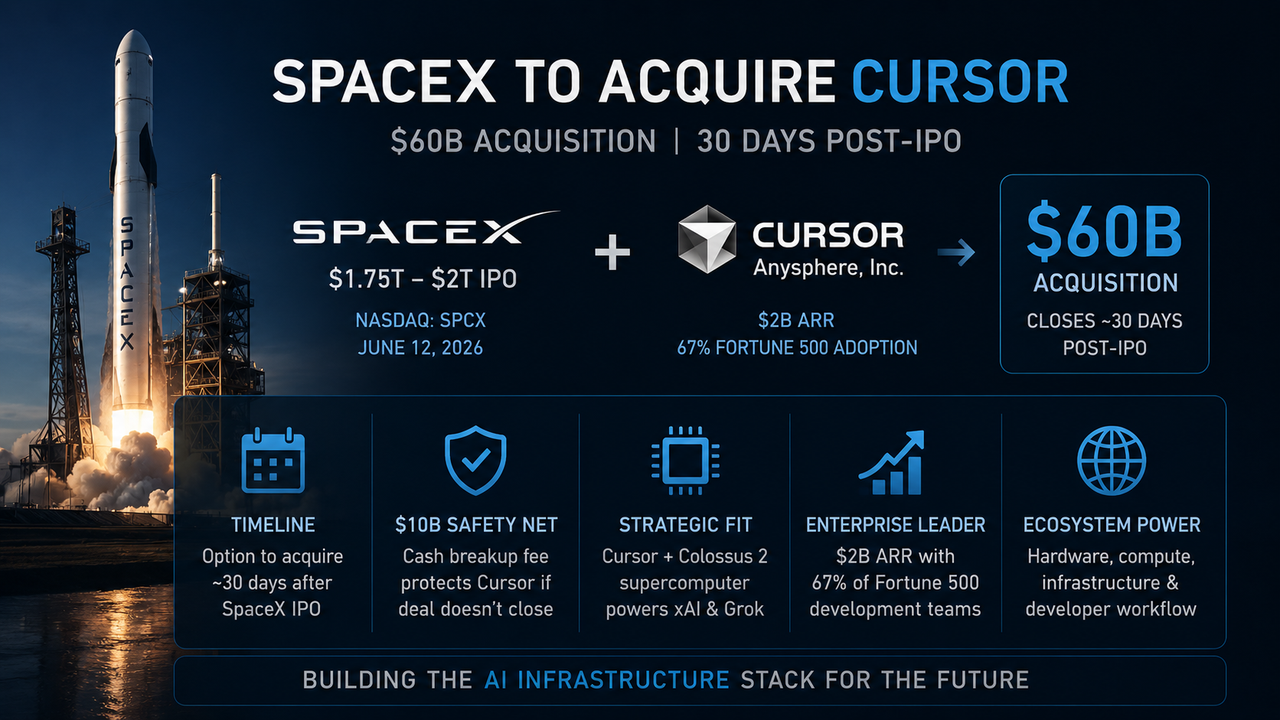
The tech world is on the brink of an unprecedented consolidation as Elon Musk’s aerospace empire targets a massive expansion into artificial intelligence software infrastructure. Following high-level disclosures regarding the upcoming SpaceX initial public offering, reports indicate a finalized corporate roadmap to absorb one of the fastest-growing AI startups in Silicon Valley.
Institutional investors and capital markets are closely tracking this development to evaluate its broader macroeconomic implications. This deep dive explores the financial mechanics, strategic motivations, and digital asset market ripples behind the core question: Will spacex acquire cursor?
Key Takeaways
-
Strategic Timeline: SpaceX plans to execute its option to acquire Cursor (Anysphere, Inc.) approximately 30 days after its public stock debut.
-
Record Valuations: The acquisition is priced at a staggering $60 billion, rolling concurrently with SpaceX's historic $1.75 trillion to $2+ trillion IPO.
-
Financial Safety Net: A monumental $10 billion cash breakup fee protects Cursor if the full corporate acquisition fails to close.
-
Tech Consolidation: The merger positions Cursor as the primary developer workflow layer for the SpaceX-xAI ecosystem, utilizing the massive Colossus 2 supercomputer.
-
Market Ripple Effects: This integration creates an immediate structural catalyst across traditional tech equities and AI-focused Web3 digital assets.
The $60 Billion Synergy: Breaking Down SpaceX's Rolling Acquisition Strategy
The financial engineering behind this transaction highlights how megacap tech corporations handle large-scale mergers and acquisitions (M&A) during a public market debut. SpaceX’s approach to absorbing Cursor demonstrates a calculated balance of timing, valuation, and balance sheet protection.
Understanding the Two-Step Option: Why Wait 30 Days Post-IPO?
Rather than pursuing an immediate buyout, SpaceX secured a formal, contractually locked option to buy Cursor for $60 billion. This choice introduces a deliberate delay, with execution planned roughly one month after the company goes public.
This two-step structure provides SpaceX with operational flexibility. It allows the core aerospace business to establish stable trading patterns in the public market before adding a major software acquisition to its balance sheet. For Cursor, the structured option deferred a planned $2 billion private funding round, aligning its future directly with Musk's conglomerate.
The Nasdaq Debut: Tracking SPCX's June 12, 2026 Listing Timeline
The timing of the acquisition is tied directly to the SpaceX IPO timeline, which is on track to be the largest stock market debut in corporate history.
With the public IPO prospectus filed on May 20, 2026, the formal roadshow is set to commence on June 4, followed by the official Nasdaq listing on June 12, 2026, under the ticker SPCX. The company intends to raise between $75 billion and $80 billion, eclipsing Saudi Aramco’s 2019 record. The close of the Cursor acquisition will follow in mid-July, exactly within the anticipated 30-day post-listing window.
Financial Transparency: Keeping Disclosures Clean Prior to the Historical IPO
The decision to wait 30 days post-IPO is heavily driven by regulatory compliance and financial reporting requirements. Incorporating a multi-billion-dollar AI software startup into a public filing right before a listing would require extensive amendments to the IPO prospectus.
By utilizing an acquisition option, SpaceX keeps its initial S-1 documentation clean and focused on its core revenue drivers, such as Starlink's 9 million users and its projected $15 billion to $16 billion in annual revenue. This strategy minimizes potential delays from the SEC, allowing the primary listing to proceed smoothly while securing the long-term AI asset.
Risk Mitigation: Analyzing the $10 Billion Cash Breakup Fee
Large-scale corporate acquisitions face frequent regulatory hurdles and shifting market conditions. To mitigate these uncertainties, the contract between SpaceX and Anysphere includes a notable protective financial clause.
Under the Hood: The Structural Safety Net for Anysphere and Cursor
The inclusion of a $10 billion cash breakup fee is one of the largest protective clauses ever seen in a venture-backed software deal. This fee functions as a structural insurance policy for Cursor’s founders and early investors.
Because Cursor walked away from late-stage private capital negotiations that valued the firm above $50 billion to pursue the SpaceX track, they required robust protection against deal cancellation. The $10 billion guarantee ensures that even if external forces block the merger, the startup remains exceptionally well-capitalized.
Worst-Case Scenarios: What Triggers the Multi-Billion Dollar Backup Fee?
The multi-billion-dollar backup fee triggers automatically if SpaceX decides not to execute its buyout option by the end of the year, or if antitrust regulators block the transaction.
If triggered, this payout is legally classified as compensation for the joint development work and data sharing currently occurring between the two firms. This structure converts potential downside risk into a well-funded commercial partnership, ensuring Cursor is compensated for its specialized engineering inputs.
The Tech Convergence: Why Will SpaceX Acquire Cursor?
Beyond the financial metrics, the driving force behind this deal lies in the technology stack. SpaceX's engineering needs demand advanced automated software workflows to support its long-term operational scaling.
Bridging the Coding Gap: Enhancing Grok’s Deep Reasoning Shortfalls
Following the massive all-stock merger between SpaceX and xAI in February 2026, Elon Musk’s artificial intelligence initiatives have possessed massive compute capabilities but lacked specialized software data. While the Grok chatbot excels at processing real-time social data from X, it has lagged behind competitors like OpenAI's GPT models and Anthropic's Claude in complex programming and logic reasoning.
Acquiring Cursor provides xAI with a massive repository of high-tier developer interaction data. This code-generation feedback loop is crucial for training future iterations of Grok, turning it from a general conversational assistant into an enterprise-grade development engine.
The Colossus 2 Advantage: Powering Cursor's Composer 2.5 Agentic AI
The technical synergy operates in both directions. Cursor's software relies on immense computational power to run its autonomous coding workflows. Through this partnership, Cursor gains direct access to xAI's Colossus 2 supercomputer cluster in Memphis, which operates at an infrastructure capacity equivalent to 1 million liquid-cooled clusters.
This compute access directly supported Cursor's release of Composer 2.5, an agentic "vibe coding" model capable of autonomously managing end-to-end software development tasks. Access to this level of hardware allows Cursor to train massive proprietary models from scratch, bypassing the constraints faced by independent software startups.
Enterprise Monopoly: Capitalizing on Cursor's 67% Fortune 500 Adoption
Cursor is not just a popular utility for hobbyists; it has established a strong position in enterprise software development. The platform has scaled its annualized recurring revenue (ARR) from $1 million in late 2023 to an estimated $2 billion by early 2026.
-
Market Penetration: Active utilization by approximately 67% of Fortune 500 development teams.
-
User Scale: Over 1 million active paying enterprise and retail software engineers globally.
-
Growth Velocity: Revenue doubled from $1 billion to $2 billion in less than two quarters.
By absorbing Cursor, SpaceX instantly commands the default environment where a vast portion of the world's senior developers write, debug, and ship corporate software.
Macro Outlook: The SpaceX-xAI Mega-Merger and Its Tech Empire Expansion
To understand the broader implications of this acquisition, one must analyze it through the lens of Musk's overarching corporate architecture. The lines between aerospace, global telecommunications, and artificial intelligence have completely blurred.
Retrospective Analysis: The Legacy of the February 2026 All-Stock Merger
The foundation for this software acquisition was laid in February 2026, when SpaceX completed the largest merger in corporate history—an all-stock transaction that combined SpaceX and xAI into a single entity valued at $1.25 trillion. This consolidated the world's largest satellite constellation (Starlink), cutting-edge orbital defense logistics, and massive AI compute clusters under one corporate banner. The upcoming June IPO represents the public market debut of this combined mega-conglomerate.
Vertical Integration: How Musk's Ecosystem Is Reshaping the AI Landscape
With the addition of Cursor, SpaceX is completing a vertically integrated technology ecosystem. Hardware operations provide the revenue foundation, Starlink handles global data transport, the Colossus supercomputer manages the processing infrastructure, and Cursor serves as the intelligent user interface layer.
This model challenges traditional Silicon Valley software structures. When the tools used to write code are owned by the same entity operating global communications networks and orbital logistics, the speed of software deployment increases significantly. This vertical integration creates a closed ecosystem that presents tough competition for pure-play AI software providers.
Market Impact: How Tech Giant M&As Move Capital Markets
Large-scale tech acquisitions often trigger immediate reallocations of capital. This multi-billion-dollar deal has clear implications across both traditional equity markets and alternative asset classes.
From Software to Web3: The Ripple Effect on AI-Focused Digital Assets
In modern liquid markets, traditional tech acquisitions often trigger rapid capital shifts in the digital asset and crypto ecosystems. Cryptocurrency traders frequently view Elon Musk's corporate movements as leading indicators for broader tech trends. The news of a $60 billion valuation for an AI developer platform provides a benchmark for decentralized AI projects, autonomous agent protocols, and Web3 compute networks.
As Cursor demonstrates the immense value of agentic "vibe coding" models, decentralized protocols focused on autonomous on-chain execution and crowd-sourced code auditing are drawing increased interest from crypto venture funds. This cross-market momentum highlights the growing connection between legacy tech M&A and Web3 risk assets.
Retail vs. Institutional Sentiments Following the $1.75 Trillion Valuation
As the June 12 Nasdaq listing approaches, institutional and retail sentiment remain divided. Fixed-income asset managers and large institutional funds view the $1.75 trillion to $2+ trillion valuation as a validation of SpaceX's diverse revenue streams, spanning satellite internet monopolies, orbital launch dominance, and advanced AI systems.
Conversely, retail market participants are focusing on the speculative upside of the AI infrastructure expansion. The inclusion of a high-growth asset like Cursor, which achieved $2 billion in ARR in record time, introduces a software multiplier to a company historically valued on heavy industrial hardware. This combination makes the upcoming IPO a highly anticipated event across capital markets.
Conclusion
The upcoming transaction answers the market's question: "Will spacex acquire cursor?" with a clear roadmap linked directly to its historic public market debut. By securing an option to absorb Anysphere for $60 billion roughly 30 days after its June 12, 2026 Nasdaq listing under the ticker SPCX, SpaceX is systematically expanding its reach across both hardware and software infrastructure. Backed by a historic $10 billion cash safety net, this integration merges xAI's massive Colossus compute infrastructure with the market's leading AI-native coding environment. For both traditional equity markets and alternative digital asset ecosystems, this merger signals a major shift toward automated, vertically integrated technology platforms.
FAQ:
Will SpaceX acquire Cursor before the June IPO?
No, SpaceX will not execute the formal acquisition prior to the listing. The company has secured a contractual option to finalize the $60 billion purchase approximately 30 days after the public market debut to keep financial disclosures straightforward during the IPO process.
What is the official ticker for the upcoming SpaceX IPO?
SpaceX is scheduled to list its shares on the Nasdaq exchange on June 12, 2026. The stock will trade under the official reserved ticker symbol SPCX.
Who owns Cursor and what is its annualized revenue?
Cursor is developed by Anysphere, Inc., an AI startup founded in 2022 by four MIT alumni. Driven by enterprise adoption and its agentic programming features, Cursor’s annualized recurring revenue surpassed $2 billion in early 2026.
How does the breakup fee impact the transaction?
The deal includes a mandatory $10 billion cash breakup fee. If regulatory hurdles or corporate changes prevent the acquisition from closing, SpaceX must pay this amount to Cursor for their ongoing joint AI training initiatives.
What supercomputer infrastructure is being utilized in this deal?
Cursor is leveraging xAI's Colossus 2 supercomputer cluster. This infrastructure provides the massive GPU compute capacity required to train Cursor's next-generation AI models, such as Composer 2.5.