

Why Is Zcash (ZEC) Price Surging While Bitcoin Drops Below $80,000 in May 2026?
2026/05/21 11:54:02
Introduction
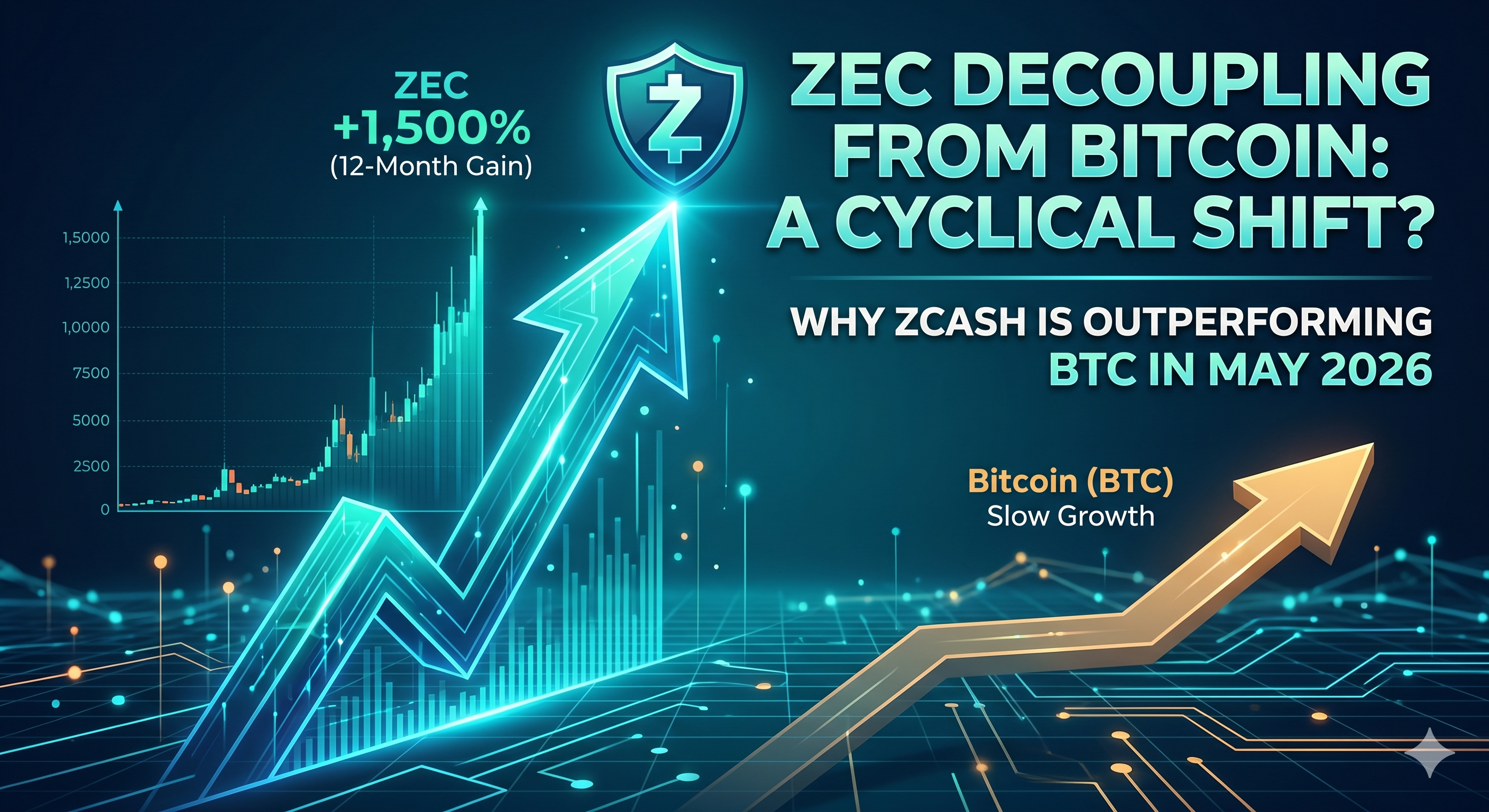
Zcash has outperformed Bitcoin by more than 1,500% over the past 12 months — and the gap is widening this week. Zcash (ZEC) led gains among crypto majors and hit a six-month high on Wednesday afternoon after the non-profit behind the token said that the U.S. Securities and Exchange Commission's probe into the foundation had formally closed. ZEC's price rose more than 12% to hit $646.80, its highest level since November. Bitcoin price, meanwhile, has slid in the opposite direction.
The short answer: three catalysts collided at once — SEC regulatory clearance for the Zcash Foundation, record adoption of shielded transactions, and an institutional rotation into privacy assets led by Multicoin Capital, Grayscale, and Arthur Hayes. At the same time, Bitcoin is suffering from heavy spot ETF outflows and hot U.S. inflation data. The result is one of the cleanest examples of altcoin decoupling in this cycle.
How Much Has ZEC Outperformed Bitcoin in May 2026?
ZEC has roughly doubled in a month while Bitcoin has lost ground. ZEC's price has gained more than 27% year to date and has surged over 1,500% during the past 12 months. The token has more than doubled over the last month alone.
The earlier May leg was equally violent. On May 6, 2026, Zcash surged nearly 30 percent to $543, extending its 30-day gain to more than 110 percent and triggering about $62 million in futures liquidations, mostly from short sellers.
Bitcoin moved in the opposite direction during the same window. Bitcoin has fallen about 6% from $82,000 to $76,800, and U.S.-listed spot bitcoin ETFs have seen over $1.5 billion in outflows since May 7, signaling sustained institutional selling pressure.
|
Metric
|
ZEC (May 2026)
|
BTC (May 2026)
|
|
Recent price
|
~$646 (six-month high)
|
~$76,800–$82,000
|
|
12-month performance
|
+1,500%
|
Down YTD
|
|
Catalysts
|
SEC closure, ETF filing, privacy rotation
|
ETF outflows, hot CPI, leverage flush
|
What Did the SEC Decision Mean for Zcash?
The SEC's decision to close its Zcash Foundation probe with no enforcement action removed the single biggest regulatory overhang on the asset. The U.S. Securities and Exchange Commission has closed its investigation into the Zcash Foundation without taking enforcement action, ending a probe that began in 2023.
According to the Zcash Foundation's Q1 2026 report, the probe began on August 31, 2023, when staff served the Foundation with a subpoena, and the case was filed as "In the Matter of Certain Crypto Asset Offerings," designated SF-04569.
The closure was formally communicated in January. It removes a regulatory overhang that had followed Zcash for over two years. Foundation officials said the nonprofit cooperated fully throughout the process, and no penalties, fines, or required changes were attached to the outcome.
The market only fully priced this in once the Foundation publicly disclosed the closure in its Q1 report on May 19, 2026 — triggering the breakout to six-month highs.
Why This Matters Beyond Zcash
The decision is part of a broader regulatory shift. The outcome aligns with a broader pullback in SEC crypto cases seen since 2025, with several other projects — including Aave, OpenSea, Robinhood, Gemini, and Ondo — having seen probes closed without charges in recent quarters.
For privacy coins specifically, this is the most explicit signal yet that operating compliantly within the U.S. is possible — something the market had not priced in for years.
Why Are Institutions Suddenly Buying Privacy Coins?
Institutional capital is rotating into privacy assets because transparency on public blockchains is now seen as a tax and surveillance risk, not just a privacy preference.
The price surge came as prominent crypto fund Multicoin Capital disclosed it had been building a significant ZEC position since February.
Other large allocators have echoed the call. Major crypto investor Barry Silbert recently described Zcash as "Bitcoin circa 2013," while firms like Grayscale Investments continue supporting the asset through institutional products. Meanwhile, Arthur Hayes revealed that ZEC is now one of his largest crypto positions outside Bitcoin.
A potential institutional on-ramp is also in motion. According to Phemex's April 2026 analysis, Grayscale has filed to convert its $137 million Zcash Trust (ZCSH) into a listed spot ETF on NYSE Arca — the first-ever proposed spot ETF for a privacy coin. If approved, this would create a regulated institutional on-ramp directly into ZEC, similar to what the Bitcoin ETF approvals did for BTC in 2024.
Is the ZEC Rally Backed by Real Adoption?
Yes — and the on-chain data is the strongest part of the bull case. Unlike previous ZEC rallies that were largely speculative, this one is being confirmed by record use of shielded transactions.
Roughly 30 percent of ZEC's supply now sits in shielded addresses, a record level that analysts say aligns this price move more with real adoption than with past, more speculative rallies, even as the token remains below its late-2025 high near $750.
Roughly 30% of all circulating ZEC, or about 5 million coins out of 16.7 million, now sits in shielded addresses, up from 8% in early 2024, as CoinDesk Research wrote in March. The shielded pool uses zero-knowledge cryptography — that proves something is true without showing how — to hide transaction details such as sender, recipient, and amount.
The shielded supply growth matters because it functions as a leading indicator. Past ZEC rallies have coincided with shielded supply growth that lagged the move, suggesting speculative participation. This rally is happening alongside record-high shielded supply, which is closer to the on-chain signature of actual adoption.
Mainstream Media Has Picked Up the Privacy Narrative
The story has now spilled beyond crypto-native channels. According to a Wall Street Journal report, many early Bitcoin supporters attending the 2026 Las Vegas crypto conference expressed frustration with how transparent and institutionalized Bitcoin has become, with some investors now believing its original privacy-focused vision has weakened as governments, ETF issuers, and blockchain surveillance firms expand their footprint.
Why Is Bitcoin Dropping at the Same Time?
Bitcoin's decline is driven by a different set of forces — hot inflation data, accelerating ETF outflows, and a leverage washout. None of these factors apply to ZEC.
Bitcoin's recent weakness accelerated following hotter-than-expected US inflation data, alongside stronger US retail sales figures that reinforced expectations for a more hawkish Federal Reserve. The renewed inflation concerns strengthened the US dollar and pushed Treasury yields higher, creating additional pressure on risk-sensitive assets such as cryptocurrencies.
The ETF picture turned sharply negative. According to data from CoinGlass, US spot Bitcoin exchange-traded funds recorded net outflows of approximately $1 billion last week, marking the largest weekly withdrawal since late January. The sharp reversal in ETF flows signals a cooling of institutional sentiment after several weeks of strong inflows that had previously supported Bitcoin's rally.
The leverage flush amplified the move. BTC fell more than 4% over the past 24 hours, dropping from recent highs near $82,000 to an intraday low around $76,500 before stabilizing slightly near $77,000 at press time. According to CoinGlass data, more than $661 million worth of crypto positions were liquidated over the past 24 hours, with bullish long positions accounting for nearly 95% of the wipeout.
This combination — macro hostility, ETF redemptions, and forced selling — is the exact opposite of what is happening to ZEC right now.
How to Trade Zcash (ZEC) on KuCoin
KuCoin offers spot and futures markets for ZEC with deep liquidity, making it one of the most efficient venues to position around the current privacy-coin rotation. Whether you want long-term exposure to the privacy narrative or short-term tactical trades around catalysts like ETF news or NU7 upgrade milestones, KuCoin provides the tools to execute.
To start trading ZEC on KuCoin:
-
Create and verify a KuCoin account.
-
Fund your wallet via stablecoin transfer, bank deposit, or card purchase.
-
Navigate to the ZEC/USDT spot pair or ZEC perpetual futures.
-
Use built-in charting tools to monitor key levels
-
Set position size and stop-losses appropriate to ZEC's volatility, which has been amplified by the recent leverage build-up.
New users can now register at KuCoin and Get Up to 11,000 USDT in New User Rewards.
Conclusion
Zcash's outperformance over Bitcoin in May 2026 is not a random divergence — it is the result of three structural catalysts firing simultaneously. The SEC's decision to close the Zcash Foundation probe with no enforcement action removed years of regulatory overhang. Record shielded-pool adoption above 30% of circulating supply confirmed that real users — not just speculators — are driving demand. And major institutional voices including Multicoin Capital, Grayscale, Barry Silbert, and Arthur Hayes have publicly endorsed ZEC as a core privacy holding.
Bitcoin, by contrast, faces a different macro setup: $1 billion-plus in weekly ETF outflows, hot U.S. inflation data, rising Treasury yields, and a leverage washout that pushed price below $77,000. The two assets are responding to entirely different drivers.
For traders, the takeaway is clear: privacy is becoming a distinct, investable narrative within crypto, and ZEC is currently its highest-beta expression. Watch the $540–$560 support zone and the $640–$755 resistance band for the next directional cue, and treat the leverage profile with appropriate caution.
Frequently Asked Questions (FAQs)
What is Zcash and how does it differ from Bitcoin?
Zcash is a privacy-focused cryptocurrency that uses zk-SNARK zero-knowledge proofs to shield transaction details. Unlike Bitcoin, Zcash uses advanced zk-SNARK technology that allows users to hide wallet addresses, transaction amounts, and transfer details while still maintaining optional transparency controls. It shares Bitcoin's 21-million fixed supply and proof-of-work model, which is why some investors describe it as "private Bitcoin."
When is the next Zcash halving?
According to Bitrue data cited by CoinMarketCap, the next halving is projected for February 2028, which will cut the reward from the current 1.5625 ZEC to 0.78125 ZEC per block. Halvings historically tighten new supply and have correlated with longer-term price appreciation.
Will Zcash get a spot ETF in the U.S.?
A spot ETF application is already under review. Grayscale has filed to convert its $137 million Zcash Trust (ZCSH) into a listed spot ETF on NYSE Arca — the first-ever proposed spot ETF for a privacy coin. Approval is not guaranteed, but the SEC's recent decision to close the Zcash Foundation probe is widely seen as a constructive signal for the broader privacy-coin category.
What is the Zcash Foundation's financial position?
According to the Foundation's Q1 2026 report, total liquid assets of $36,701,379 against total liabilities of just $12,714 leave net liquid assets of $36,688,666. ZEC holdings of 85,412.34 coins, valued at $248.22 per coin, made up 58.6% of the portfolio. USD and USDC combined accounted for 33.5%, with BTC rounding out the remainder at 7.9%. This provides multi-year runway for protocol development.
What are the biggest risks for ZEC holders right now?
The two main risks are leverage and execution risk on the quantum-resistance roadmap. Open interest near $1.23 billion means a sharp reversal could trigger long liquidations. Separately, the Zcash Open Development Lab plans a quantum-recoverable wallet launch in June 2026 and full post-quantum security in late 2027 — both complex engineering milestones whose delivery is not guaranteed. Regulatory sentiment toward privacy coins outside the U.S. also remains an open variable.