

What Is LI.FI Earn? Cross-Chain Yield Made Simple for Institutions
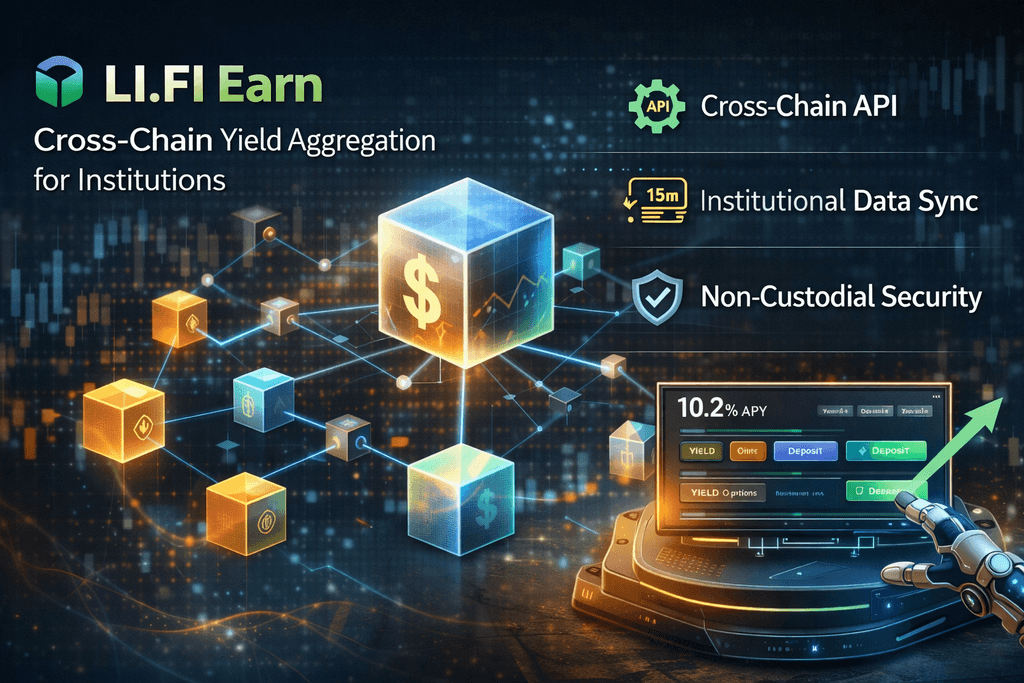
In the rapidly evolving landscape of 2026, institutional investors are increasingly looking beyond simple custody toward sophisticated yield-generation strategies within the decentralized finance (DeFi) ecosystem. However, the technical barriers associated with cross-chain fragmentation often stifle capital efficiency, leaving professional treasuries searching for a streamlined solution that balances security with seamless operational execution across multiple blockchain networks.
This comprehensive guide explores What Is LI.FI Earn? and how this institutional-grade tool leverages primary cross-chain aggregation to simplify complex yield-bearing transactions for professional market participants.
Key Takeaways
-
LI.FI Earn is a specialized API and execution layer designed to aggregate yield opportunities across 20+ chains and 20+ audited protocols.
-
It utilizes a NormalizedVault schema to provide a consistent data structure, allowing institutions to compare returns across disparate ecosystems.
-
The LI.FI Composer enables "one-click" deposits, automating the bridging, swapping, and staking process in a single transaction.
-
Data integrity is prioritized with 15-minute APY updates and 2-minute transactional capability checks.
-
The platform is non-custodial, ensuring that institutions retain full control over their private keys and assets throughout the lifecycle of an investment.
The Institutional Dilemma: The Cost of Fragmented DeFi Liquidity
The primary hurdle for institutional adoption of DeFi in 2026 remains the extreme fragmentation of liquidity. While the "multi-chain" future has arrived, it has brought with it a chaotic web of Layer 1s, Layer 2s, and the emerging Layer 3 app-chains. For an institutional player, this fragmentation isn't just a technical nuisance; it represents a significant drain on resources and a barrier to high-fidelity risk management.
Why Traditional DeFi Onramps Fail Institutional Standards
Traditional retail-focused DeFi onramps are built for manual users who are comfortable with MetaMask pop-ups and manual bridge waiting times. For a professional treasury or a hedge fund, these "manual" steps introduce unquantifiable risks. Standard interfaces often lack the robust API documentation, historical data tracking, and compliance-ready reporting that institutional stakeholders demand before deploying multi-million dollar positions.
The Complexity Gap: Manual Bridging vs. Automated Intent Execution
The "Complexity Gap" refers to the distance between a capital allocator's intent (e.g., "I want 8% yield on USDC") and the execution (bridging from Ethereum to Base, swapping for a specific LP token, and staking). Manual bridging requires handling gas on multiple chains and monitoring bridge status, which is operationally expensive. Automated intent execution, however, allows the allocator to simply define the end state, leaving the infrastructure to find the most efficient path.
Quantifying Friction: How Operational Overhead Erodes Net APY
When institutions calculate their net yield, they must account for:
-
Gas Slippage: Multiple transactions on high-traffic chains.
-
Labor Costs: The time spent by analysts and engineers to execute and monitor positions.
-
Liquidity Opportunity Cost: The 10–30 minutes assets spend in transit across bridges.
-
By the time these costs are factored in, a 10% gross APY can easily dwindle to a 6% net return.
What Is LI.FI Earn? Redefining the Cross-Chain Yield Stack
What Is LI.FI Earn? It is a revolutionary data and execution middleware that abstracts away the complexities of the multi-chain world. Rather than building individual integrations for every new vault or bridge, LI.FI Earn provides a single API point that connects institutions to the entire yield landscape.
The "Everything-to-Everything" Thesis: A Unified Entry Point
The core philosophy of LI.FI Earn is that liquidity should be fluid. Whether your capital is sitting in $$ET$$ on Mainnet or $$SO$$ on Solana, you should be able to enter any supported yield vault on any chain instantly. This "Everything-to-Everything" approach treats the blockchain ecosystem as a single liquidity pool rather than a series of disconnected islands.
Beyond Basic Aggregation: The Role of LI.FI in the 2026 Modular Era
As we enter the modular era, where execution, settlement, and data availability are unbundled, the need for a "coordinator" becomes vital. LI.FI doesn't just aggregate; it orchestrates. It understands which chains are modular, which rollups share sequencers, and which paths offer the highest security for large-scale capital movement.
Meet the Composer: The Engine Powering Institutional "Zaps"
The "Composer" is the technical heart of the LI.FI Earn suite. It is a smart contract orchestration tool that bundles swaps and bridge calls. For institutions, this means "Zapping"—the ability to move from a raw asset into a yield-bearing position in a single atomic-like sequence, reducing the window of exposure to market volatility.
Architecture Deep Dive: How LI.FI Earn Works Under the Hood
To understand why LI.FI Earn is the preferred choice for institutions, one must look at the robust engineering that powers its backend. It is built to be a high-availability service that mirrors the reliability of traditional financial (TradFi) systems.
The Ingestion Engine: Standardizing 20+ Protocols and 20+ Chains
The Ingestion Engine is a proprietary crawler that monitors over 20 different blockchains and dozens of blue-chip protocols. It pulls raw data directly from the blockchain state, ensuring that the information isn't reliant on third-party aggregators who may have their own latencies or biases.
The NormalizedVault Schema: A Universal Language for Risk Managers
One of the most valuable features for institutional users is the NormalizedVault Schema. In DeFi, every protocol defines "APY" or "TVL" slightly differently. LI.FI Earn standardizes these definitions into a single JSON schema.
-
Consistency: A USDC vault on Aave and a USDC vault on Morpho are described with identical fields.
-
Comparability: Risk managers can programmatically filter vaults by risk score, historical volatility, and asset composition.
Capability Resolution: Why 2-Minute Data Freshness is a Hard Requirement
In cross-chain finance, a bridge that was working 10 minutes ago might be paused now. LI.FI Earn’s Capability Resolution checks the health of the transaction path every 120 seconds. This prevents institutions from initiating a transaction that would otherwise fail or get stuck in a bridge's "limbo" state, which is a critical requirement for maintaining high-velocity capital.
Intent-Based Routing: Solving the Slippage Problem for Large-Scale Capital
For large orders, slippage is the "silent killer" of returns. LI.FI Earn utilizes an intent-based routing system. Instead of following a rigid path, the system looks at the desired end state and sources liquidity from across the entire ecosystem—DEXs, private solvers, and cross-chain intent fillers—to ensure the institution receives the best possible execution price.
Security & Risk Management: The Institutional Trust Layer
Security is not an "add-on" for LI.FI; it is the foundation. Given the history of bridge exploits in the crypto industry, LI.FI Earn has implemented several layers of protection to satisfy the stringent requirements of institutional compliance and risk officers.
-
Non-Custodial Design: LI.FI Earn never takes custody of assets. All logic is executed via smart contracts that the user interacts with using their own keys.
-
Vetted Bridging: Only bridges with proven track records and robust security architectures (like Circle's CCTP or Chainlink CCIP) are prioritized for institutional flows.
-
Audit-First Culture: The smart contracts powering the Composer and Earn API undergo frequent third-party audits.
Trust-Minimized Infrastructure: Reducing Smart Contract Dependency
LI.FI Earn aims for a trust-minimized approach. By utilizing "solvers" and intent-fillers, the platform reduces the amount of time capital stays within a middle-man contract. This architectural choice limits the "attack surface" available to potential exploits.
Vetted Protocols: The Selection Criteria for Institutional Vaults
Not every yield opportunity makes it onto LI.FI Earn. The platform employs a strict vetting process:
-
TVL Thresholds: The protocol must have significant liquidity to prevent price manipulation.
-
Audit History: Multiple successful audits from reputable firms like Trail of Bits or OpenZeppelin.
-
Governance Stability: Assessment of the protocol's decentralization and upgradeability risks.
Monitoring and Alerts: How LI.FI Earn Prevents Transactional Failures
The system includes real-time monitoring that alerts users if a transaction is deviating from the expected path. If a bridge delay exceeds a certain threshold, the LI.FI monitoring stack provides visibility, ensuring that institutional operators are never "in the dark" about the status of their funds.
Comparison: LI.FI Earn vs. Traditional Yield Aggregators
When evaluating What Is LI.FI Earn?, it is helpful to contrast it with the standard yield aggregators that dominated the early 2020s. While older aggregators were often limited to a single chain or a small set of "vaults," LI.FI Earn represents a generational leap in flexibility and developer support.
| Feature | Traditional Aggregators | LI.FI Earn |
| Chain Support | Usually single-chain or limited L2s | 20+ Chains (EVM & Non-EVM) |
| Asset Entry | Must hold the specific deposit token | Any asset can be "zapped" in |
| Data Standard | Protocol-specific (Inconsistent) | NormalizedVault Schema (Standardized) |
| Developer Integration | Multiple SDKs and manual bridges | Single API for all cross-chain yield |
| Execution | Manual steps for bridging/swapping | Atomic-like "one-click" execution |
Flexibility: Why Single-Chain Aggregators are Losing Relevance
In 2026, the highest yields are rarely on the most established chains. Single-chain aggregators force institutions to miss out on "early adopter" rewards on new Layer 2s because the effort to bridge is too high. LI.FI Earn’s chain-agnostic nature ensures that institutions can follow the yield wherever it migrates.
Developer Experience: Integrating One API vs. Twenty Protocol SDKs
For a company building a fintech app or an institutional dashboard, time-to-market is everything. Integrating twenty different protocol SDKs is a maintenance nightmare. LI.FI Earn provides a single, well-documented API, allowing developers to add cross-chain yield functionality in a fraction of the time it would take to build it from scratch.
Cost Efficiency: Analyzing Gas Savings via Optimized Pathfinding
Because LI.FI Earn aggregates liquidity from across the entire market, it can often find paths that a single aggregator would miss. By optimizing the order of swaps and bridges, LI.FI can significantly reduce the total gas overhead, which is particularly beneficial when moving large volumes of capital that would otherwise move the market.
Future-Proofing Strategy: Scaling with the LI.FI Ecosystem
Investing in LI.FI Earn is not just about today's yield; it’s about positioning for the future of finance. The platform is designed to scale alongside the "Internet of Blockchains," ensuring that as the industry evolves, the institutional gateway remains open and efficient.
Adapting to New Chains: Seamless Integration of Emerging L2s and L3s
The "L2 Summer" has been replaced by a "Modular Expansion." New chains are launching weekly. LI.FI Earn’s architecture is designed to onboard new networks rapidly. When a new high-performance chain launches, LI.FI can often provide yield access within days, giving its users a significant "first-mover" advantage.
Agentic Commerce: How LI.FI Earn Powers AI-Driven Treasury Management
One of the most exciting developments in 2026 is the rise of AI agents for treasury management. What Is LI.FI Earn doing in this space? It provides an "agent-friendly" API. AI agents can use LI.FI Earn to autonomously rebalance portfolios and harvest yield across 20 chains based on pre-set risk parameters, ushering in the era of "Agentic Commerce."
The Roadmap for 2026: What’s Next for Institutional Earn Features
The upcoming roadmap for LI.FI Earn includes deeper integrations with institutional custody providers (like Fireblocks and Copper) and the introduction of "permissioned" vaults for KYC-compliant yield. These features will further bridge the gap between traditional finance and the decentralized frontier.
Conclusion
In summary, What Is LI.FI Earn? It is the definitive solution for institutions seeking to capture the vast yield opportunities of the multi-chain DeFi world without the traditional operational headaches. By providing a unified data schema, an automated execution engine through the Composer, and a security-first architecture, LI.FI Earn has made cross-chain yield accessible, manageable, and scalable for the most demanding professional investors. As we look toward the future of 2026, tools like LI.FI Earn will be the essential infrastructure that allows institutional capital to move as freely as information on the internet.
FAQ
Is LI.FI Earn custodial or non-custodial?
What Is LI.FI Earn? It is entirely non-custodial. LI.FI never has access to your private keys or the ability to move your funds without your direct signature. You retain full ownership and control of your assets at every step of the cross-chain yield process.
How does LI.FI handle bridge risks for institutional clients?
LI.FI mitigates bridge risk by only aggregating highly reputable, audited, and battle-tested bridging solutions. Furthermore, the system provides real-time monitoring and capability resolution to ensure that you only initiate transactions through bridges that are currently healthy and liquid.
Can I integrate LI.FI Earn into an existing multi-sig setup?
Yes, LI.FI Earn is designed to be compatible with institutional multi-sig wallets like Gnosis Safe. The transactions generated by the LI.FI API can be proposed to a multi-sig, where they can be reviewed and signed by the required number of authorized parties before execution.
What are the fees associated with using the Earn API?
LI.FI typically charges a small transparent fee for its routing and execution services, which is often offset by the gas savings and better price execution provided by its aggregation engine. Specific pricing tiers are available for high-volume institutional partners and API integrators.