

Privacy Infrastructure in Ethereum DeFi for Global Enterprises
2026/04/28 19:57:02
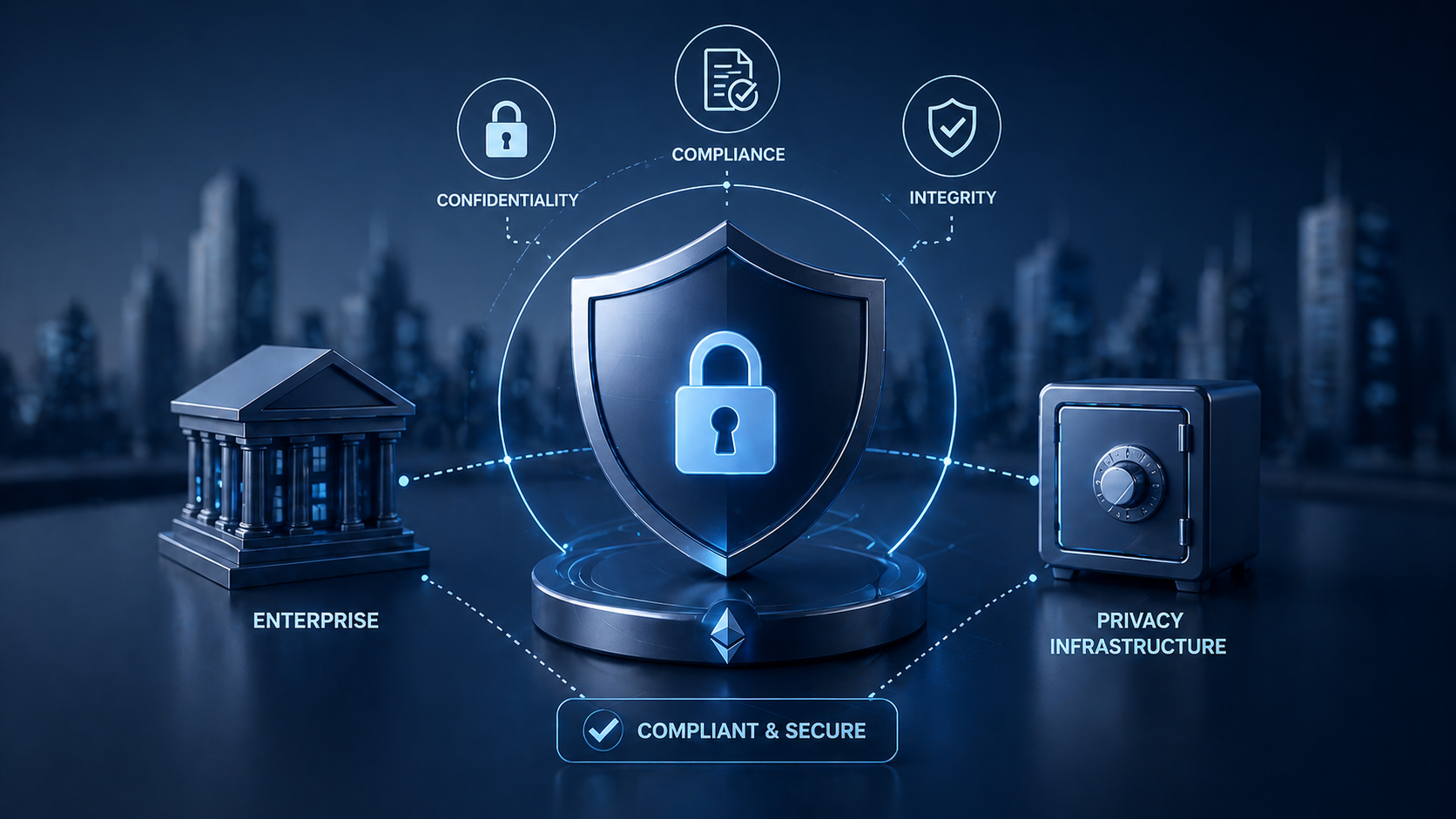
The rapid evolution of decentralized finance has brought Ethereum to the forefront of global institutional interest. However, for Global Enterprises, the transition from traditional systems to Ethereum DeFi is often hindered by the inherent transparency of public blockchains. To bridge this gap, robust Privacy Infrastructure is being developed to provide the confidentiality, security, and regulatory compliance required by modern corporations.
This comprehensive guide explores how cutting-edge Privacy Infrastructure is revolutionizing Ethereum DeFi for Global Enterprises, enabling secure, private, and compliant financial operations on a global scale.
Key Takeaways:
As we navigate through 2026, the narrative surrounding blockchain has shifted from "transparency at all costs" to "privacy by design." For Global Enterprises, this shift is not just a preference—it is a survival mechanism.
-
Confidentiality is Commercial Power: Without privacy, an enterprise’s strategic moves, vendor contracts, and payroll are visible to any competitor with an internet connection.
-
Compliance is Non-Negotiable: Regulatory frameworks like GDPR and the FATF Travel Rule require data protection measures that standard public ledgers cannot provide.
-
Mitigating Toxic Value Extraction: Private transactions protect institutional capital from "invisible taxes" like Maximal Extractable Value (MEV) and predatory front-running bots.
-
The Hybrid Future: The most successful Global Enterprises are adopting hybrid models that combine the security of Ethereum’s mainnet with the confidentiality of private execution layers.
Deciphering the Core: What is Privacy Infrastructure in Ethereum DeFi?
To understand the current landscape, we must define what Privacy Infrastructure actually entails in the context of Ethereum DeFi. It is a stack of cryptographic tools and secondary networks that allow for the validation of transactions without the public disclosure of sensitive underlying data.
The Transparency Paradox: Why Public Ledgers Deter Corporate Capital
Ethereum’s greatest strength—its immutable, public ledger—is also its primary barrier for Global Enterprises. In a traditional setting, a company's financial health is a closely guarded secret, revealed only to authorized auditors and stakeholders. On a public blockchain, every "buy" order, every liquidity provision, and every treasury movement is broadcasted in real-time. This "Transparency Paradox" creates a situation where the more successful a company is on-chain, the more vulnerable it becomes to competitive counter-strategies.
Moving Beyond Pseudonymity: The Transition to True On-Chain Confidentiality
Many newcomers mistake pseudonymity for privacy. While your Ethereum address does not directly show your name, behavioral patterns form a digital fingerprint. For Global Enterprises, pseudonymity is insufficient; data forensic firms can easily deanonymize corporate wallets by cross-referencing off-chain data. True confidentiality requires the actual transaction amounts and asset types to be encrypted.
How Privacy Layers Interact with the Ethereum Mainnet (L1 vs. L2)
Modern Privacy Infrastructure typically operates as a Layer 2 (L2) or sidechain to avoid the high costs and transparency of the Ethereum Layer 1 (L1).
-
Layer 1 (The Settlement Layer): Acts as the final arbiter of truth, storing cryptographic "proofs" that transactions occurred correctly without reading the specific data.
-
Layer 2 (The Execution Layer): The core of the privacy work. Platforms like Aztec or Manta process transactions privately off-chain and then send a summarized "validity proof" to the mainnet.
The Three Pillars of Privacy: Technologies Powering Enterprise Confidentiality
The backbone of Privacy Infrastructure consists of three primary cryptographic breakthroughs. These technologies are currently protecting billions of assets within Ethereum DeFi.
Zero-Knowledge Proofs (ZKPs): The Gold Standard for Data Verification
Zero-Knowledge Proofs allow a prover to convince a verifier that a statement is true without revealing any specific information beyond that truth. For a business, this means proving they have sufficient funds to execute a trade without exposing their total balance.
Zk-SNARK and Zk- STARK are the core mathematical frameworks making this possible.
Stealth Addresses: Obfuscating Recipient Identity and Transaction History
Stealth addresses allow a sender to generate a one-time-use address for a recipient. This ensures that while the transaction is recorded on-chain, it cannot be linked back to the recipient's public identity or history. This is vital for Global Enterprises when paying employee salaries or supplier invoices.
Shielded Pools: Creating Private Liquidity Environments within DeFi
Shielded pools are decentralized hubs that "obfuscate" or "shield" assets using ZKPs. Once an enterprise deposits assets, they enter an anonymous state and can interact with Ethereum DeFi protocols within that shielded environment. The link to the outside world only reappears when assets are withdrawn to a public address.
Fully Homomorphic Encryption (FHE): Computing on Encrypted Corporate Data
FHE is the "holy grail" of privacy technology. It allows developers to perform mathematical operations directly on encrypted data without ever decrypting it. Global Enterprises can use this to run proprietary trading algorithms on the Ethereum cloud without node operators ever seeing the logic or the data being processed.
The Enterprise Business Case: Why Privacy Matters for Your Bottom Line
Investing in Privacy Infrastructure is not just about security; it is a strategic financial decision that directly impacts the Profit and Loss (P&L) of Global Enterprises.
-
Competitive Intelligence Protection: Hide the accumulation of Real World Assets (RWA) on-chain to prevent competitors from outbidding or disrupting supply chains.
-
Operational Security: Hide the size of the treasury to reduce the attack surface for social engineering and cyber attacks targeting high-net-worth corporate wallets.
-
Capital Efficiency: Use private mempools to avoid slippage and losses caused by front-running bots that monitor large orders.
A common misconception is that privacy is the enemy of regulation. In reality, Privacy Infrastructure in Ethereum DeFi is the only way to satisfy conflicting global laws.
GDPR and the "Right to be Forgotten" on an Immutable Blockchain
GDPR grants individuals the "right to be forgotten," which is extremely difficult on an immutable blockchain. Privacy infrastructure solves this by keeping Personal Identifiable Information (PII) off-chain, storing only an encrypted hash on the blockchain. When data needs to be "forgotten," deleting the off-chain data renders the on-chain hash useless.
Selective Disclosure: Proving KYC/AML Compliance Without Leaking PII
Through Privacy Infrastructure, Global Enterprises can use "zk-KYC." This proves their status as a "verified entity" without revealing tax IDs or ownership structures to the general public.
Auditability Features: How "View Keys" Satisfy Tax and Legal Requirements
Privacy does not mean invisibility to the government. Enterprise-grade privacy tools often include "View Keys." A company can share a specific key with auditors or tax authorities, allowing them full visibility into transaction history without sacrificing public privacy.
Strategic Implementation: 2026 Case Studies and Infrastructure Models
Currently, Global Enterprises adopting privacy infrastructure primarily follow these models:
Private Rollups: Why Aztec and Railgun are Leading the Enterprise Shift
Aztec and Railgun are at the forefront of "Privacy-as-a-Service." Aztec’s ZK-rollup architecture supports private smart contract execution, allowing companies to run private DAOs or private credit books directly on top of Ethereum's liquidity.
Decentralized Identity (DID): The Foundation of Secure Enterprise Interaction
Privacy begins with identity. Using DIDs, enterprises can manage employee access to DeFi protocols. Employees can prove their "treasury signer" authority via ZKPs without the blockchain ever exposing their name or rank.
Conclusion
The integration of Privacy Infrastructure with the Ethereum DeFi ecosystem represents a turning point for Global Enterprises. By solving the fundamental conflict between public transparency and corporate confidentiality, these cryptographic tools are unlocking trillions of dollars in institutional capital. As ZKP and FHE technologies mature, performing secure, compliant, and private business operations on-chain will become the benchmark for the global financial system.
FAQ
Is "Private DeFi" legal under current FATF guidelines?
Yes, provided the Privacy Infrastructure includes auditability features. Global Enterprises utilize "Selective Disclosure" to share data with regulators while keeping it hidden from the public to meet AML/KYC requirements.
How does privacy infrastructure affect transaction speed (Gas & Latency)?
While privacy transactions in Ethereum DeFi carry a slight premium, the widespread adoption of "hardware acceleration" in 2026 has significantly reduced latency. The cost is negligible compared to the protection of commercial secrets.
Can an enterprise maintain an audit trail while using shielded pools?
Yes. Modern privacy infrastructure is built with "View Keys." This allows Global Enterprises to grant auditors or tax authorities full visibility into shielded pool activities without compromising public privacy.
What is the difference between a "Mixer" and "Enterprise Privacy Infrastructure"?
Mixers are simple tools designed solely to break transaction links. Enterprise-grade Privacy Infrastructure in Ethereum DeFi is a comprehensive suite supporting smart contracts, selective disclosure, and regulatory hooks, making it suitable for compliant Global Enterprises.