

OpenUSD vs USDC: Circle Q2 2026 Earnings and Whether CRCL Stock Is Worth Buying Now
2026/08/06 11:25:00
Introduction
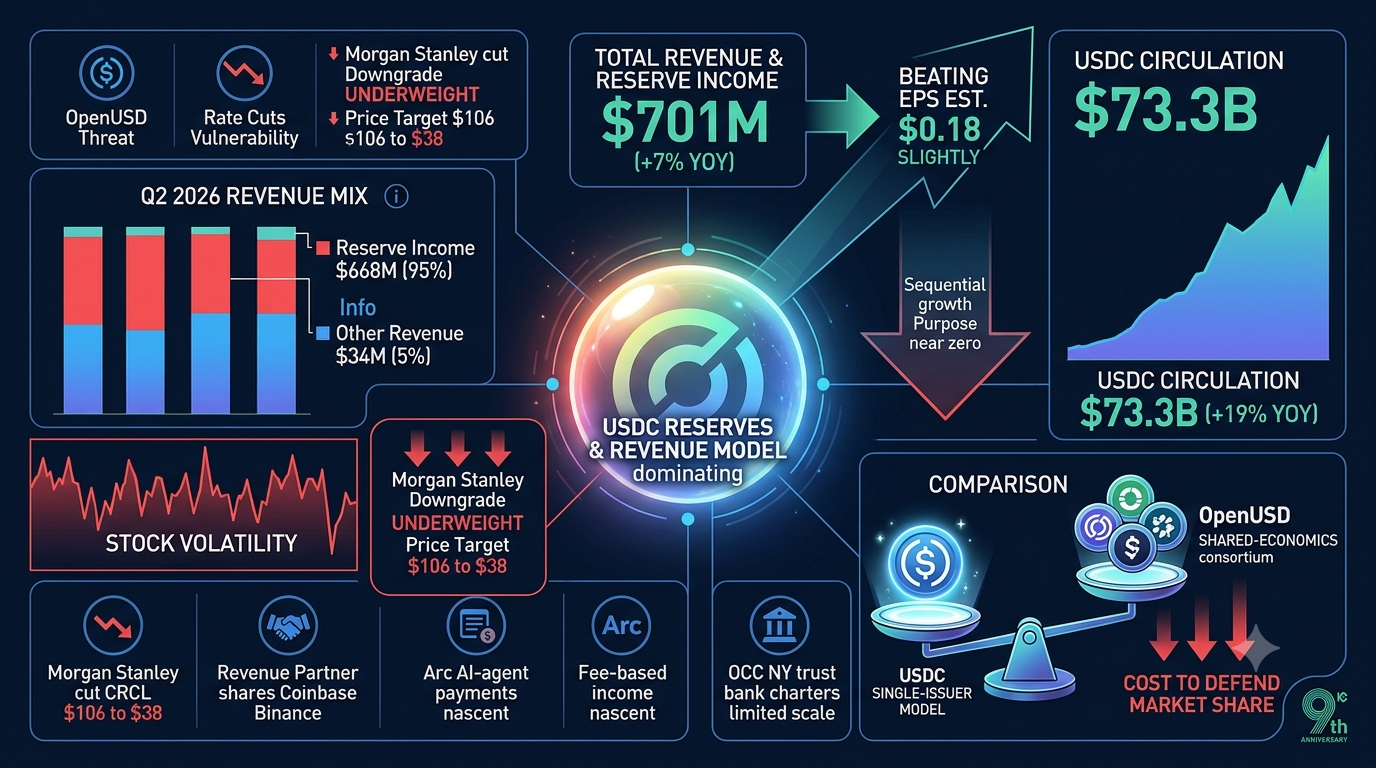
Circle’s Q2 2026 results confirm that heavy reliance on USDC reserve interest leaves the company vulnerable to rate cuts, distribution partners, and new competition from OpenUSD. According to Circle’s official Q2 2026 earnings report released on August 5, 2026, total revenue and reserve income reached $701 million — up 7% year-over-year but missing Wall Street estimates of roughly $713–717 million. Reserve income alone accounted for about 95% of the total. Diluted EPS of $0.18 slightly beat expectations, yet sequential growth was near zero and other revenue declined.
Combined with Morgan Stanley’s August 3, 2026, cut of its price target from $106 to $38 and a downgrade to underweight, the numbers show limited near-term catalysts for Circle stock (CRCL). Long-term upside depends on shifting from holding-based income to usage-based fees — a transition that remains early.
What Did Circle’s Q2 2026 Earnings Actually Show?
Circle reported total revenue and reserve income of $701 million in Q2 2026, a 7% year-over-year increase but only 1% sequential growth and below consensus forecasts. According to the company’s August 5, 2026, release and earnings presentation, reserve income came in at $668 million, or approximately 95% of the total, while other revenue fell to $34 million from $42 million in Q1. RLDC margin held steady at 41.2%. Diluted EPS reached $0.18, edging past the $0.16 consensus.
USDC in circulation ended the quarter at $73.3 billion, up 19% year-over-year yet down sequentially from roughly $77 billion at the end of Q1. Average circulation rose 25%, supporting the modest reserve-income gain. On-chain transaction volume jumped 151% to $14.8 trillion. The reserve return rate, however, dropped 66 basis points to 3.5%, reflecting lower short-term U.S. Treasury yields.
These figures sit squarely in line with Circle’s structural challenges. Nearly all profit still flows from interest earned on cash and Treasuries backing USDC. Federal Reserve rate cuts directly compress that yield. At the same time, distribution partners such as Coinbase and Binance continue to claim larger revenue shares. Payments, settlement, and network services have yet to generate material scale. The earnings miss and sequential softness therefore validate market concerns rather than dispel them.
How Does OpenUSD Threaten USDC and Circle’s Business Model?
OpenUSD (OUSD), the consortium stablecoin announced by Open Standard in late June 2026, directly targets the economics that power Circle’s profits. More than 140 partners — including Visa, Mastercard, Stripe, Coinbase, BlackRock, and Google — plan to share most reserve yield after a management fee, offer zero mint/redeem fees at scale, and operate under partner-board governance. Launch is expected later in 2026 on multiple chains starting with Solana.
Unlike Circle’s single-issuer model, in which the company retains the bulk of reserve interest, OpenUSD redistributes that income to the businesses that actually use and distribute the coin. This structure raises the cost for Circle to defend USDC market share and distribution relationships. Morgan Stanley explicitly cited OpenUSD on August 3, 2026, when it cut its CRCL price target from $106 to $38 and lowered long-term USDC supply forecasts by 33% for 2027 and 44% for 2028. The bank argued that competition from shared-economics stablecoins and tokenized money-market products will pressure margins and force a lower-margin shift toward transaction revenue.
USDC remains the second-largest dollar stablecoin with deep liquidity and integrations, yet OpenUSD’s design attacks the exact revenue stream that still accounts for 95% of Circle’s top line. Until OpenUSD generates meaningful circulating supply and transaction flow, the threat is prospective. Once live, the competitive pressure on distribution costs and reserve retention becomes concrete.
Why Is Circle’s Revenue Model So Sensitive to Interest Rates and Partners?
Circle’s profitability remains overwhelmingly tied to USDC balances and short-term dollar rates. According to the Q2 2026 results, reserve income of $668 million represented roughly 95% of total revenue and reserve income, consistent with the approximately 94% share seen in Q1. A 25% rise in average circulation only partially offset the 66-basis-point drop in the reserve return rate to 3.5%.
Distribution and transaction costs stayed elevated, reflecting revenue-sharing arrangements with major exchanges and platforms. On the August 5, 2026, earnings call, management confirmed that the Coinbase agreement was renewed under existing terms, preserving USDC’s core position across Coinbase products. That continuity provides stability but does not reduce the share of economics flowing to partners.
Other revenue — payments, network services, Arc, and enterprise offerings — declined from $42 million to $34 million and still constitutes less than 5% of the total. Circle has repeatedly highlighted AI-agent payments, the Arc network (mainnet launch scheduled for September 16, 2026), and newly granted trust charters (OCC and New York). These initiatives remain early-stage and have not yet produced scale. Bank charters currently allow self-custody of USDC reserves, saving fees, yet do little to expand fee-based income from third-party custody or transaction processing.
The model’s sensitivity is therefore structural: lower rates or slower USDC growth immediately compress the dominant revenue line, while partner economics and nascent usage fees have yet to provide an offsetting buffer.
What Did Circle’s CEO Say About the Path Forward?
CEO Jeremy Allaire and the management team used the August 5, 2026, earnings call to emphasize adoption metrics and long-term platform ambitions. They pointed to the 19% year-over-year rise in USDC circulation, the 151% surge in on-chain volume, the Coinbase renewal, progress on Arc, and regulatory trust charters as evidence of growing utility beyond pure trading.
The responses address surface concerns but leave the core challenge largely untouched. Circle still earns primarily when users hold USDC rather than when they actively use it for payments, settlement, or AI-driven transactions. Management raised full-year 2026 other-revenue guidance to $310–330 million (including Arc token presale proceeds) and lifted the RLDC margin outlook, yet these figures remain modest relative to the $668 million quarterly reserve income base.
The strategic necessity is clear: Circle must migrate from a balance-sheet interest model to a high-volume, fee-generating network. Until that shift materializes at scale, short-term earnings power stays constrained by rates, competition, and distribution costs.
What Are the Longer-Term Prospects for Circle and USDC?
Longer-term value hinges on whether Circle can successfully monetize USDC usage rather than mere holdings. The company has secured the regulatory foundation (OCC and New York trust charters) and is building infrastructure around Arc, AI-agent payments, and enterprise settlement. These efforts aim to capture transaction fees and network effects as stablecoins move deeper into real-world payments and tokenized assets.
Success is not guaranteed. AI-payment volumes remain negligible today, and the bank-charter benefits are currently limited to self-custody efficiencies. OpenUSD and similar consortium models will test Circle’s ability to defend share without further diluting margins. Until a new narrative of scaled fee income emerges, patient capital is required. Investors seeking exposure must weigh the still-dominant reserve-income model against the multi-year timeline needed for diversification.
Join KuCoin 9th Anniversary Trading Campaign
Now you can trade such trending stock assets on KuCoin, including Circle, and others.
KuCoin is celebrating its 9th anniversary with a special platform campaign filled with exclusive rewards, trading activities, and limited-time offers. Don’t miss the chance to participate and enjoy the benefits as the exchange marks nine years of growth and innovation. Visit the official campaign page now:
Conclusion
Circle’s Q2 2026 earnings, released August 5, 2026, delivered a modest 7% revenue increase to $701 million that missed estimates, with 95% still derived from USDC reserve income of $668 million. EPS of $0.18 beat lightly, RLDC margin held at 41%, and USDC circulation grew 19% year-over-year to $73.3 billion, yet sequential softness and a lower reserve return rate underscored ongoing pressures. Morgan Stanley’s August 3 price-target slash to $38 and the arrival of OpenUSD’s shared-economics model further highlight the challenges of rate sensitivity, partner revenue shares, and limited scale in payments and network services.
Management’s Coinbase renewal and Arc progress offer continuity, but the core shift from holding-based to usage-based income remains incomplete. Near-term upside for CRCL stock appears constrained; longer-term potential exists if Circle successfully scales fee generation, yet that outcome requires time and execution. Investors should monitor USDC balances, rate trends, OpenUSD adoption, and other-revenue growth closely while recognizing the current structural realities.
FAQs
What is the main difference between OpenUSD and USDC?
OpenUSD uses a consortium model that shares most reserve yield with partners and charges zero mint/redeem fees, while USDC is issued by a single company (Circle) that retains the majority of reserve interest.
How much of Circle’s revenue still comes from USDC reserves?
According to the Q2 2026 earnings report, reserve income of $668 million represented approximately 95% of total revenue and reserve income.
Did Circle renew its agreement with Coinbase?
Yes. On the August 5, 2026, earnings call, management confirmed the agreement was renewed under existing terms, keeping USDC central to Coinbase’s product suite.
Why did Morgan Stanley cut its Circle price target so sharply?
On August 3, 2026, Morgan Stanley lowered the target from $106 to $38 and downgraded the stock, citing slower expected USDC growth, reserve-income sensitivity, and competitive pressure from OpenUSD and tokenized products.