



Could Gold Price Reach $5,000 Again by the End of 2026? Analyst Forecasts, Key Drivers, and Investment Outlook
2026/05/16 04:40:33
Introduction
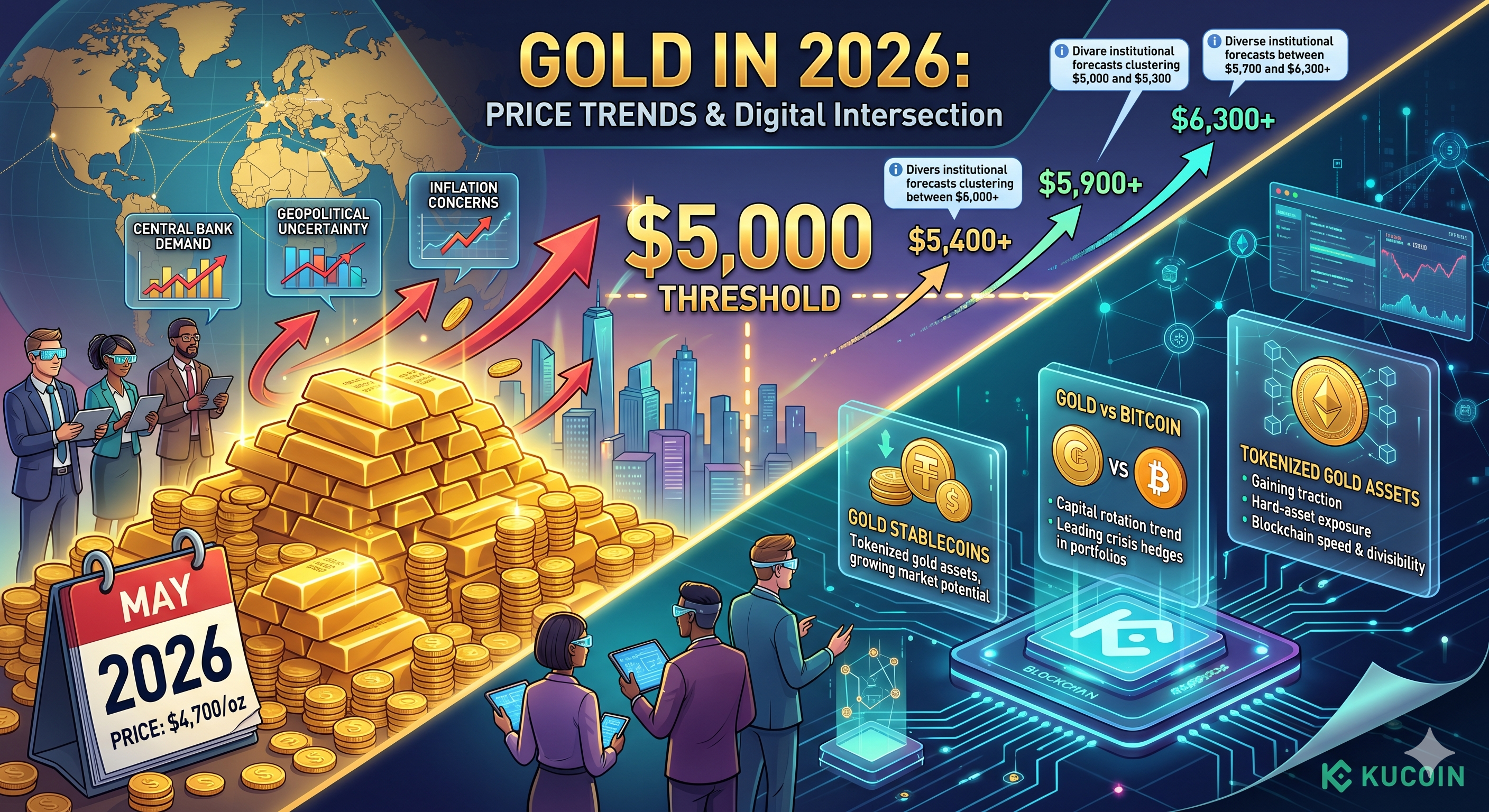
Gold has already proven it can trade above $5,000 per ounce in 2026. After hitting record highs above $5,300 in February 2026, prices have settled near $4,700 as of May 2026, leaving investors to wonder whether the precious metal will reclaim and hold above the $5,000 threshold by year-end. The answer from most Wall Street analysts is yes — but the path depends on central bank demand, geopolitical stability, and Federal Reserve policy. According to aggregated forecasts from over two dozen institutions compiled by SBCGold, the consensus for year-end 2026 ranges from $4,500 to $6,300 per ounce, with a significant cluster of banks targeting $5,000 or higher.
For investors exploring how digital assets intersect with precious metals:
-
Gold Stablecoin explores tokenized gold assets and their growing market potential, and
-
Gold vs Bitcoin compares the two leading crisis hedges and capital rotation trends shaping portfolios in 2026.
What Are the Latest Gold Price Forecasts for 2026?
Most major investment banks expect gold to end 2026 at or above $5,000 per ounce. J.P. Morgan leads the bullish camp with a $6,300 year-end target, citing continued reserve diversification by central banks and sustained investor demand for hard assets. Wells Fargo matches this $6,300 forecast, while UBS projects $5,900 in its base case with potential spikes toward $6,200 during the year. Goldman Sachs recently raised its end-of-2026 target to $5,400 per ounce, arguing that private-sector investors may diversify further amid lingering global policy uncertainty.
The $5,000 level itself has become a common benchmark rather than an ambitious stretch target. Bank of America forecasts gold could hit $6,000 by spring 2026, while Deutsche Bank, Societe Generale, and Yardeni Research all target $6,000 for the year. Citi raised its short-term target to $5,000 citing heightened geopolitical risks and physical market shortages. Commerzbank upgraded its 2026 forecast from $4,400 to $5,000 by year-end, and HSBC believes the bull market will press prices to a $5,000 high during the first half of 2026.
According to data compiled by SBCGold in April 2026, the distribution of institutional forecasts reveals a clear bullish skew:
|
Institution
|
2026 Forecast
|
Time Frame
|
|
J.P. Morgan
|
$6,300
|
End-2026
|
|
Wells Fargo
|
$6,300
|
End-2026
|
|
UBS
|
$5,900
|
End-2026
|
|
Goldman Sachs
|
$5,400
|
End-2026
|
|
Commerzbank
|
$5,000
|
End-2026
|
|
Citi
|
$5,000
|
Q2 2026
|
|
Standard Chartered
|
$4,500
|
Q4 2026
|
|
World Bank
|
$3,575
|
2026 Average
|
Even the more conservative LBMA analyst consensus sits at $4,742 per ounce according to AhaSignals data from May 2026, which still implies meaningful upside from current levels near $4,700. The consensus dispersion score reads 100 out of 100, indicating maximum disagreement among professional forecasters.
Not all forecasts are bullish. Standard Chartered predicts $4,500 by the fourth quarter of 2026, while Fidelity International and Saxo Bank target $4,000. The World Bank offers the most conservative outlook at $3,575 per ounce. These bearish scenarios typically assume aggressive Federal Reserve tightening, a stronger U.S. dollar, or rapid cooling of inflation that reduces safe-haven demand.
Prediction markets reflect this wide dispersion of views. According to AhaSignals data from May 2026, Polymarket contracts show a 32% probability that gold will touch $6,000 by December 2026 and a 13% chance of hitting $7,000. The high dispersion score suggests volatility could remain elevated throughout the year, creating both opportunities and risks for traders.
Why Are Analysts So Bullish on Gold in 2026?
Three structural forces are driving the bullish consensus: unprecedented central bank accumulation, persistent geopolitical risk, and a macroeconomic environment where inflation concerns outweigh interest rate headwinds.
Are Central Banks Still Buying Gold at Record Levels?
Central banks remain the single largest structural buyer in the gold market, and their appetite shows no signs of slowing. According to MoneyMagpie, institutions across emerging markets continue increasing gold reserves as they diversify away from traditional currencies and government bonds. China, India, Turkey, and other emerging-market central banks have been net buyers for four consecutive years, creating a long-term price floor that few private-market sellers can offset.
This official-sector demand is qualitatively different from speculative retail buying. Central banks purchase gold as a reserve asset with multi-decade holding periods, which removes physical supply from circulation permanently. This structural demand is acting as a cushion that limits sharp declines even during risk-off periods when gold might typically sell off. The firm notes that even in a downside scenario, gold is unlikely to experience a deep collapse because this structural demand provides persistent underlying support.
How Do Geopolitical Tensions Support Gold Prices?
Geopolitical uncertainty has become a permanent feature of the 2026 macro landscape rather than a temporary shock. Tensions in the Middle East, concerns around global trade routes, and shifting alliances have sustained safe-haven flows into gold throughout the first half of the year. When investors become nervous about the global economy or financial markets, gold often becomes more attractive as a non-correlated store of value.
Unlike previous cycles where geopolitical spikes caused brief gold rallies followed by corrections, the current environment features overlapping risks that keep uncertainty elevated. Trade tensions, tariff disputes, and questions about Federal Reserve independence have created a backdrop where institutional investors maintain strategic gold allocations rather than treating them as tactical trades. Metals Focus notes that trade tensions, inflation risks, and fragile confidence should sustain safe-haven demand while fiscal strains and doubts over the Fed's independence curb the dollar's appeal.
What Role Do Inflation and Interest Rates Play?
Gold performs best when real interest rates — nominal rates minus inflation — are low or negative. According to Angle360, gold is no longer moving like a traditional commodity but behaving like a core macro asset that responds directly to inflation expectations and currency movements. Bank of America argues that the White House's policy framework remains supportive for gold given fiscal deficits, rising debt, and a push to cut rates with inflation still around 3%.
The relationship between gold and interest rates is nuanced. While higher nominal rates typically hurt non-yielding assets, gold has rallied in 2026 even during periods when rate-cut expectations were pushed back. This suggests that investors are pricing in long-term currency debasement rather than short-term yield differentials. If major central banks begin cutting rates in the second half of 2026, the removal of the opportunity-cost headwind could provide additional fuel for prices. According to InvestingCube, slower global growth and persistent demand from China and emerging-market central banks support a long-term bullish narrative, with dips increasingly treated as accumulation opportunities.
What Risks Could Prevent Gold From Hitting $5,000?
Despite the bullish consensus, several macro headwinds could cap gold's upside or trigger meaningful pullbacks before year-end.
Could a Stronger Dollar and Higher Real Yields Hurt Gold?
The most immediate risk to gold prices is a sustained rise in U.S. real yields. Gold does not pay interest or dividends, so it becomes less attractive when Treasury Inflation-Protected Securities offer competitive real returns. According to InvestingCube, any sustained increase in U.S. real yields historically triggers downside moves in gold, with a bear case targeting the $3,700 to $3,950 range if oil prices rise above $120 and the geopolitical impasse escalates further.
A stronger U.S. dollar — often driven by hawkish Federal Reserve policy or safe-haven flows into dollar assets — also creates headwinds. UBS noted in April 2026 that a stronger dollar, rising oil prices, and a shift in rate expectations that pushed real yields higher had already reduced the appeal of non-yielding assets such as gold, prompting the bank to lower its short-term June target to $5,200 while maintaining its $5,900 year-end view. This dynamic illustrates how quickly the macro environment can shift and why gold's path to $5,000 may include significant volatility.
Is the Oil Shock a Threat to Gold's Rally?
The oil shock represents the single greatest near-term danger to gold prices in 2026. According to InvestingCube, higher oil prices above $100 per barrel could force a hawkish shift in Federal Reserve expectations, strengthening the dollar and creating an inflationary push that paradoxically hurts gold by raising real yields. If the new Fed leadership acts decisively to contain inflationary pressures from higher oil prices, gold could retest the $4,300 to $4,380 levels seen in 2025.
Gold's massive rally from 2025 into 2026 also means the market is vulnerable to profit-taking. According to MoneyMagpie, some analysts warn that gold's huge rally means volatility could remain high throughout 2026, with sharp corrections possible even within an overall uptrend. Investors should expect multiple tests of key resistance levels before any sustained breakout above $5,000 is confirmed.
How Can Investors Prepare for Gold's Next Move?
Positioning for gold in 2026 requires understanding the difference between physical ownership, derivatives exposure, and emerging digital alternatives.
Should Investors Choose Physical Gold or ETFs?
Physical gold and exchange-traded funds remain the most accessible vehicles for retail and institutional investors. ETFs offer liquidity and ease of trading without storage concerns, while physical bullion provides direct ownership without counterparty risk. According to UBS, strong ETF demand has been a key driver of gold's 2026 performance alongside central bank accumulation.
For long-term investors seeking portfolio diversification, gold often behaves differently from stocks and bonds, which can help reduce overall portfolio risk. Angle360 notes that gold is competing with both equities and digital assets for investor attention, but it plays a different role — providing stability and protection rather than growth. This is why gold continues to attract capital even when other asset classes perform well. It is not replacing them. It is balancing them.
Are Tokenized Gold Assets Worth Considering?
Tokenized gold represents a growing intersection between precious metals and blockchain technology. These digital assets allow investors to gain gold exposure with the settlement speed and divisibility of cryptocurrency trading. As the spoke content on Gold Stablecoins details, tokenized gold products are gaining traction among investors who want hard-asset exposure without the friction of physical storage or traditional brokerage accounts.
The choice between physical, ETF, and tokenized gold depends on investment horizon, risk tolerance, and whether the goal is wealth preservation or tactical trading. For investors already active in cryptocurrency markets, tokenized gold offers a familiar interface and 24/7 liquidity that traditional gold markets cannot match. This convergence of traditional and digital finance is creating new avenues for gold investment that did not exist in previous bull markets.
Conclusion
Gold has already demonstrated its capacity to trade above $5,000 in 2026, having touched $5,300 in February before consolidating near $4,700. The weight of institutional evidence suggests that a return to and sustained hold above $5,000 is not only possible but probable by year-end, with J.P. Morgan, Wells Fargo, UBS, and numerous other major banks forecasting targets between $5,000 and $6,300.
The bullish case rests on three durable pillars: central banks continuing their multi-year accumulation spree, geopolitical uncertainty sustaining safe-haven demand, and a macro environment where inflation and fiscal deficits undermine confidence in fiat currencies. Risks remain — particularly from a stronger dollar, higher real yields, or an oil shock that forces aggressive Federal Reserve tightening — but even bearish scenarios mostly target $4,000 to $4,500, implying limited downside from current levels.
For investors, 2026 offers a rare convergence of traditional and digital gold vehicles. Whether through physical bullion, ETFs, or tokenized assets on platforms like KuCoin, the tools for gaining gold exposure have never been more accessible. The question is no longer whether gold can reach $5,000, but whether investors are positioned to benefit when it does.
FAQs
Will gold reach $5,000 again in 2026?
Most major banks believe gold will reach or exceed $5,000 per ounce in 2026. Goldman Sachs targets $5,400, Commerzbank and Citi target $5,000, while J.P. Morgan and Wells Fargo forecast $6,300 by year-end.
What is the highest gold price prediction for 2026?
J.P. Morgan and Wells Fargo share the highest mainstream forecast at $6,300 per ounce by end-2026. Robert Kiyosaki has predicted $25,000, though this is an outlier view not shared by institutional analysts.
Why did gold drop after hitting $5,300 in early 2026?
Gold pulled back due to a stronger U.S. dollar, rising oil prices, and shifting Federal Reserve rate expectations that pushed real yields higher, reducing the appeal of non-yielding assets according to UBS.
Is gold still a good investment if it is already near $4,700?
Yes, according to analyst consensus, gold still offers upside potential with year-end targets clustering between $5,000 and $6,300. Structural central bank demand provides a long-term floor that limits severe downside.
How can cryptocurrency investors gain gold exposure?
Investors can trade tokenized gold assets and gold-backed stablecoins on cryptocurrency exchanges like KuCoin, gaining precious metals exposure with blockchain settlement speed and 24/7 liquidity.