

What Is the Shutdown Price of Bitcoin Mining Machines in 2026? How to Judge It
2026/04/02 19:00:03
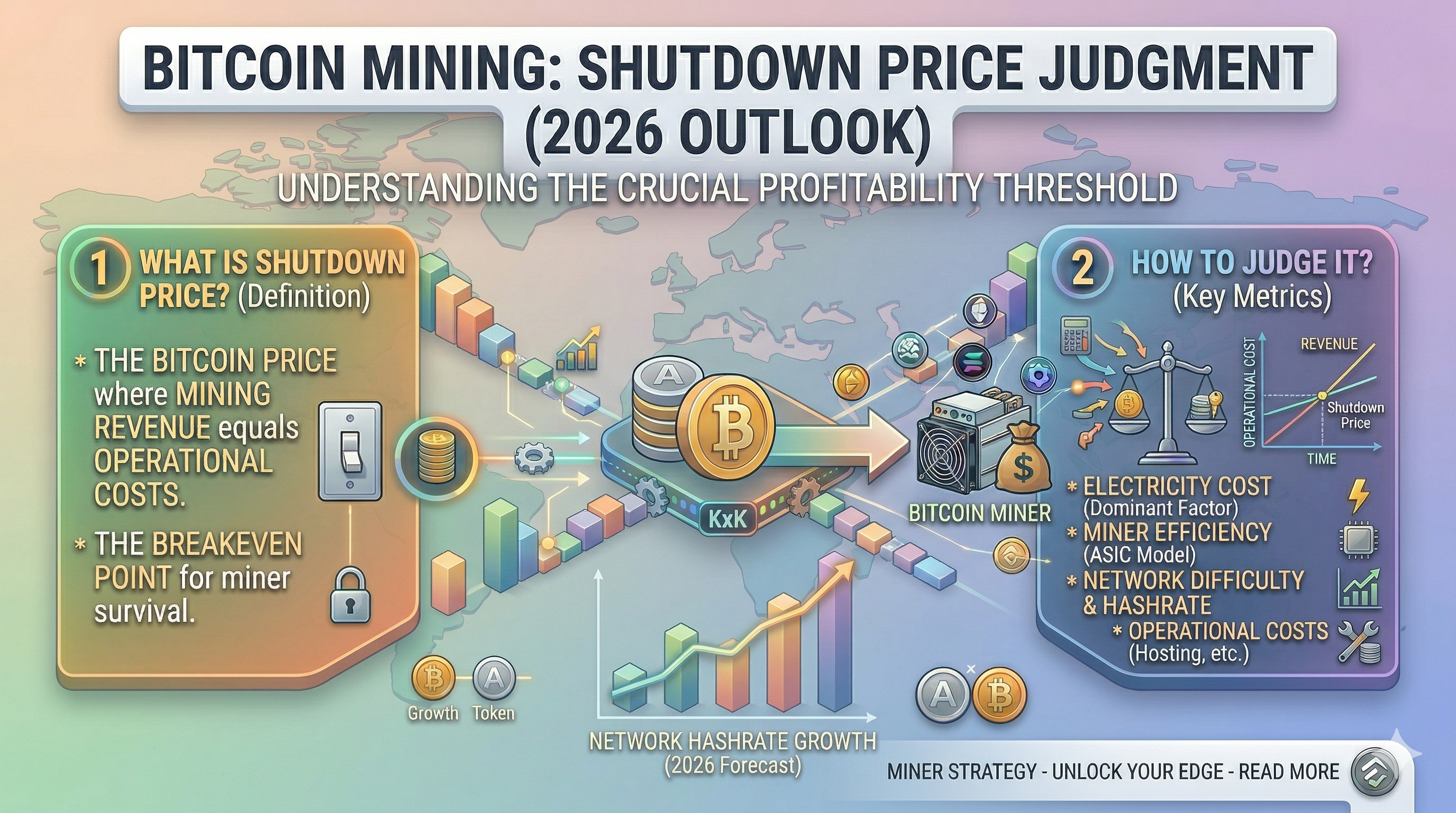
The shutdown price of Bitcoin mining machines in 2026 is not a fixed number but a dynamic threshold shaped by hashprice, electricity costs, ASIC efficiency, and network difficulty. As mining margins tighten in the post-halving era, understanding these variables is essential to determining when machines become unprofitable and why large portions of the network periodically shut down.
The Meaning of a Shutdown Price in Bitcoin Mining
The shutdown price in Bitcoin mining refers to the level at which operating a mining machine becomes economically irrational because costs exceed revenue. It is not simply the Bitcoin market price, but a relationship between revenue per unit of hashpower and total operational expenses. In 2026, this concept has become central to understanding mining cycles, as many operators are forced offline when margins compress. The idea gained prominence after the 2024 halving reduced block rewards to 3.125 BTC, cutting miner income in half overnight.
Shutdown price is better understood as a range rather than a single number. For some miners with cheap electricity and efficient hardware, operations can continue profitably even when Bitcoin trades at relatively low levels. Others, especially those using older machines or paying higher power rates, reach shutdown conditions much earlier. Industry estimates show that inefficient miners begin shutting down when Bitcoin approaches the mid-$70,000 range, while more efficient operations can survive at lower levels.
This concept explains why mining hashrate fluctuates during market downturns. As profitability disappears, weaker operators exit, reducing competition and eventually stabilizing the network. Shutdown price is therefore not just a cost metric, it is a key driver of Bitcoin’s self-correcting economic system.
The Real Cost of Mining Bitcoin in 2026
Mining Bitcoin in 2026 involves a complex cost structure that goes far beyond electricity. While power remains the largest expense, total mining costs include hardware depreciation, maintenance, cooling, labor, and financing. Analysts estimate that the average production cost of Bitcoin in early 2026 sits around $77,000, with full “all-in” costs exceeding $100,000 for many operators.
Electricity alone can account for 60–80% of operational costs. A difference of just $0.02 per kWh can determine whether a mining farm is profitable or operating at a loss. Efficient miners typically secure power below $0.06 per kWh, while those paying closer to $0.10 struggle to remain viable. Hardware efficiency also plays a major role. New-generation ASICs operate at 15–20 joules per terahash, allowing them to produce more output with less energy. Older machines, consuming over 30 J/TH, quickly become unprofitable in tight-margin environments.
These cost layers create a wide dispersion in shutdown prices across the industry. While headlines often cite a single break-even number, the reality is that each miner operates under a unique cost structure. This variation is what drives cycles of miner capitulation and recovery.
Hashprice: The Most Important Metric in 2026
Hashprice has emerged as the most critical indicator of mining profitability in 2026. It represents the daily revenue earned per unit of hashpower, typically measured in dollars per petahash per second (PH/s/day). This metric combines block rewards and transaction fees into a single value that reflects real-time mining income.
Recent data shows that hashprice has dropped significantly, falling to around $30–$38 per PH/s/day, levels that are near or below breakeven for many miners. This decline is driven by a combination of lower Bitcoin prices, increased network difficulty, and reduced block rewards following the halving.
Hashprice acts as a stress signal for the mining industry. When it falls below certain thresholds, less efficient machines are forced offline. Estimates suggest that many miners begin shutting down when hashprice drops below $35 per PH/s/day, especially if they lack access to cheap electricity. This metric is more useful than Bitcoin price alone because it directly reflects miner revenue. A rising Bitcoin price does not guarantee profitability if difficulty increases at the same time. Hashprice captures this balance, making it the most accurate tool for identifying shutdown conditions.
Electricity Costs: The Ultimate Survival Filter
Electricity costs are the single most decisive factor in determining whether a mining machine continues running or shuts down. In 2026, the margin for error is extremely small. Miners operating at $0.05 per kWh can remain profitable under conditions that would bankrupt those paying $0.08 or higher. This sensitivity explains why mining operations are concentrated in regions with cheap energy. Hydropower, stranded gas, and renewable energy sources provide a competitive advantage. Even a one-cent difference in electricity pricing can significantly impact annual profitability.
Electricity costs also interact with hashprice. When hashprice declines, only miners with the lowest energy costs can continue operating. Others are forced to shut down, reducing network difficulty and eventually restoring balance. The importance of electricity has increased since the 2024 halving. With reduced block rewards, miners rely more heavily on cost efficiency to survive. This has transformed mining into an energy arbitrage business, where success depends less on scale and more on access to cheap, reliable power.
ASIC Efficiency and the Death of Older Machines
Hardware efficiency has become a defining factor in mining survival. In 2026, the gap between modern and older ASIC machines is so large that many legacy devices are effectively obsolete. New-generation machines such as high-efficiency ASICs can remain profitable at significantly lower Bitcoin prices compared to older models.
Break-even data shows that some newer machines operate profitably at Bitcoin prices between $69,000 and $74,000, while older models require much higher prices to stay viable. This creates a continuous cycle of hardware replacement, where inefficient machines are phased out as soon as profitability declines.
The result is a more industrialized mining landscape dominated by large operators with access to capital and advanced equipment. Smaller miners using outdated hardware are increasingly unable to compete. This technological arms race reinforces the concept of a moving shutdown price. As new machines enter the network, overall efficiency improves, pushing the profitability threshold lower for top-tier operators while raising it for everyone else.
Network Difficulty and Competitive Pressure
Bitcoin’s mining difficulty adjusts approximately every two weeks to maintain a consistent block production rate. This mechanism ensures network stability but also intensifies competition among miners. When more machines join the network, difficulty increases, reducing the rewards earned by each participant. In 2026, difficulty has reached historically high levels due to record hashrate growth. The network has surpassed 1 zetahash per second, reflecting massive industrial expansion. This growth has significantly reduced individual miner profitability, even during periods of strong Bitcoin prices.
Difficulty acts as a hidden cost. Even if electricity and hardware remain constant, rising difficulty can push a mining operation into unprofitability. This is why shutdown prices cannot be calculated in isolation, they depend on the broader network environment. When difficulty becomes too high relative to Bitcoin price, weaker miners shut down, causing difficulty to adjust downward. This cycle helps stabilize the network but creates volatility in mining profitability.
The Post-Halving Reality: Why Margins Collapsed
The 2024 halving fundamentally reshaped mining economics. By reducing block rewards from 6.25 BTC to 3.125 BTC, it cut miner revenue in half overnight. This event marked the beginning of a new era where efficiency became the primary determinant of survival.
Transaction fees have not been sufficient to offset this loss. In 2025 and early 2026, fees accounted for a very small portion of miner revenue, leaving operators highly dependent on Bitcoin price. As a result, many miners are operating with razor-thin margins. When Bitcoin price falls below production cost, widespread shutdowns occur. Data shows that Bitcoin has traded below average mining cost at times in 2026, forcing miners to sell reserves and reduce operations.
This environment has made shutdown prices a critical concept. It determines not only individual profitability but also the overall health of the mining industry.
Real Shutdown Price Ranges in 2026
In 2026, shutdown prices vary widely depending on operational efficiency. Electricity-only break-even levels are estimated around $74,000, while full cost models can exceed $100,000 per Bitcoin.
Efficient miners with advanced ASICs and cheap power can operate below these levels, sometimes remaining profitable in the $60,000–$70,000 range. Less efficient operators may shut down even when Bitcoin trades above $80,000. Hashprice data reinforces this range-based view. When revenue falls below $30–$35 per PH/s/day, a significant portion of the network becomes unprofitable.
This dispersion explains why mining shutdowns occur gradually rather than all at once. Different operators reach their shutdown thresholds at different times, creating a layered response to market conditions.
How to Calculate Your Own Shutdown Price
Calculating shutdown price requires combining several variables: electricity cost, machine efficiency, and expected revenue. A simple approach involves dividing total daily operating costs by expected Bitcoin output. For example, a miner consuming 3 kW at $0.06 per kWh incurs daily electricity costs of around $4.32. This cost must be compared against expected mining revenue based on hashprice and network difficulty.
More advanced models include hardware depreciation and maintenance costs. These provide a more accurate estimate of all-in break-even levels. Real-time tools such as mining calculators can simplify this process, allowing operators to adjust assumptions and test different scenarios. The key is to monitor changes in hashprice and difficulty, as these variables can shift rapidly.
Why Miners Shut Down in Waves
Mining shutdowns rarely happen instantly across the entire network. Instead, they occur in waves as different operators reach their individual break-even thresholds. This pattern reflects the diversity of cost structures within the industry.
When Bitcoin price declines or hashprice drops, high-cost miners shut down first. This reduces network hashrate, leading to a difficulty adjustment that improves profitability for remaining operators. This cycle has been observed repeatedly in 2026, with reports indicating that 15–20% of mining capacity has become unprofitable during periods of stress. These waves of shutdown and recovery are essential to Bitcoin’s design. They ensure that the network remains secure while adapting to changing economic conditions.
The Link Between Shutdown Price and Bitcoin Market Cycles
Shutdown price plays a crucial role in Bitcoin’s broader market cycles. When price falls below production cost, miners are forced to sell reserves to cover expenses, adding downward pressure to the market.
Historically, these periods have marked local bottoms. When inefficient miners exit, selling pressure decreases, and the network stabilizes. Over time, this can contribute to price recovery. In 2026, this relationship remains evident. The alignment between Bitcoin price and mining cost continues to influence market dynamics, making shutdown price an important indicator for traders and analysts.
Conclusion: A Moving Target Defined by Efficiency
The shutdown price of Bitcoin mining machines in 2026 is not a fixed number but a constantly shifting threshold shaped by multiple variables. Hashprice, electricity costs, ASIC efficiency, and network difficulty all interact to determine when mining becomes unprofitable.
The post-halving environment has made this calculation more critical than ever. Margins are thinner, competition is higher, and only the most efficient operators can survive prolonged downturns. Understanding shutdown price provides valuable insight into both mining economics and Bitcoin’s broader market behavior. It reveals why miners exit the network, how difficulty adjusts, and why the system remains resilient despite constant pressure.
FAQ
1. What is the shutdown price in Bitcoin mining?
It is the point where mining revenue no longer covers operational costs, forcing miners to turn off machines.
2. What is the average break-even price in 2026?
Estimates range from around $74,000 (electricity only) to over $100,000 when including all costs.
3. What is hashprice and why does it matter?
Hashprice measures revenue per unit of hashpower and is the most accurate indicator of mining profitability.
4. Can miners still be profitable below $70,000?
Yes, but only with highly efficient hardware and very low electricity costs.
5. Why do miners shut down during price drops?
Because revenue falls below operating costs, making continued mining unsustainable.
Disclaimer
This content is for informational purposes only and does not constitute investment advice. Cryptocurrency investments carry risk. Please do your own research (DYOR).