

BIS Warns USDT & USDC Expansion Risks Asian Banking Sector: What Does It Mean for Crypto Investors?
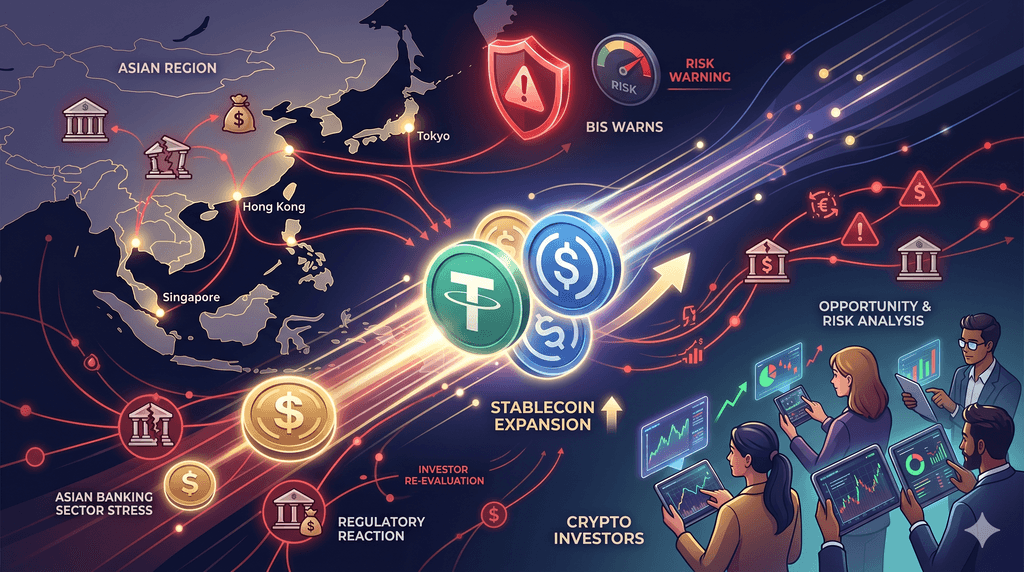
The world's central bank for central banks just sounded a loud alarm — and every crypto investor holding USDT or USDC should be paying close attention.
On April 20, 2026, Pablo Hernández de Cos, General Manager of the Bank for International Settlements (BIS), delivered one of the most pointed warnings yet against the unchecked expansion of dollar-pegged stablecoins. Speaking to an audience of global financial policymakers, De Cos identified five specific risk categories tied to stablecoin growth: effects on credit supply, financial stability, monetary policy, fiscal policy, and regulatory circumvention. He specifically called out Tether's USDT and Circle's USDC — together accounting for roughly 90% of a $320 billion stablecoin market — as assets that behave less like cash and more like investment products, carrying systemic risks that could ripple through banks and financial markets during periods of stress.
For Asia, where stablecoin adoption is embedded in everyday trading, remittance corridors, and DeFi infrastructure, the stakes couldn't be higher. And for crypto investors worldwide, understanding what the BIS is actually warning about — and why now — is critical for navigating the months ahead.
Key Takeaways
-
The BIS issued a landmark warning on April 20, 2026, identifying USDT and USDC as sources of financial stability risk, potential "digital dollarization," and regulatory arbitrage threats.
-
The stablecoin market has reached $320 billion, with USDT (~$187B) and USDC (~$78B) dominating over 90% of the sector, giving them the size to genuinely move banking systems and Treasury markets.
-
Asian banking systems face particular exposure through deposit displacement, capital flight risks, and the erosion of central bank monetary control in markets from Singapore to South Korea.
-
International regulation remains fragmented, with the FSB admitting that global stablecoin rulemaking has stalled — creating uncertainty that could affect stablecoin access and usability for investors.
-
For crypto investors, the BIS warning is a signal, not a death sentence. Regulatory pressure typically increases compliance, legitimacy, and ultimately, long-term stability for the asset class.
Why the BIS Fired a Warning Shot at USDT and USDC
The BIS does not typically make headlines by naming specific crypto assets. The fact that the April 20 statement directly called out USDT and USDC by name signals a significant escalation in the institution's concern about stablecoin systemic risk.
De Cos framed the core issue clearly: the largest dollar stablecoins share characteristics with investment products rather than cash-like money. He pointed to fees and conditions on primary market redemptions, as well as episodes where their prices diverge from their intended $1 peg on secondary markets. In his assessment, these features make USDT and USDC behave more like exchange-traded funds (ETFs) than money — while still creating run and contagion risks because their issuers hold short-term government debt and bank deposits as reserve assets.
The timing of the warning is deliberate. The stablecoin sector has ballooned from roughly $125 billion two years ago to more than $320 billion today, according to DeFiLlama. As of January 2026, USDT alone holds $186 billion in circulation, with 63% of its reserves parked in U.S. Treasury bills. USDC, with a market cap of approximately $78–79 billion, holds 32% of its reserves in T-bills. During 2024, these two issuers' combined net purchases of Treasury securities were reportedly comparable to those of major foreign governments. When stablecoin issuers become that large a buyer of sovereign debt, their actions stop being a niche crypto story and become a macroeconomic event.
The BIS also raised an important stress-scenario concern: in a market panic, rapid outflows from stablecoins could force the hurried liquidation of those Treasury and bank deposit reserves into already strained markets — transmitting funding pressure across the financial system in ways that closely resemble a classic bank run.
How USDT and USDC Expansion Threatens Asian Banking Stability
Asia is ground zero for many of the risks the BIS outlined, and the region's varied regulatory landscape makes it especially vulnerable.
The dominant concern is "digital dollarization" — a process the BIS and IMF have both flagged as a structural threat to monetary sovereignty in emerging and developing economies. When residents of countries like Vietnam, Indonesia, or the Philippines shift savings and daily transactions into dollar-pegged stablecoins, local banks lose deposits and cheap funding. Central banks in these markets lose their grip on monetary transmission: interest rate changes become less effective when a growing share of the economy runs on tokens that bypass the domestic banking system entirely.
A 2026 analysis by Tiger Research on Asia's stablecoin landscape puts the paradox sharply into focus: even when Asian regulators allow local-currency stablecoins as a protective measure, placing those tokens on a blockchain simultaneously opens conversion paths to dollar stablecoins. A Korean won-denominated stablecoin, for instance, can be swapped into USDT with a few clicks on a decentralized exchange. The tool designed to protect the local currency can paradoxically accelerate capital outflows. This dynamic explains why several Asian central banks initially preferred CBDCs over private stablecoins — government-issued digital currencies allow capital controls to be enforced at the protocol level.
The banking sector risks compound further at the reserve level. When USDT and USDC grow their Treasury bill holdings dramatically, they effectively become significant shadow investors in U.S. sovereign debt. BIS research published in early 2026 found that during periods of T-bill scarcity, a $3.5 billion stablecoin inflow compresses 3-month Treasury yields by 5–8 basis points — roughly double the baseline estimate. For Asian central banks whose reserve management and exchange rate policies are closely tied to U.S. yield dynamics, this is not an abstract concern.
China remains the clearest example of the hard line this pressure can produce. Under a 2021 joint notice from ten government agencies including the People's Bank of China, all virtual asset-related activities are classified as illegal financial activities — a stance unchanged as of early 2026. The logic is straightforward: allowing dollar stablecoins access to Chinese financial infrastructure creates an uncontrollable channel for capital flight, with no technical way to prevent on-chain swaps to offshore exchanges and ultimate conversion to dollars.
Singapore, Hong Kong, Japan, and South Korea have taken more measured approaches — building regulatory frameworks designed to capture the technology's benefits while managing sovereignty risks. But as the BIS has made clear, nationally fragmented rules are themselves a risk factor, creating arbitrage opportunities that push stablecoin activity toward less-regulated jurisdictions.
The Fragmented Global Regulation Problem — And What It Means for Markets
One of the most significant revelations from the April 2026 BIS statement is how little progress has been made on unified global stablecoin standards.
Bank of England Governor Andrew Bailey, who chairs the Financial Stability Board, recently admitted that international rulemaking for stablecoins has effectively stalled. Major economies are pushing ahead with their own frameworks on different timelines and with often incompatible approaches. The EU has moved furthest with its MiCA framework, which has already restricted USDT's availability within European regulated markets. The U.S. is working through the Digital Asset Market Clarity Act, with lawmakers also debating a compromise on stablecoin yield — whether issuers should be permitted to pay interest on stablecoin holdings. Meanwhile, Asian jurisdictions are each charting their own path.
This regulatory fragmentation has real market consequences. When BIS research identifies that stablecoin issuers' "redemption frictions can push prices away from their intended $1 value," it is pointing at a structural vulnerability that becomes more dangerous without consistent global backstops. Proposals currently being debated include limiting interest payments on stablecoins, giving issuers access to central bank lending facilities, and introducing deposit-insurance-type arrangements for reserve protection. None of these have been globally adopted.
For investors, the fragmentation means the regulatory environment for USDT and USDC will remain highly variable by geography throughout 2026. Access, usability, and yield characteristics may continue to differ significantly depending on jurisdiction — making it critical for investors to track both their local regulatory environment and broader international policy developments.
What This Means for Crypto Investors Holding Stablecoins Right Now
The BIS warning does not signal that USDT or USDC are about to collapse. What it signals is that the era of stablecoins operating as largely unregulated infrastructure is ending — and that transition carries both risks and opportunities for investors.
On the risk side, the BIS warning increases the probability of near-term regulatory actions targeting stablecoin issuers, particularly in Asian markets. Investors in jurisdictions that have not yet finalized their frameworks could face sudden access restrictions, trading pair removals, or mandatory migrations between stablecoin versions. USDC has already navigated this kind of disruption — the USDC de-peg during Silicon Valley Bank's collapse in March 2023, when Circle disclosed $3.3 billion of its cash reserves were held at SVB, offers a vivid historical lesson in how reserve transparency (or lack thereof) can trigger rapid market instability.
On the opportunity side, regulatory clarity — even when initially disruptive — tends to increase institutional participation and long-term market depth. USDC's impressive growth in 2026, reaching $78 billion and capturing 64% of stablecoin transaction volume in March 2026 for the first time in nearly a decade, reflects exactly this dynamic: Circle's compliance-first approach under the 2025 GENIUS Act has made it the preferred stablecoin for institutional B2B settlement, payroll infrastructure, and payment networks like Visa and Stripe.
For retail crypto investors, several practical strategies stand out in this environment. First, understanding the reserve composition of any stablecoin you hold is now essential due diligence — not optional. USDC's monthly third-party attestations offer more visibility than USDT's periodic reports, a distinction regulators and institutional investors are increasingly acting on. Second, geographic diversification of stablecoin holdings across multiple chains and venues reduces exposure to any single regulatory action. Third, tracking on-chain stablecoin flows as a market indicator provides an edge — periods of significant stablecoin market cap growth often precede capital rotation into risk assets like Bitcoin and Ethereum.
A critical watchpoint for Asian investors specifically: monitor whether your jurisdiction introduces restrictions on offshore stablecoin usage, mandatory KYC for stablecoin redemptions, or required migration to locally licensed alternatives. These are the most likely near-term policy responses to the BIS warning, particularly in markets where digital dollarization concerns are acute.
When regulatory signals shift this quickly, where you trade matters as much as what you trade.
KuCoin — widely recognized as the "People's Exchange" with over 30 million users globally — has built its platform precisely for market environments like this one. The exchange supports both USDT and USDC across hundreds of trading pairs, giving investors maximum flexibility to shift between stablecoin positions, rotate into risk assets, or take cover during volatility, all without leaving the crypto ecosystem.
What makes KuCoin particularly well-suited for the current stablecoin environment? Consider the tools available for navigating exactly the kind of regulatory-driven volatility the BIS warning could trigger. KuCoin's real-time market data allows traders to monitor USDT and USDC market cap changes alongside trading volume — a combination that can identify capital rotation events early. When stablecoin inflows spike into exchange wallets, it often signals accumulation before a market move. KuCoin's order books for pairs like BTC/USDT and ETH/USDT are consistently among the most liquid in the industry, reducing slippage during high-volume periods.
KuCoin also supports USDC as collateral for futures and margin positions, providing a stable base for leveraged trading strategies that isn't subject to the price swings of the underlying asset. The platform's integration with KCC (KuCoin Community Chain) and other Layer 2 networks enables ultra-low-cost USDC transfers — a practical advantage as on-chain settlement becomes more central to institutional and retail crypto activity alike.
The deeper insight here is this: in a world where the BIS is warning about stablecoin systemic risk, exchanges with deep liquidity, transparent operations, and diverse product offerings become more valuable — not less. Volatility creates opportunity; the question is whether your trading infrastructure can execute when the market moves.
Asia's Regulatory Divergence: Singapore, Japan, South Korea, and the Race to License Stablecoins
The BIS warning lands in an Asia-Pacific region that is simultaneously the world's most active stablecoin market and the most regulatorily fragmented.
Singapore has positioned itself as a global hub for stablecoin issuers, assembling a roster of compliant operators through the Monetary Authority of Singapore's licensing framework. The city-state's approach — regulated but open — makes it a likely beneficiary if stricter rules push issuers out of other jurisdictions. Singapore's framework explicitly addresses reserve requirements, redemption rights, and issuer disclosures in ways that align with the BIS's stated concerns.
Hong Kong enacted its stablecoin law but has yet to grant its first license as of April 2026. The SAR is in a delicate position: close enough to mainland China to feel the pressure of Beijing's hard line on dollar stablecoins, but distinct enough in its financial system to pursue regulated integration. Institutional crypto infrastructure is deepening in Hong Kong, but the licensing timeline remains uncertain.
Japan moved earlier than many anticipated, with a startup opening the stablecoin market ahead of traditional banks even within its conservative framework. Japanese banks are now positioning to participate in the stablecoin sector, and the country's regulatory clarity has made it attractive for compliant USDC-oriented use cases.
South Korea has major players on standby but is mired in debate over issuer eligibility — specifically whether banks or fintech companies should be permitted to issue stablecoins. The delay creates regulatory uncertainty that amplifies the BIS's concern about arbitrage: if onshore options remain unavailable, Korean users will continue routing activity through offshore platforms.
The common thread across all four markets is the race to establish frameworks that capture stablecoin technology's efficiency benefits without surrendering monetary sovereignty to dollar-pegged tokens issued outside their jurisdiction. The BIS warning, and its explicit identification of USDT and USDC as systemically significant, will accelerate this race in 2026.
Conclusion: The BIS Warning Is a Signal to Get Smarter, Not Scared
The BIS's April 2026 warning about USDT and USDC is the strongest signal yet that the stablecoin market has grown too large to remain a regulatory gray zone. With a combined circulation exceeding $265 billion, USDT and USDC are now genuinely capable of influencing Treasury yields, banking deposit flows, and monetary policy transmission across Asia and beyond — and global regulators have taken notice.
For crypto investors, the key takeaway is not that stablecoins are about to disappear. It is that the stablecoin landscape is entering a period of accelerated regulatory definition, and the investors who thrive will be those who understand which assets are likely to gain compliance premium (USDC's trajectory is instructive here) and which jurisdictions are moving toward access restrictions.
The BIS has identified the risks. The Financial Stability Board has acknowledged that global coordination has stalled. Asian regulators are racing to build frameworks that protect monetary sovereignty without abandoning the technology. All of this points to a period of elevated volatility and opportunity in the stablecoin sector — exactly the kind of environment where informed investors and capable trading platforms make the difference.
Stay informed, manage your stablecoin exposure with awareness of reserve composition and jurisdictional risk, and use the tools available on platforms like KuCoin to move decisively when markets shift. The central bankers are paying attention. You should too.
FAQs
Is USDT or USDC going to be banned in Asian countries because of the BIS warning?
Not immediately, and a blanket ban is not the likely outcome in most Asian markets. Singapore, Hong Kong, Japan, and South Korea are building regulatory frameworks rather than pursuing prohibition. China is the exception, having already classified virtual asset activities as illegal. For most Asian crypto investors, the more realistic near-term risk is additional KYC requirements, restrictions on integrating stablecoins into domestic payment infrastructure, and requirements to use locally licensed alternatives.
Should I switch from USDT to USDC based on the BIS concerns?
The BIS's concerns apply to both stablecoins, though USDC's stronger reserve transparency and regulatory compliance with frameworks like the U.S. GENIUS Act gives it a structural advantage in regulated markets. USDC overtook USDT in transaction volume in March 2026, driven by institutional adoption. For investors prioritizing compliance and transparency, USDC is currently the stronger choice. USDT remains unmatched in raw liquidity and trading pair breadth for active traders.
How does the stablecoin regulatory situation affect Bitcoin and other crypto assets?
Stablecoin regulation has a significant indirect impact on broader crypto markets because stablecoins are the primary settlement and trading medium for most crypto transactions — accounting for 75% of total crypto trading volume in Q1 2026. If major stablecoins face redemption restrictions or reduced accessibility, liquidity across the entire crypto market contracts. Conversely, regulatory clarity tends to attract institutional capital, which is supportive for risk assets like Bitcoin and Ethereum over the medium term.
What is "digital dollarization" and why does it concern Asian central banks?
Digital dollarization refers to the process by which citizens in non-U.S. countries adopt dollar-denominated stablecoins as substitutes for their national currency for savings, transactions, and payments. This weakens central banks' ability to use interest rates and capital controls as monetary policy tools, because a growing share of economic activity bypasses the domestic financial system. The IMF and BIS both regard digital dollarization as a material risk to monetary sovereignty, particularly in emerging markets across Southeast Asia, South Asia, and Latin America.
What should crypto investors monitor in the coming months given this warning?
Key watchpoints include: (1) progress or stalling of the U.S. Digital Asset Market Clarity Act and any stablecoin yield provisions; (2) first stablecoin license issuances in Hong Kong; (3) any BIS or FSB follow-up reports proposing binding global stablecoin standards; (4) USDT market share trends versus USDC in both supply and transaction volume; (5) on-chain stablecoin flows into centralized exchange wallets as a leading indicator of capital rotation into risk assets.
Disclaimer: This article is for informational purposes only and does not constitute financial or investment advice. Cryptocurrency investments carry significant risk. Always conduct your own research before making investment decisions.