

What is Capitulation? How to Identify Historical Bottoms in Crypto Markets
2026/03/25 15:33:02
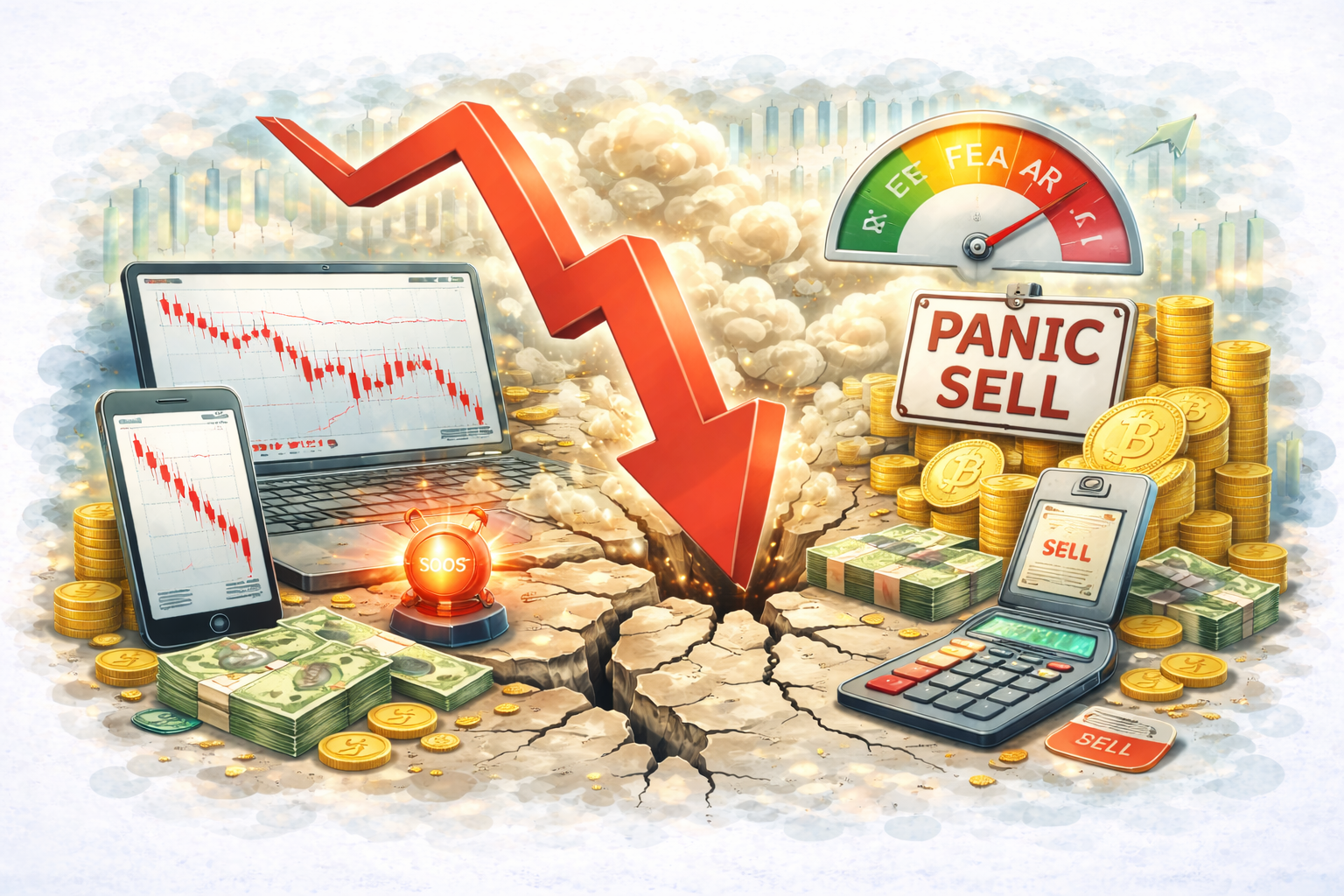
Capitulation is one of the most significant events in any financial market cycle, and in cryptocurrency markets its effects are particularly pronounced. It describes the point at which holders who have resisted selling throughout a prolonged price decline finally abandon their positions, generating a concentrated surge of sell-side pressure. The resulting volume spike and price collapse often marks the exhaustion of a downtrend — a moment that, in retrospect, frequently aligns with a market's historical bottom.
This article examines what capitulation means in crypto and traditional finance, how technical analysis is used to identify it, and what on-chain and market signals traders observe to distinguish genuine bottoms from temporary relief rallies.
Key Takeaways
-
Capitulation occurs when the final group of holders in a declining market surrenders their positions, producing a sharp, high-volume price drop that often marks a cycle bottom.
-
The psychological driver of capitulation is the shift from hope to despair — a point at which further holding appears irrational to the majority of remaining participants.
-
Technical indicators such as volume spikes, RSI extremes, and long lower wicks on candlestick charts are used to identify potential capitulation events in real time.
-
On-chain metrics including the MVRV ratio, realized loss data, and exchange inflow spikes provide additional evidence that a capitulation event is underway or has concluded.
-
Capitulation events are only confirmed in hindsight — identifying a true bottom while it is forming carries significant uncertainty.
-
Historical crypto bear markets have produced identifiable capitulation events, but the duration and recovery timeline following each event has varied considerably.
What Is Capitulation?
Capitulation, in financial markets, refers to the point at which investors or traders who have held a depreciating asset through a sustained decline finally sell — typically at or near the lowest prices of the cycle. The term is borrowed from military terminology, where it describes the act of surrendering after prolonged resistance. In markets, it captures the same psychological dynamic: a threshold is crossed at which continued holding feels untenable, and selling becomes the dominant response regardless of the realized loss.
In cryptocurrency markets, capitulation events are amplified by several structural characteristics. Crypto markets operate continuously without trading halts, meaning panic selling can persist across time zones without interruption. Leverage is widely used, so forced liquidations from margin positions add mechanical selling pressure on top of voluntary exits. The participant base includes a high proportion of retail holders who entered during prior bull phases and may lack the experience or financial resilience to hold through severe drawdowns.
The result is that crypto capitulations tend to be rapid and extreme — producing price declines of 30% to 60% or more within days or weeks, accompanied by trading volume far above average. These events are emotionally intense for participants but structurally important: the exhaustion of sellers is what creates the conditions for a price floor to form.
Understanding Capitulation
When Investors Bail Out
Capitulation does not happen at the first sign of a declining market. It occurs after a sustained downtrend has already eroded the confidence of most participants. Early in a bear market, many holders rationalize continued holding — expecting a recovery, averaging down, or refusing to realize losses. This behavior slows the decline and creates periodic relief rallies that reset expectations without establishing a genuine bottom.
As the bear market extends, the pool of committed holders shrinks. Those with the weakest conviction or the highest cost basis exit first. By the time capitulation arrives, the remaining sellers are those who held longest — often the most resilient participants — and their final exit creates the concentrated supply event that drives the terminal drop. After this cohort has sold, the supply available at distressed prices is largely exhausted.
The Psychology Behind the Final Flush
The psychological state that triggers capitulation is not simply fear — it is the replacement of hope with resignation. Throughout a bear market, most holders maintain some expectation that prices will recover. Capitulation occurs when that expectation collapses. News events, a breach of a major support level, or an external macro shock can serve as the trigger, causing a rapid reassessment of future prospects across a large number of participants simultaneously.
This shared psychological shift is why capitulation produces such distinctive market signatures: the combination of extreme volume, rapid price movement, and a subsequent stabilization that reflects the temporary absence of sellers willing to exit at lower prices. Traders on KuCoin observing such conditions in real time must weigh these signals carefully, as the intensity of a move alone does not confirm a bottom.
Using Technical Analysis to Identify Capitulation
Technical analysis offers several tools for recognizing capitulation patterns on price charts. None of these signals is definitive in isolation, but their convergence strengthens the case that a selling climax has occurred.
The most commonly referenced technical signatures of capitulation include:
-
Volume climax — A single session or short sequence of sessions with trading volume significantly above the historical average (often 3x to 5x normal). This represents the concentrated exit of a large number of participants in a compressed timeframe.
-
Long lower wicks — Candlestick patterns showing a sharp intraday low followed by a recovery close. The long wick indicates that sellers drove price to an extreme low but buyers absorbed the supply and pushed price back toward the session's midpoint or higher.
-
RSI at extreme oversold levels — The Relative Strength Index reading below 20 on daily or weekly charts, particularly when accompanied by divergence (price making a lower low while RSI makes a higher low), suggests momentum exhaustion.
-
MACD histogram reversal — A shift from expanding negative histogram bars to contracting ones signals slowing downward momentum at potential bottoms.
-
Bollinger Band breach and mean reversion — Price extending far below the lower Bollinger Band and then returning inside the band is associated with volatility spikes that accompany selling climaxes.
-
High-timeframe support test — A spike to a major long-term support level — such as a prior cycle high, a multi-year moving average, or a key Fibonacci retracement — followed by a rapid recovery above that level.
Traders monitoring real-time market data across crypto pairs can observe these patterns as they form, though confirmation typically requires waiting for a close above the recovery level to reduce the risk of acting on a false signal.
Example of Capitulation
Crypto market history contains multiple events that display the technical and behavioral characteristics of capitulation, each arising from different triggering circumstances.
In November 2018, Bitcoin's price broke below the $6,000 level that had served as a floor for most of that year. The subsequent decline, which carried the price to below $3,200 by December 2018, was accompanied by multi-year high trading volumes and RSI readings at extreme oversold territory. The December 2018 low proved to be the cycle bottom, and the price did not revisit those levels in the following market cycle.
In March 2020, a broad risk-off event across global markets caused Bitcoin to fall approximately 50% within 48 hours, briefly touching levels near $3,800 before sharply reversing. The extreme volume and speed of the recovery — combined with the failure to establish new lows — was subsequently interpreted as a capitulation event.
In November 2022, a sequence of events in the crypto industry triggered a sharp decline across major assets. Bitcoin's price declined to approximately $15,500, a level that represented the lowest point of that bear cycle. The selling was characterized by high exchange inflows, elevated realized losses in on-chain data, and a sharp spike in trading volume — all consistent with the patterns associated with capitulation. Each of these events looked uncertain and potentially transient as it unfolded; their identification as capitulation events was only confirmed over the weeks and months that followed.
How Do Traders Identify Capitulation?
Identifying capitulation requires combining price-based technical signals with on-chain data and market sentiment indicators. Each layer addresses a different dimension of the event.
On-Chain Indicators
On-chain metrics provide insight into holder behavior that is not visible in price and volume data alone:
-
MVRV ratio below 1.0 — When Ethereum's or Bitcoin's market capitalization falls below the realized capitalization (the aggregate cost basis of all supply), it indicates that the average holder is at an unrealized loss. Historically, extended periods below MVRV 1.0 have coincided with capitulation zones.
-
Realized loss spikes — Sharp increases in the volume of coins moved on-chain at a loss indicate that long-term holders are selling below their cost basis — a behavioral marker of capitulation.
-
Exchange inflow surges — A sudden increase in assets moving from self-custody wallets to exchange addresses suggests that holders are preparing to sell, consistent with the early stages of a capitulation event.
-
Funding rates turning sharply negative — In perpetual futures markets, deeply negative funding rates indicate that short sellers are dominant and are paying a premium to maintain positions, often at extremes that coincide with price bottoms.
Sentiment Indicators
Market sentiment surveys and the Fear & Greed Index — a composite measure of market sentiment derived from volatility, volume, social media activity, and dominance data — reaching "extreme fear" territory is frequently observed at or near capitulation events. This does not confirm a bottom but indicates that sentiment-based pessimism has reached a historical extreme.
Educational resources on reading these layered signals are available through the KuCoin blog, where in-depth market analysis articles address on-chain data interpretation and technical analysis frameworks.
How Long Does Capitulation Last?
Capitulation itself — the acute selling event — typically unfolds over a period of days to a few weeks. The initial flush can be compressed into hours or a single trading session, as in the March 2020 event, or it can extend across a sequence of declining sessions before the terminal low is established.
The more relevant question for most participants is how long the post-capitulation base-building phase lasts. After the primary sellers have exited, markets typically enter a period of low volatility and reduced volume — sometimes called an accumulation range — where price consolidates without clear directional conviction. This phase can last from weeks to many months before a sustained trend reversal takes hold.
In Bitcoin's historical cycles, the gap between the capitulation low and the beginning of a sustained recovery has ranged from a few weeks (as in March 2020) to over a year (as in the 2018–2019 bear market). There is no fixed duration, and the timeline depends on the underlying conditions that triggered the bear market, the pace of structural improvements in the market, and the broader macroeconomic environment.
Is Capitulation Good or Bad?
Capitulation is a neutral market event in structural terms — it is neither inherently good nor bad. Its character depends entirely on the position a participant holds when it occurs.
For those who held through the bear market and sell during the capitulation, the event represents the realization of maximum losses. Their exit at the cycle's lowest prices is the defining feature of capitulation from a participant's perspective.
For those who were in cash or had avoided the prior decline, capitulation events have historically represented periods where assets became available at prices far below their prior cycle highs. Whether those prices ultimately prove advantageous depends on subsequent market behavior, which is not knowable at the time of the event.
For the market as a whole, capitulation serves a structural function: it clears the supply overhang created by holders who acquired positions at higher prices. Once this supply has been absorbed or exited, the remaining holder base is typically composed of participants with lower cost bases or higher conviction — conditions that are often associated with a more stable price floor. Traders who want to stay informed on any developing market events or platform-level responses to volatile conditions can monitor KuCoin announcements for relevant updates.
Conclusion
Capitulation describes the terminal phase of a market decline, in which the final cohort of holders under sustained selling pressure exits their positions, generating the supply exhaustion that often precedes a market bottom. In cryptocurrency markets, capitulation events are identifiable through a combination of extreme volume, RSI and MVRV readings at historical lows, on-chain realized loss spikes, and exchange inflow surges. While these signals converge to suggest that a selling climax is occurring or has occurred, they cannot confirm a bottom in real time — capitulation events are only fully recognizable in hindsight. Understanding the mechanics and historical patterns of capitulation supports more informed interpretation of bear market price action.
Create your free KuCoin account today to access over 700+ global crypto assets and the latest gems. Sign Up Now!
FAQs
What is capitulation in crypto markets?
Capitulation in crypto refers to the point in a bear market when holders who resisted selling finally exit their positions, creating a concentrated surge of sell-side pressure. The resulting volume spike and sharp price decline often mark the exhaustion of a downtrend, historically coinciding with the lowest prices of a market cycle.
How do traders identify a capitulation event?
Traders identify capitulation through a combination of technical signals — including high-volume sell sessions, long lower wicks on candlestick charts, and extreme RSI readings — and on-chain data such as MVRV ratios below 1.0, realized loss spikes, and sharp increases in exchange inflows. Confirmation typically comes only after the event, when prices stabilize and recover.
How long does a capitulation event last in crypto?
The acute capitulation phase — the concentrated sell event — typically unfolds over hours to a few weeks. The subsequent base-building or accumulation period, during which price consolidates before a directional recovery, has historically ranged from weeks to over a year in major Bitcoin bear market cycles.
Is capitulation the same as a market crash?
Not exactly. A market crash describes a rapid, severe decline in price, often triggered by an external event. Capitulation is a specific behavioral event within a bear market — the final surrender of holders — that may or may not coincide with an external shock. Crashes can trigger capitulation, but capitulation can also occur without a single identifiable crash event.
Can capitulation happen more than once in a single bear market?
Yes. Extended bear markets can produce multiple capitulation-like events at different price levels, as successive groups of holders reach their tolerance thresholds and exit. These events are sometimes called "capitulation waves." Only the final one, which produces the cycle's lowest prices, is retrospectively identified as the primary capitulation event.
What on-chain metrics are most useful for detecting capitulation?
The most widely referenced on-chain capitulation signals include the MVRV ratio falling below 1.0, a sharp spike in realized losses (coins moved on-chain at prices below their acquisition cost), a surge in exchange inflows from self-custody wallets, and deeply negative perpetual futures funding rates. These metrics are examined in combination rather than individually.
Further reading
Disclaimer: The information on this page may have been obtained from third parties and does not necessarily reflect the views or opinions of KuCoin. This content is provided for general informational purposes only, without any representation or warranty of any kind, nor shall it be construed as financial or investment advice. KuCoin shall not be liable for any errors or omissions, or for any outcomes resulting from the use of this information. Investments in digital assets can be risky. Please carefully evaluate the risks of a product and your risk tolerance based on your own financial circumstances. For more information, please refer to our Terms of Use and Risk Disclosure.