

Kalshi Surpasses Polymarket in Global Trading Volume with $22B Valuation - What Does It Mean?
Introduction
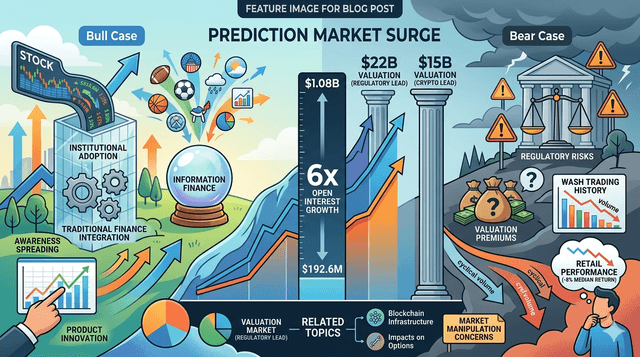
In March 2026, the prediction market industry reached a milestone that would have seemed absurd just three years ago: a $22 billion valuation for the dominant platform. The gap between Kalshi's $22 billion and Polymarket's $15 billion represents roughly $7 billion a staggering figure for what was once dismissed as a niche crypto experiment. This valuation gap reflects a dramatic reversal: Polymarket once led by a similar margin before regulatory compliers caught up.
Annual trading volume climbed from $15.8 billion in 2024 to approximately $63.5 billion in 2025. But volume alone does not tell the full story. Open interest across prediction markets has surged 6x year-over-year, from $192.6 million to $1.08 billion actual capital at stake, not just transactional churn.
This article examines the valuation dynamics driving the prediction market boom, provides a bull case for why prediction markets could become a mainstream asset class, and presents a bear case for why the hype may exceed fundamentals. Understanding the investment thesis rather than just trading mechanics is essential for anyone considering exposure.
For traders seeking deeper context, this article connects to related topics:
-
Blockchain Infrastructure for prediction markets enables the technical foundation;
-
Impacts of prediction markets on options explain how prediction markets compare to traditional derivatives
The Valuation Dynamics: Why $22 Billion Matters
From Niche to Mainframe: The Valuation Arc
The $22 billion valuation represents more than just money. It signals institutional confidence in a previously marginalized industry. When Polymarket was the undisputed leader, the gap in its favor was similar in magnitude. The reversal reflects how quickly regulatory compliance can shift competitive dynamics.
Kalshi's valuation doubling from $11 billion to $22 billion in months reflects several factors. First, the $1 billion funding round provided capital for expansion. Second, regulatory clarity from the CFTC's March 2026 determination that prediction markets are derivatives. It creates a legally compliant pathway. Third, institutional adoption. Over $100 billion in annualized trading volume demonstrated sustainable demand.
The valuation multiple is notable. At $22 billion with $238 billion in 2025 trading volume, the price-to-sales ratio exceeds 90x. For comparison, traditional exchanges trade at 5-15x revenue. This premium reflects growth expectations. And scrutiny.
What the Open Interest Tells Us
The 6x year-over-year growth in open interest from $192.6 million to $1.08 billion provides crucial context beyond transaction volumes. Open interest represents actual positions held to maturity, not just trading activity. Higher open interest means more capital is committed to outcomes over longer time horizons.
This matters for the investment thesis. Transaction volume can be inflated by wash trading or arbitrage. Open interest represents genuine economic exposure. The growth from under $200 million to over $1 billion in a single year demonstrates that users are building meaningful positions, not just speculating ephemerally.
The $7 Billion Gap Explained
The approximately $7 billion valuation gap between the two platforms reflects more than just volume differences. Several factors contribute:
Regulatory compliance carries a premium. Kalshi's CFTC-approved status means institutional capital can flow without regulatory risk. This creates access to capital that decentralized alternatives cannot touch.
Product breadth matters. Kalshi has expanded beyond political markets into sports, economic indicators, and corporate events. Each new category represents revenue expansion.
Operational reliability creates enterprise value. Banks and institutions prioritize operational resilience over ideological commitments. Kalshi's infrastructure reflects this priority.
Platform Comparison Overview
|
Metric
|
Kalshi
|
Polymarket
|
|
Valuation
|
$22 billion
|
~$15 billion
|
|
2025 Trading Volume
|
$238 billion
|
$220 billion
|
|
Market Share
|
52.6%
|
~47%
|
|
Regulation
|
CFTC-approved
|
No KYC
|
|
Annualized Volume
|
$100 billion+
|
~$80 billion
|
This comparison illustrates how regulatory compliance translates to valuations. Institutional access commands a premium that shows up in the multiple gap.
Bull Case: Why Prediction Markets Could Go Mainstream
The Information Finance Revolution
The convergence of prediction markets with traditional finance represents what some call "information finance" the monetization of knowledge through market mechanisms. Unlike traditional analysis that relies on polling or expert opinion, prediction markets aggregate dispersed information through price discovery.
This information aggregation has proven valuable. When Polymarket's Ethereum wallet correctly predicted the Trump assassination attempt survival before polls indicated any signal, it demonstrated information value that traditional methods could not match. The market knew something the polls missed.
The investment thesis extends beyond individual platforms. The entire information finance category could grow as awareness spreads. With only a fraction of retail traders aware of prediction markets, the addressable market remains large.
Institutional Adoption Accelerating
The $100 billion in annualized trading volume reflects genuine institutional participation. This is not retail churn. It represents capital allocations from entities with sophisticated risk management.
The entry of major exchanges like Cboe launching prediction market products validates the category. When traditional infrastructure providers allocate resources to a market, they signal confidence in long-term viability.
Coinbase, Robinhood, and other mainstream crypto platforms have added prediction market access or related products. This distribution network reaches users who would never seek out specialized platforms.
New Product Innovation Expanding Markets
Perpetual futures represent the latest innovation. Unlike traditional prediction markets that settle at event resolution, perpetuals allow continuous trading and position management. This innovation addresses one of the key limitations of binary outcomes: exit timing. Traders no longer need to wait for events to conclude to exit positions.
The expansion from political prediction into sports, weather, economic data, and corporate events broadens the addressable market. Every news event becomes a potential trading opportunity. The TAM expansion is significant. With over 4,000 active sports markets on Polymarket alone, the breadth of tradable events exceeds traditional sportsbooks.
Crypto-native product innovation drives continued growth. The introduction of cross-chain bridges enables broader token access. Mobile apps and simplified interfaces reduce onboarding friction. These innovations collectively expand the addressable user base beyond crypto-native early adopters.
The growth trajectory suggests continued expansion. Institutional infrastructure developmentcustodial solutions, regulatory compliance tooling, and institutional-grade analyticsenables deeper institutional participation. This infrastructure builds once and supports future growth.
The Technology Infrastructure Advantage
Blockchain infrastructure provides unique advantages over traditional prediction platforms. Smart contracts automate settlement, eliminating counterparty risk. When users place bets, the wager locks in a smart contract that automatically executes payouts based on predetermined conditions.
The technical architecture varies by platform. Polymarket uses a hybrid model, with trade execution on Polygon while maintaining Ethereum mainnet for final settlement. This approach achieves transaction costs below $0.01 per trade while preserving blockchain security guarantees.
Oracle systems represent critical infrastructure. Accurate outcome verification determines whether markets have value. Polymarket uses designated reporters for routine verification while reserving decentralized arbitration for contested outcomes.
Bear Case: Why Caution Is Warranted
Valuation Premiums Exceed Fundamentals
The 90x price-to-sales multiple exceeds even the most aggressive tech growth stocks. At $22 billion valuation with $238 billion in volume, the math requires continued exponential growth to justify the multiple.
Traditional exchanges like Cboe trade at 5-15x revenue with similar volumes. The prediction market premium assumes growth continues indefinitely. But volume can be cyclical. Political events drive disproportionate volume, and non-election years may see significant declines.
The Polymarket wash trading controversy demonstrated volume vulnerability. Research found that wash trading may have accounted for around 60% of all Polymarket trading in December 2024, before subsiding to around 5% by May 2025. This history creates uncertainty about underlying organic demand.
Regulatory Risk Remains Significant
Despite CFTC clarity, regulatory risk persists. The determination that prediction markets are derivatives brings insider trading laws and market manipulation regulations that previously did not apply. Compliance costs will increase.
The decentralized model faces existential risk. If regulators tighten requirements on crypto prediction platforms, Polymarket's competitive advantagesZero KYC and global accessibility could become liabilities.
State-level regulations vary significantly. Some jurisdictions have explicitly banned prediction markets, creating geographic fragmentation.
Market Manipulation Concerns Are Real
The insider trading concerns prompted action from both platforms. In March 2026, both publicly outlined new measures to curb insider trading, emphasizing restrictions on trading by individuals with nonpublic information.
The nature of prediction markets creates manipulation incentives. Unlike stocks where manipulation requires significant capital, prediction markets on niche topics can be moved by smaller positions. The incentive to trade on insider information is inherent in the structure.
Academic research has documented instances where prediction market prices moved suspiciously before public announcement. This history suggests ongoing integrity challenges.
Retail Performance Remains Poor
The median retail return of -8% since mid-2025 raises fundamental questions about value creation. Retail traders are losing money consistently, suggesting prediction markets may not serve their interests well.
The comparison to traditional sports betting (-5% median return) is not encouraging. Both groups lose, but prediction market participants lose more. This suggests the "simpler" mechanics do not translate to better outcomes.
Information advantages concentrate among sophisticated traders. Retail participants compete against professional information gatherers with better data, analysis, and risk management.
Conclusion
The $22 billion valuation represents a watershed moment for prediction markets, but whether it signals sustainable growth or speculative excess remains unclear. The bull case rests on information finance becoming a mainstream asset class with institutional adoption accelerating. The bear case highlights valuation premiums, regulatory risks, and persistent retail underperformance.
The 6x growth in open interest to $1.08 billion demonstrates genuine capital commitment beyond transactional volume. Yet the retail median return of -8% raises questions about value distribution. The wash trading history creates uncertainty about underlying demand.
The competitive dynamics continue evolving. Kalshi's regulatory compliance provides access that drives institutional volume. Polymarket's decentralized model serves users excluded from regulated platforms. Both models have merit.
For traders, understanding both cases is essential. The prediction market category will likely continue growing, but whether current valuations reflect fundamentals or hype determines appropriate exposure levels.
FAQs
Q: Why is Kalshi valued higher than Polymarket?
A: Several factors contribute to the $7 billion valuation gap. First, regulatory compliance enables institutional access and removes legal uncertainty. Second, CFTC-approved status creates a legally defensible business model. Third, operational reliability attracts enterprise and institutional capital. Fourth, product expansion into sports and economic markets broadens revenue.
Q: What does the 6x open interest growth mean?
A: The growth from $192.6 million to $1.08 billion in open interest represents genuine capital commitment to predicting market outcomes. Unlike transaction volume, which can include wash trading, open interest shows actual positions held to resolution. This growth indicates increasing sophistication and longer time horizons.
Q: Are prediction markets a good investment for retail traders?
A: The median retail return of -8% since mid-2025 suggests caution is warranted. While platforms may succeed, trading individual markets requires information advantages. The structure concentrates benefits among sophisticated information gatherers.
Q: What regulatory risks exist?
A: Despite CFTC classification as derivatives, regulatory risk persists. The March 2026 determination brings insider trading and market manipulation laws. Decentralized platforms face uncertain status. State-level regulations vary significantly.
Q: How do prediction markets compare to traditional betting?
A: Prediction markets operate as exchange users trade against each other versus traditional sportsbooks that take the opposite position. This creates different incentive structures. Both show retail losing money (-8% prediction vs -5% sports), but prediction markets lose more.