

Can You Mine XRP? The Essential Guide to the XRP Ledger in 2026
2026/03/24 15:45:02
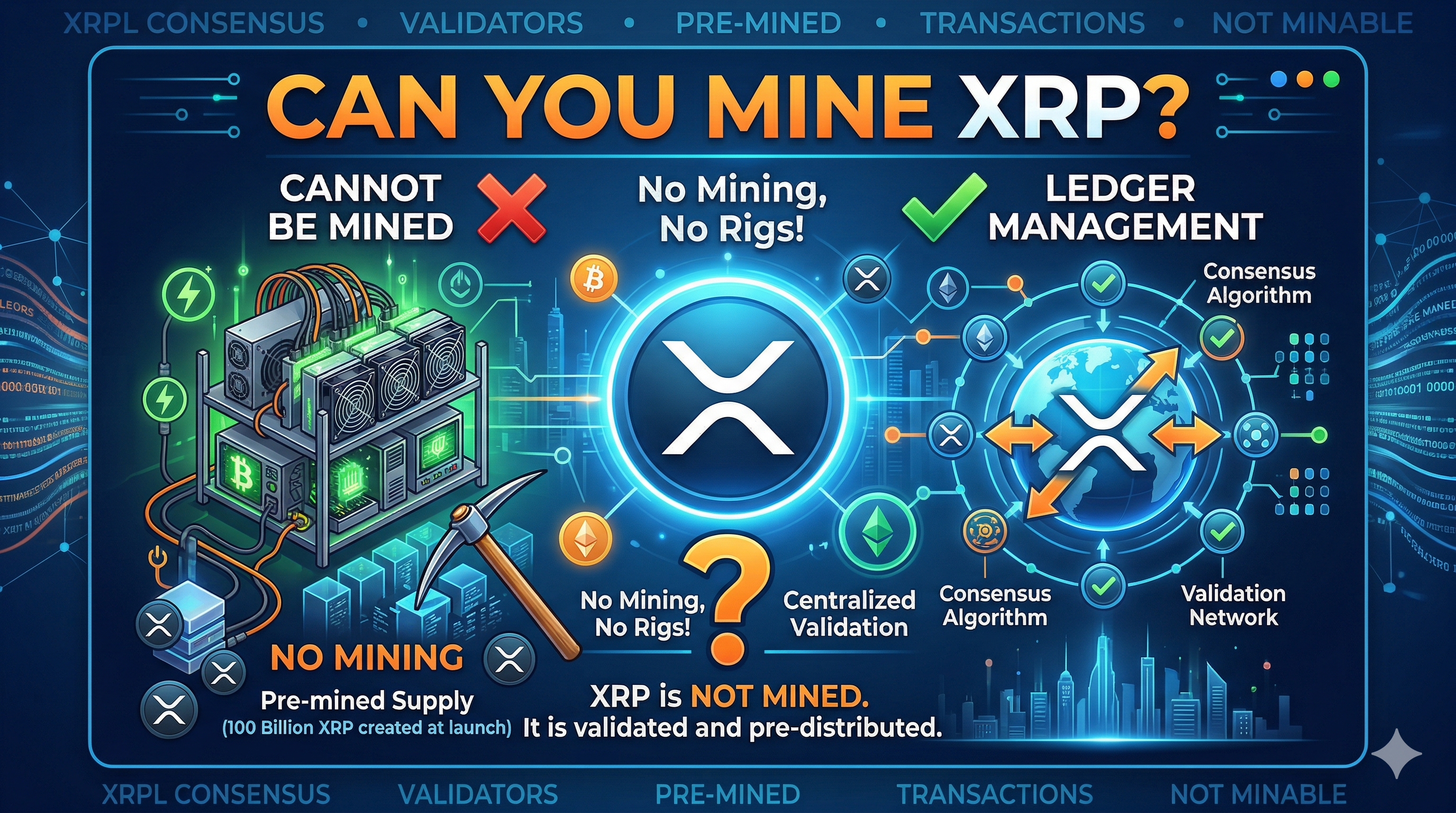
In the rapidly evolving world of digital assets, the quest for "mining" remains a cornerstone for many crypto enthusiasts. Just as Bitcoin grew into a global phenomenon through the efforts of decentralized miners securing the network with specialized hardware, new investors often arrive at the XRP ecosystem with a single question: Can you mine XRP? However, the architectural reality of the XRP Ledger (XRPL) is fundamentally different from the Proof-of-Work (PoW) systems that define Bitcoin or the early days of Ethereum.
As we navigate through 2026, where environmental sustainability and institutional efficiency are the primary drivers of blockchain adoption, understanding why the answer to "can you mine XRP" is a definitive "no" becomes crucial for any informed participant. Unlike assets that rely on the expenditure of electricity to mint new coins, XRP was designed from its inception to be a high-speed, low-cost utility for global value transfer.
This article explores the technical foundations of the XRPL, the consensus mechanism that replaces traditional mining, and the legitimate ways you can participate in the ecosystem today.
Key Takeaways
-
XRP is Not Mineable: Unlike Bitcoin, the entire supply of 100 billion XRP was created (pre-mined) at the ledger's launch in 2012. There is no mathematical puzzle to solve and no block rewards for participants.
-
Consensus Over Mining: The XRP Ledger uses the Federated Consensus mechanism rather than Proof-of-Work. This allows for transaction finality in 3–5 seconds with virtually zero energy consumption.
-
Managed Supply via Escrow: To ensure market stability, Ripple (the largest holder of XRP) utilizes a cryptographically secured escrow system to release a set amount of XRP into the market monthly.
-
Earning vs. Mining: While you cannot mine XRP, you can earn it through decentralized finance (DeFi) activities on the XRPL, such as providing liquidity to Automated Market Makers (AMMs) or via institutional lending.
-
Regulatory Clarity: Following the 2026 Clarity Act and the resolution of long-standing legal battles, XRP is recognized as a digital commodity in the U.S., paving the way for institutional ETFs and broader adoption.
Why XRP Cannot Be Mined: The Pre-Mined Architecture
To understand why "mining" is an inapplicable term for XRP, one must look at the birth of the XRP Ledger. In traditional mining ecosystems like Bitcoin, coins enter circulation as a reward for miners who use computational power to validate transactions. This process is essentially a continuous "minting" event. XRP took a diametrically opposite approach.
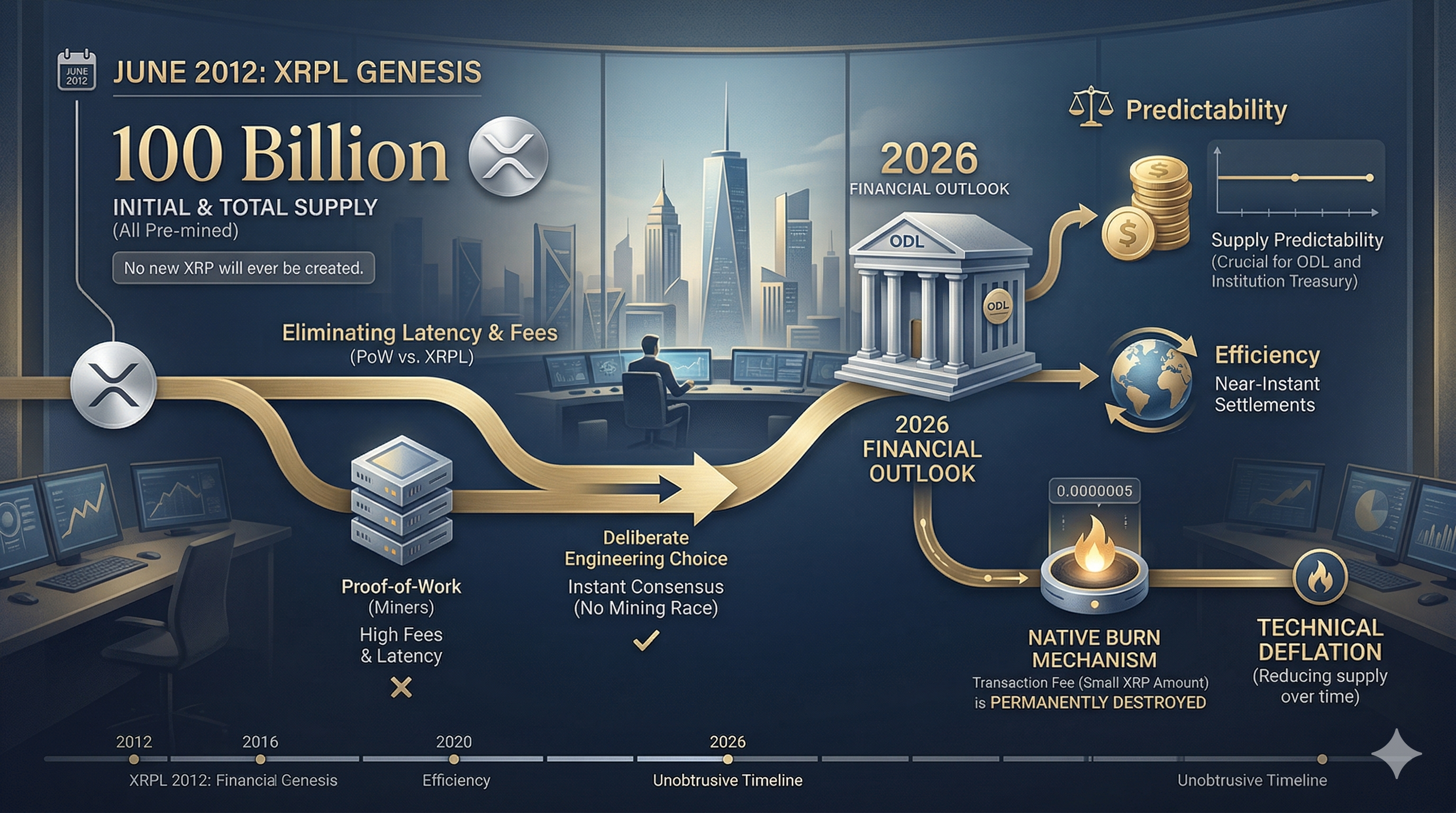
When the XRP Ledger was launched in June 2012 by Arthur Britto, David Schwartz, and Jed McCaleb, 100 billion XRP tokens were generated all at once. No more can ever be created. This "pre-mined" status was a deliberate engineering choice to facilitate near-instantaneous settlement. By removing the need for a competitive mining race, the network avoids the latency and high fees often associated with congested Proof-of-Work chains.
In the 2026 financial landscape, this fixed supply is a key feature. Because there is no mining difficulty to adjust and no halving events to wait for, the supply of XRP is highly predictable. For global banks and payment providers using the On-Demand Liquidity (ODL) service, this predictability is essential for managing treasury operations and cross-border settlements without the erratic supply shocks seen in mineable assets. Furthermore, the ledger's native burn mechanism—where a small amount of XRP is destroyed with every transaction, makes the asset technically deflationary over time.
How the XRP Ledger Reaches Consensus Without Miners
If there are no miners to verify transactions, how does the network remain secure? The answer lies in the Ripple Protocol Consensus Algorithm (RPCA). Instead of the "longest chain" rule enforced by hash power, the XRPL relies on a network of independent Validators.
Validators are servers that run the XRPL software and participate in the consensus process. These entities do not "compete" for rewards. Instead, they work together to reach an agreement on which transactions are valid and in what order they should be recorded. Every few seconds, validators compare their versions of the transaction set; once a supermajority (usually 80% or more) agrees, the ledger is "closed," and the transactions are finalized.
As of 2026, the network operates with over 150 independent validators globally. This structure is known as Federated Consensus. It is inherently more efficient because it doesn't require "wasteful" computation. In the current environmental climate, where carbon taxes and "green" mandates are standard in the financial sector, the XRPL's consensus model has gained significant traction. A single XRP transaction uses a negligible amount of energy—roughly equivalent to a single Google search—compared to the massive electrical footprint of mining a single Bitcoin block.
The Role of Escrow: How New XRP Enters the Market
Since the total supply of XRP is fixed at 100 billion, you might wonder how the circulating supply increases. The answer lies in Ripple’s use of a cryptographically secured Escrow system. To provide transparency and prevent a sudden market flood, Ripple locked 55 billion of its XRP holdings into a series of monthly escrows in 2017.
Every month, 1 billion XRP is released from escrow. Ripple typically uses a portion of this to support its operations, incentivize ecosystem development, and provide liquidity to institutional partners. In practice, historical data from early 2026 shows that Ripple often re-locks between 600 million and 800 million of these tokens into new escrows, effectively limiting the actual amount that enters the market to approximately 200–400 million XRP per month.
This mechanism serves as the functional equivalent of "scheduled issuance" in a mining-based coin. It allows the market to price in the supply influx years in advance. In the current 2026 market, as exchange-held XRP balances hit seven-year lows due to the rise of XRP ETFs, the escrow schedule remains a critical point of interest for traders looking to understand long-term supply-demand dynamics.
Can You Mine XRP Indirectly? Avoiding the "Cloud Mining" Trap
A common search result for "how to mine XRP" often leads to various websites and apps claiming to offer XRP mining software. It is vital to be extremely cautious: strictly speaking, these platforms are not mining XRP.
Most legitimate "indirect mining" services operate by using your computer’s hardware to mine a different, mineable cryptocurrency—usually Monero (XMR) or Ethereum Classic (ETC)—and then automatically exchanging those rewards for XRP on your behalf. While this can be a way to acquire XRP using your GPU or CPU, it is technically "mining-for-XRP" rather than mining the native token of the XRPL.
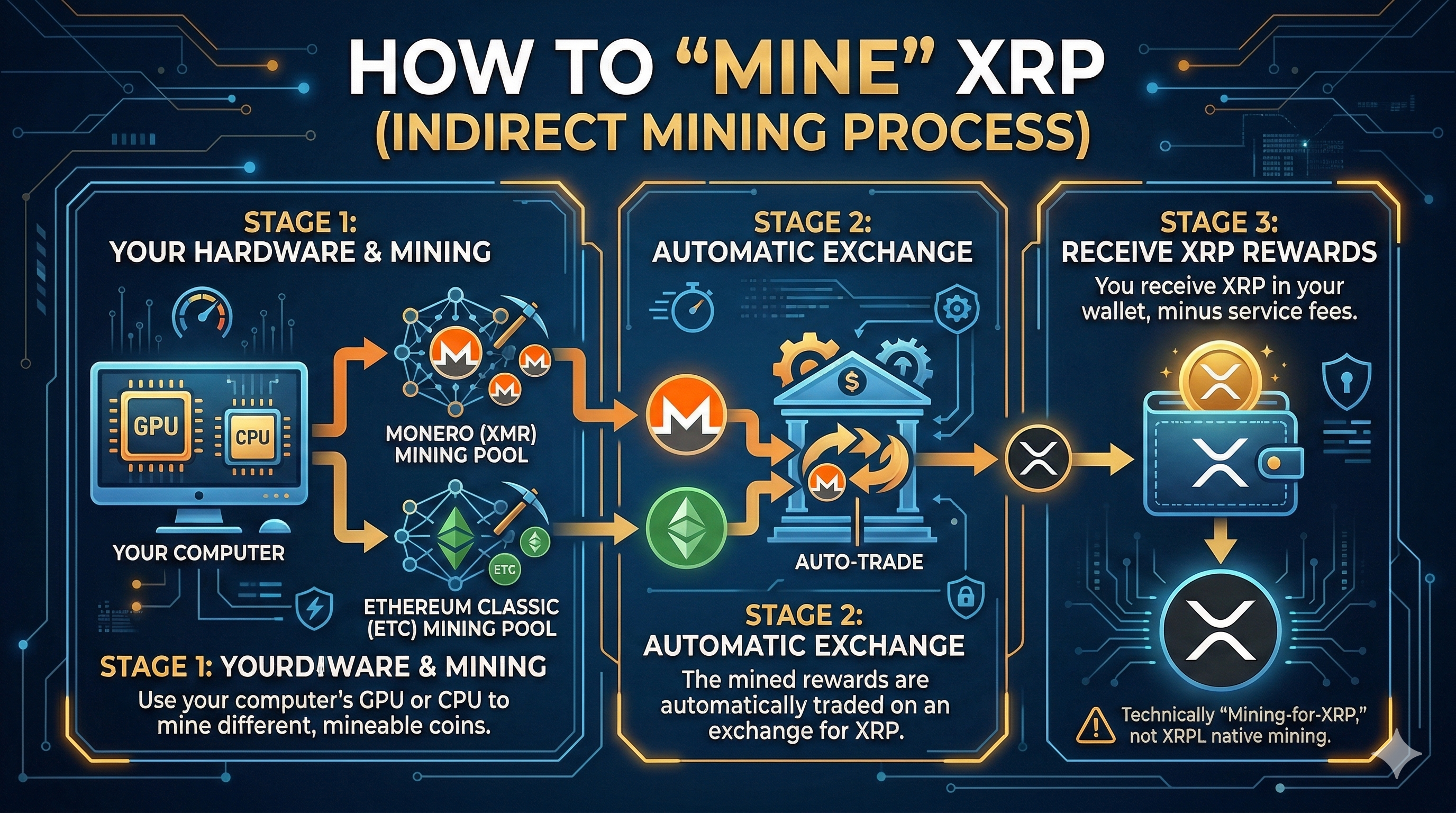
However, the 2026 market is also rife with fraudulent "cloud mining" schemes. These platforms often promise guaranteed daily returns if you "rent" their XRP mining rigs. Given that the XRPL does not support mining at the protocol level, any service claiming to have "XRP mining hardware" is a scam. Legitimate acquisition always happens through reputable exchanges, through contributing to the network's liquidity pools, or via participating in the growing XRPL DeFi ecosystem.
Risks and Scams: Avoiding Fake XRP Miners
The popularity of XRP combined with the general lack of technical knowledge regarding its consensus mechanism has created a breeding ground for "Mining Scams." Every year, thousands of investors lose their XRP to platforms promising "unrealistic cloud mining returns."
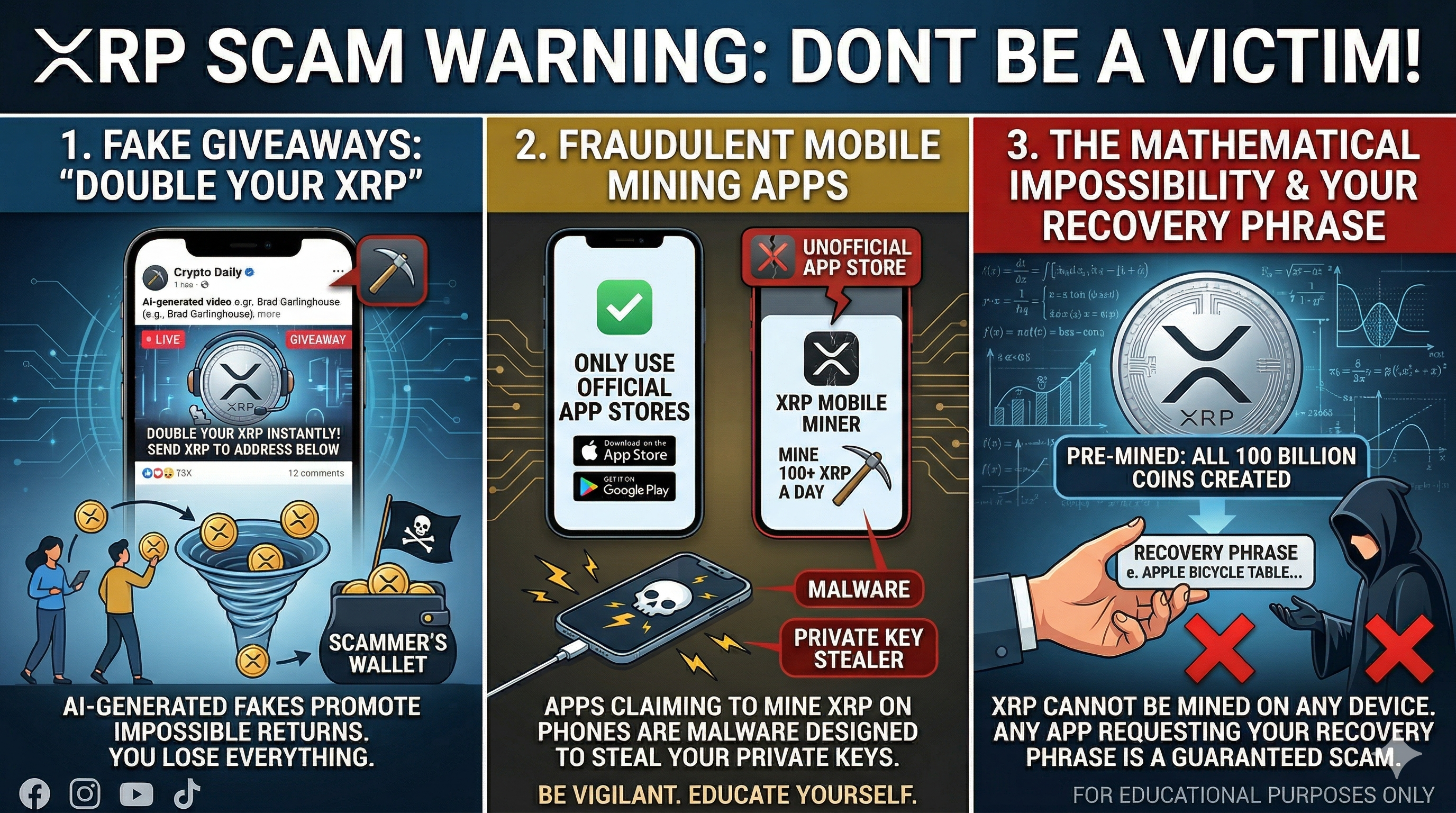
The most common scam is the "Double Your XRP" giveaway. These often appear as live streams on social media featuring AI-generated versions of Ripple's leadership. They claim that if you send 1,000 XRP to a "mining pool address," they will send 2,000 XRP back. This is a classic "advance-fee" fraud. Once you send your XRP, it is gone forever.
Another prevalent threat is the "Mobile Miner" app found on unofficial app stores. These apps claim to use your phone's processor to mine XRP. In reality, these apps are often "Remote Access Trojans" (RATs) or malware designed to steal your private keys or monitor your banking activity. Because XRP is pre-mined, any app claiming to mine it directly on a phone is mathematically impossible and a guaranteed security risk. Always remember: if a platform asks for your 12 or 24-word recovery phrase to "link your miner," they are trying to empty your wallet.
Better Alternatives: How to Earn XRP in 2026
If your goal is to grow your XRP holdings without simply buying them on an exchange, there are several modern alternatives to mining that align with the XRPL’s 2026 features.
Liquidity Provision via AMMs: Following the implementation of the XLS-30d amendment, the XRP Ledger features a native Automated Market Maker (AMM). Users can deposit their XRP and another asset (such as the RLUSD stablecoin) into a liquidity pool. In return, they earn a portion of the trading fees generated by that pool. This is often more profitable and far less hardware-intensive than traditional mining.
Institutional Lending and Yield: With the regulatory clarity provided by the 2026 Clarity Act, many regulated platforms now offer yield on XRP deposits. This is done by lending the XRP to institutional market makers who use it to facilitate On-Demand Liquidity for cross-border payments. Unlike the high-risk lending of the past, these 2026 programs are often backed by strict collateral requirements.
The Dual-Asset Strategy with RLUSD: In 2025, Ripple officially launched RLUSD, a regulated, USD-backed stablecoin. On the XRPL, users can swap between XRP and RLUSD instantly. While RLUSD provides a stable $1.00 value for settlement, holding XRP allows you to benefit from the network's growth and participate in "liquidity farming" where you earn rewards for pairing these two assets together.
The Future of Distribution: Institutional ETFs and the 2026 Market
One of the most significant shifts in 2026 is the emergence of XRP Spot ETFs. For the first time, institutional capital can flow into the XRP ecosystem through traditional brokerage accounts. This has fundamentally changed the distribution model of the asset.
While Bitcoin miners used to be the primary sellers in the market, the primary "sellers" for XRP in 2026 are institutional liquidity providers who manage the flow between the XRPL and the traditional financial world. The transition from a retail-driven speculative asset to an institutional-grade digital commodity was solidified by the SEC settlement in August 2025 and the subsequent passage of the Clarity Act.
Furthermore, the launch of an EVM-compatible sidechain in 2025 has expanded the XRPL’s reach. Developers can now build Solidity-based decentralized applications (dApps) that use XRP for gas fees, creating new demand sinks for the token. This evolution ensures that even without mining, the XRP token remains central to a thriving, multi-chain financial ecosystem.
Conclusion
The question "Can you mine XRP?" is ultimately a gateway to understanding the shift from first-generation blockchain technology to institutional utility networks. You cannot mine XRP because the network was designed to move beyond the constraints and inefficiencies of Proof-of-Work. By utilizing a Federated Consensus model, the XRP Ledger offers a sustainable, lightning-fast, and cost-effective alternative to the energy-hungry mining rigs of the past.
In 2026, the value of XRP is found not in the "digging" for new coins, but in the liquidity it provides to the global financial system. Whether you are acquiring XRP through a regulated ETF, earning fees as a liquidity provider in a native AMM, or using it as a bridge currency for cross-border remittances, you are participating in a system built for the "Internet of Value." The era of the miner is being replaced by the era of the liquidity provider, and the XRPL remains at the forefront of this transformation.
FAQs
Why doesn't XRP have miners?
XRP was designed to solve the "Double Spend" problem without using energy-intensive mining. By pre-mining the entire supply and using a consensus algorithm among independent validators, the network achieves faster speeds and lower costs than mining-based chains like Bitcoin.
Is running a validator the same as mining?
No. Running a validator helps secure the network, but you do not receive new XRP as a reward. Most organizations run validators to ensure they have a direct, secure, and reliable interface with the ledger for their own institutional operations.
How does the 2026 Clarity Act affect XRP?
The Clarity Act provides a formal legislative framework in the U.S., defining XRP as a non-security digital commodity. This has enabled banks and institutional funds to integrate XRP into their treasury and payment operations without legal risk.
What is the difference between XRP and RLUSD?
XRP is the native cryptocurrency of the XRP Ledger with a floating market price, used for liquidity and network fees. RLUSD is a regulated stablecoin pegged to the U.S. Dollar, designed for institutions that need price stability for settlement.
Can I get XRP by mining other coins?
Yes, some multi-currency mining pools allow you to use your hardware to mine Proof-of-Work coins like Monero and receive your payouts in XRP. However, you are not mining the XRP Ledger itself.
Is the supply of XRP really decreasing?
Yes. The XRP Ledger burns a tiny fraction of XRP for every transaction to prevent network spam. While the amount is small (typically 10 drops or 0.00001 XRP), it makes the total supply of 100 billion slowly deflationary over time.