

Will Crypto Whales Always Win? The Myth of Following Smart Money in 2026
2026/05/19 14:06:02
Introduction
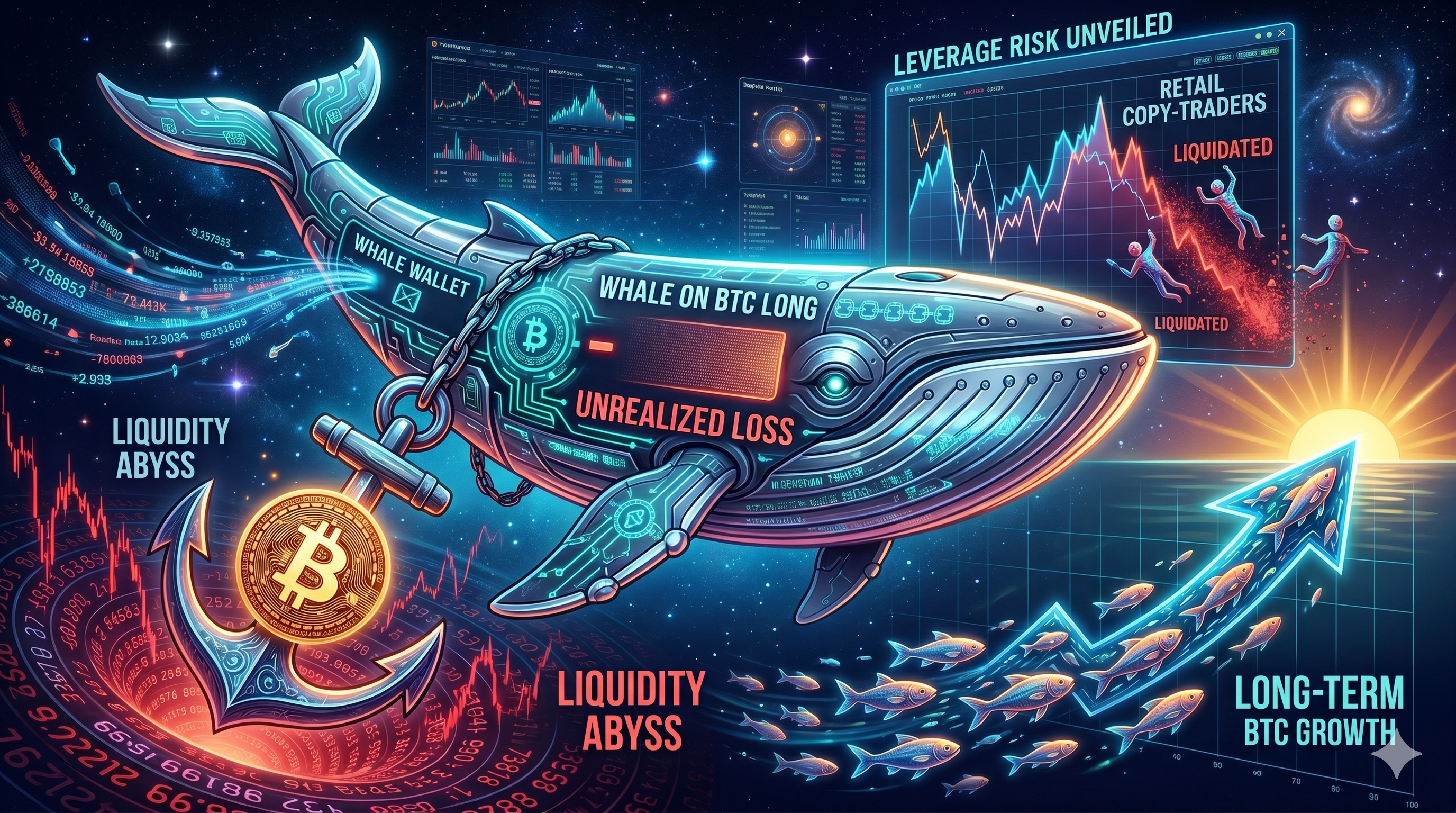
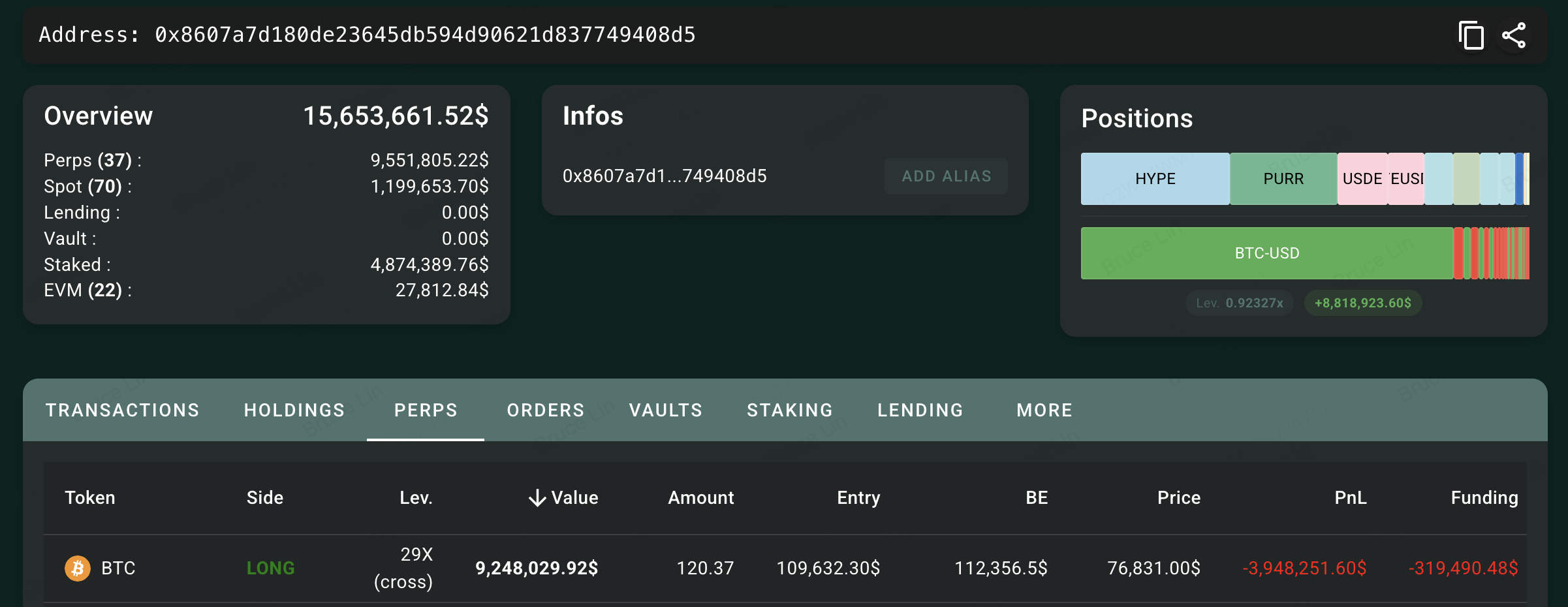
A single Hyperliquid whale is currently sitting on $3.94 million in unrealized losses on a Bitcoin long position — roughly 12 times the original margin committed. The trader entered at $109,632 with 29x leverage and has refused to close for over 220 days. This is not an obscure degen account. It is one of the most-watched "smart money" addresses on the platform.
The short answer to whether crypto whales always win is no — and the assumption that retail traders can copy-trade their way to guaranteed profits is one of the most expensive myths in the market. Whales can move illiquid small-cap tokens, but on deep-liquidity assets like Bitcoin, their size becomes a liability rather than an edge. This article breaks down where whales actually win, where they lose badly, and why a simple Bitcoin HODL strategy continues to outperform most whale-following approaches for retail investors.
What Is a Crypto Whale?
A crypto whale is any wallet or entity holding enough of a given asset to materially influence its price through a single transaction. The exact threshold varies by token — for Bitcoin, addresses holding 1,000 BTC or more are commonly classified as whales, while for a low-cap meme coin, even $500,000 in concentrated holdings can qualify.
Whales fall into several categories that behave very differently:
-
Early holders and OG investors who accumulated at near-zero cost basis
-
Market makers and trading firms running delta-neutral or arbitrage strategies
-
Project insiders and team wallets with token unlocks and vesting cliffs
-
Leveraged speculators like the 0x860 address using high-leverage derivatives
-
Institutional treasuries and ETF custodians holding on behalf of clients
The popular retail narrative collapses all of these into one mythical figure — the omniscient "smart money" trader who always knows what comes next. That figure does not exist.
Do Whales Always Make Money in Crypto?
No — whales lose money frequently, sometimes catastrophically, and the public on-chain ledger means their losses are now visible in real time. The conviction that following a whale guarantees profit ignores three structural realities: leverage cuts both ways, position size limits exit liquidity, and conviction without flexibility turns into trapped capital.
The 0x860 Hyperliquid Case Study
According to Hyperinsight monitoring data as of May 18, 2026, the address 0x860 has become the largest losing BTC long whale on Hyperliquid. The trader entered 220 days ago — on October 11, 2025, immediately after a market crash — bottom-fishing BTC with 29x leverage at an average price of $109,632 on a $13.2 million position.
The trade initially worked. Within 10 days the position showed significant unrealized profit. Then BTC broke below the entry average on October 30, 2025 — and the position has never recovered. The whale has refused to close. Current unrealized losses sit at approximately $3.94 million, roughly 12 times the original margin posted.
This whale is not unsophisticated. The wallet's total capital is estimated in the tens of millions, meaning the effective account-level leverage is only around 1.1x. But that $3.94 million unrealized loss has still eroded approximately 30% of the entire account's capital — on a single trade that retail copy-traders were piling into when the position first went green.
What This Trade Teaches Retail
Following the whale into this trade in October 2025 would have generated 10 days of profit followed by 210 days of mounting losses. Any retail trader using similar leverage without the whale's deep balance sheet would have been liquidated months ago. The whale survives only because of capital depth — an advantage retail does not have.
The lesson is structural: copying a whale's entry without copying their balance sheet, risk tolerance, and exit framework is not smart-money mimicry. It is unhedged exposure with worse terms.
When Can Whales Actually Move the Market?
Whales reliably move price in two conditions: thin order books and concentrated supply. Both conditions collapse on large-cap assets but persist on small-cap meme tokens and newly launched coins.
Where Whales Do Win — Small-Cap and Meme Coins
On low-liquidity tokens, a single whale or coordinated group holding a large share of circulating supply can meaningfully manipulate price. The mechanics are straightforward:
-
Thin order books mean a single market buy can move price 10% or more
-
Concentrated supply means there are few competing sellers to absorb pressure
-
Social-driven momentum means a whale wallet labeled "smart money" attracts copycats
-
Exit liquidity is created by retail traders who buy the pump
This is why meme coin charts often show sharp vertical moves followed by equally sharp collapses. The whale's "win" depends on retail providing exit liquidity at the top — meaning that for every winning whale, there is typically a much larger pool of losing retail wallets.
Where Whales Struggle — Bitcoin and Major Caps
On Bitcoin, no single whale controls enough supply to dictate price. Bitcoin's chip distribution is spread across miners, long-term holders, ETF custodians, exchanges, sovereign treasuries, corporate balance sheets, and millions of retail wallets. This dispersion is one of the core reasons BTC has remained durable across multiple cycles.
A whale dumping $100 million of BTC into the market today represents a fraction of daily spot and derivatives volume. The same dump on a $20 million market cap meme coin would cut the price in half. Size becomes irrelevant when the order book is deep enough to absorb it.
Why Do Retail Traders Lose When Copying Whales?
Retail traders lose when copying whales because they observe the entry but not the exit, lack the capital depth to survive drawdowns, and arrive late to trades that the whale has already positioned for. The information asymmetry runs the opposite direction from what retail assumes.
The Information Lag Problem
By the time a whale address shows up on monitoring dashboards like Arkham, Lookonchain, or Hyperinsight, the trade is already public. Other large players have seen it. The whale's edge — if any existed — has decayed.
Retail copy-traders effectively buy from the whales who entered earlier and now want exit liquidity. The "smart money" label is a marketing frame applied to capital that has already moved.
The Asymmetric Risk Problem
Whales can absorb a 30% drawdown because the position is a small fraction of total capital. A retail trader copying the same position at the same leverage often cannot. Identical trades produce identical entries but very different outcomes because the staying power is different.
The 0x860 address is alive after 220 days underwater because 99% of its capital sits in reserve. A retail wallet matching the trade dollar-for-dollar without the reserve would have been liquidated repeatedly.
The Survivorship Bias Problem
Crypto Twitter celebrates the whales who win. The ones who lose either go quiet, change addresses, or — like 0x860 — become cautionary tales only after the damage is done. The visible sample is filtered. The true win rate of "smart money" wallets, when measured across all tracked addresses over multi-year periods, is far closer to coin-flip than the narrative suggests.
What Is the Best Strategy for Retail Investors?
The simplest and most durable retail strategy remains buying Bitcoin and holding through cycles — a framework that consistently outperforms most whale-following and high-frequency approaches over multi-year horizons. The reasoning is structural, not ideological.
Why BTC HODL Works
Bitcoin's long-term price trend has been upward across every multi-year window in its history. Its supply is fixed at 21 million coins. Its holder base is the most diversified in crypto. Its liquidity is deep enough that no single actor can dictate direction for long. These properties compound in favor of patient holders and against active traders who pay fees, taxes, and emotional cost on every round trip.
Retail does not need to predict the next whale move. Retail needs to outlast volatility — and that requires a simple framework, not a sophisticated one.
A Practical Retail Framework
|
Approach
|
Capital Required
|
Skill Required
|
Typical Outcome
|
|
BTC dollar-cost averaging and hold
|
Low
|
Low
|
Tracks BTC trend over cycles
|
|
Copy-trading whale wallets
|
Medium
|
Medium
|
Late entries, poor exits
|
|
High-leverage perp trading
|
High
|
Very high
|
Liquidation in volatility
|
|
Meme coin rotation
|
Low
|
Very high
|
Heavy losses for most
|
The asymmetry is clear. The strategies that demand the least skill and capital tend to produce the most durable outcomes for non-professional participants.
When Whale-Watching Is Useful
Whale activity can still serve as a sentiment signal rather than a trade signal. Sustained accumulation across many independent large wallets — visible through on-chain metrics — is more meaningful than any single whale's position. Net flows into and out of exchanges, ETF custody changes, and long-term holder supply trends are aggregate data points that survive scrutiny better than individual address tracking.
The distinction matters: aggregate whale behavior describes market conditions; individual whale trades are noise dressed up as signal.
How to Build a Long-Term BTC Position on KuCoin
KuCoin offers retail traders the core tools needed to execute a disciplined BTC strategy without taking on the leverage risk that destroys whale-followers. You can buy BTC directly with stablecoins, set up recurring dollar-cost-averaging purchases, and store holdings either on-platform or in self-custody.
To start building a BTC position on KuCoin:
-
Register a KuCoin account and complete identity verification
-
Deposit fiat through supported channels or transfer stablecoins
-
Use the spot market to buy BTC at market or limit prices
-
Optionally enable recurring buys to automate dollar-cost averaging
-
Consider KuCoin Earn products for additional yield on idle BTC holdings
New users can now register at KuCoin and Get Up to 11,000 USDT in New User Rewards.
Conclusion
Crypto whales do not always win — and the assumption that retail traders can ride their coattails to guaranteed profit is one of the most expensive misconceptions in the market. Whales can dominate thin, concentrated meme-coin markets where supply control translates into price control. On Bitcoin and other deep-liquidity assets, their size becomes a constraint rather than an advantage.
The 0x860 Hyperliquid whale, sitting on roughly $3.94 million in unrealized losses 220 days after a confident leveraged entry, is the live example. Retail traders who copied that entry without the whale's reserve capital have long since been liquidated. The whale survives. The followers did not.
For most retail participants, the most durable strategy remains the simplest: accumulate Bitcoin, hold through cycles, and ignore the noise generated by individual whale movements. BTC's dispersed holder base, fixed supply, and deep liquidity are the same properties that make it resistant to whale manipulation — and those properties work for patient holders rather than against them. Conviction in BTC, paired with disciplined sizing, continues to beat most attempts at copying smart money.
Frequently Asked Questions (FAQs)
How can I track crypto whale wallets in real time?
Public on-chain dashboards like Arkham, Lookonchain, Nansen, and Hyperinsight let anyone monitor large wallets across major blockchains and perp DEXs. These tools show entries, exits, and unrealized PnL, but they reveal trades only after they have already executed — meaning the information edge is limited and the data is best used for aggregate sentiment rather than individual trade copying.
Are whale wallets and "smart money" wallets the same thing?
No. Whale wallets are defined by position size, while "smart money" is a marketing label often applied to wallets with strong historical PnL on a chosen lookback window. The two overlap but are not identical — many large whales are mediocre traders, and many high-performing wallets are mid-sized accounts that simply timed a few trades well.
Can a single whale crash the Bitcoin price?
A single whale cannot meaningfully crash Bitcoin's price for any sustained period. Daily BTC spot and derivatives volume sits in the tens of billions of dollars, and the holder base is distributed across ETFs, miners, corporate treasuries, sovereign wallets, exchanges, and millions of retail addresses. Short-term volatility from a large sell order typically gets absorbed within hours.
How much money do you need to be considered a Bitcoin whale?
The conventional threshold is 1,000 BTC or more in a single wallet or controlled cluster of wallets, which at current prices represents nine-figure exposure. Smaller tiers — sometimes called "humpback" or "shark" wallets at 100 to 1,000 BTC — also receive monitoring attention but are not considered true whales in the traditional sense.
Is copy-trading on platforms safer than manually following whales?
Copy-trading platforms reduce execution lag and emotional error but do not eliminate the core asymmetry. The leader's risk tolerance, capital depth, and exit timing rarely match the follower's, and many copy-trading leaderboards over-represent recent winners while quietly removing losing accounts. Treat copy-trading as one input among many, not a substitute for an independent risk framework.