

Is RWA the New Digital Gold? Comparing 24/7 Liquidity vs. Millennia of Trust
2026/05/15 17:03:02
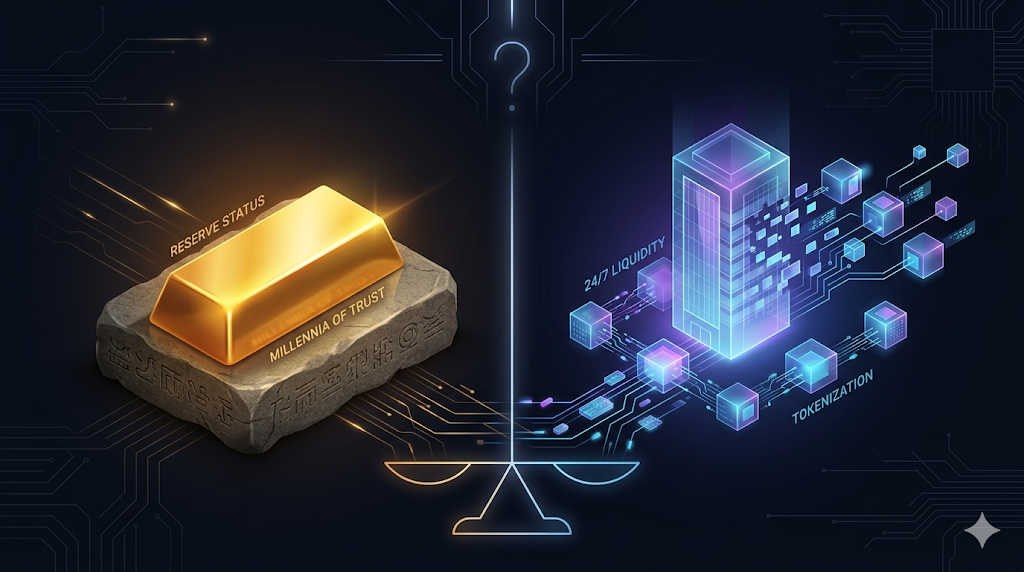
Is the $19.32 billion Real-World Asset (RWA) market replacing physical gold as the ultimate safe haven? No, RWA tokenization is not replacing physical gold's 5,000-year social contract; rather, it upgrades how investors access and trade traditional assets. According to Binance News from May 2026, the market cap of tokenized real-world assets surged 256 percent to hit $19.32 billion, driven by unprecedented institutional demand.
While physical gold relies on historical trust and central bank stockpiling, RWAs offer programmatic efficiency, fractional ownership, and absolute 24/7 liquidity. Investors no longer have to choose between tangible security and digital speed.
What is Real-World Asset (RWA) Tokenization?
Real-world asset tokenization is the process of converting physical or traditional financial instruments into digital tokens managed by blockchain smart contracts. This cryptographic transformation bridges the massive $20 trillion traditional asset market with high-speed digital finance.
By utilizing decentralized ledgers, tokenization aggressively strips away layers of expensive financial intermediaries. This severe reduction in administrative overhead directly translates to lower fees and faster settlement times for retail end-users. The underlying tangible asset remains safely secured in a traditional trust, while its digital twin circulates freely across global decentralized exchanges.
The Expansion of Tokenized Treasuries and Commodities
Tokenized United States Treasuries and digitized commodities currently dominate the RWA sector, reflecting a massive shift toward on-chain yield generation. According to ChainCatcher data from March 2026, tokenized U.S. Treasuries officially exceeded $10 billion in total market value. Top-tier financial institutions are actively migrating dormant capital into blockchain environments to capture risk-free yield without ever leaving the digital ecosystem.
Furthermore, tokenized commodities reached a staggering $5.55 billion in early 2026. This explosive growth is heavily concentrated in fully backed gold tokens like PAXG and XAUT. These specific digital assets allow active cryptocurrency traders to immediately hedge against digital market volatility without liquidating their entire portfolios back into fiat currency.
Gold vs. RWA—Millennia of Trust vs. Programmatic Efficiency
Physical gold maintains an undisputed global monopoly on absolute trust, serving as the ultimate, unprogrammable sovereign reserve asset. Its deep value stems directly from a 5,000-year historical consensus that operates completely independently of modern internet infrastructure or electrical grids. According to a May 2026 macroeconomic analysis by J.P. Morgan, central banks will continue purchasing an estimated 755 tonnes of physical gold annually to fiercely hedge against fiat dollar devaluation.
Conversely, the market value of tokenized RWAs is derived entirely from programmatic efficiency and strict legal enforcement. While a physical gold bar requires an expensive guarded vault, a tokenized asset requires a mathematically flawless and secure smart contract. Investors utilizing RWAs explicitly prioritize the speed of capital deployment over the tangible, offline security that traditional precious metals guarantee.
Why Central Banks Continue to Choose Physical Gold
Global central banks overwhelmingly prefer physical gold over tokenized assets because physical possession entirely eliminates third-party counterparty risk. When a sovereign nation physically holds gold bullion strictly within its own borders, no foreign entity or decentralized protocol can legally freeze or confiscate that wealth. Physical gold maintained strong support near $4,705 per ounce due directly to this exact, continuous sovereign demand.
Tokenized assets, regardless of their cryptographic security, always fundamentally rely on a centralized custodian to hold the underlying physical asset. If a traditional banking partner fails or a hostile government issues a sudden regulatory freeze, the linked RWA tokens instantly lose their backing. Therefore, massive institutional entities view physical gold as the final, impenetrable defensive layer against total systemic financial collapse.
The 24/7 Liquidity Advantage of Tokenized Assets
The absolute liquidity of continuous 24-hour trading is the defining operational advantage that tokenized assets hold over traditional financial markets. Traditional commodity and stock markets stubbornly halt operations on weekends and national holidays, leaving investors completely vulnerable to breaking macroeconomic news. By strategically moving these exact same assets onto a decentralized blockchain infrastructure, active traders can instantly react to global events at any hour.
According to a May 2026 data report, the trading volume for tokenized gold spot alone reached an unprecedented $90.7 billion in the first quarter of the year. This massive capital velocity definitively proves that modern investors demand continuous, completely unrestricted access to their personal wealth. The blockchain network never sleeps, effectively eliminating the massive, dangerous price gaps that frequently occur during traditional market opening hours.
Instant Settlement and Fractional Ownership
Blockchain transaction settlement occurs almost instantaneously, completely bypassing the archaic, slow T+2 (trade date plus two days) settlement cycle of legacy finance. When an investor purchases a tokenized real estate share or a gold-backed token, ownership is mathematically transferred to their digital wallet in seconds. This rapid architecture thoroughly eliminates the inherent counterparty risk heavily associated with delayed banking wire transfers.
Simultaneously, cryptographic fractionalization permanently democratizes access to traditionally gated, exceptionally high-cost investments. Real-world asset protocols actively utilize fractionalization engines to mathematically divide a single expensive asset into millions of micro-shares. According to a May 2026 Brickken market analysis, everyday retail traders can now confidently invest as little as $0.01 into wholesale-priced gold, destroying the traditional barriers of high dealer premiums.
Evaluating Institutional RWA Adoption in Q2 2026
Institutional Wall Street capital is officially migrating on-chain, aggressively utilizing sophisticated tokenized funds to secure massive liquidity advantages. The outdated narrative that blockchain technology is solely built for retail speculation has been entirely dismantled by the calculated actions of global asset managers.
These top-tier legacy financial institutions are heavily utilizing smart contracts to instantly route massive capital between digital stablecoins and traditional government debt. By smoothly integrating with highly established blockchain networks, these specialized funds achieve automated, flawless compliance and real-time auditing. This advanced institutional architecture serves as the foundational, unalterable blueprint for a completely digitized global bond market.
How Protocols Address Custodial and Oracle Security
Robust decentralized oracle networks and strict legal special purpose vehicles (SPVs) are absolutely mandatory to protect tokenized assets from devastating digital exploits. An RWA protocol is functionally only as secure as the external data feed rapidly reporting the true value of the off-chain asset. Decentralized oracles provide continuous, verifiable cryptographic proof of reserve, ensuring the digital token perfectly matches the physical inventory in real-time.
From a strict legal standpoint, tokenized assets are entirely isolated from the severe operational risks of the issuing digital platform. Based on established May 2026 institutional compliance standards, physical assets are heavily segregated into highly secure, bankruptcy-remote legal structures. If the blockchain protocol developers ever face sudden insolvency, the underlying gold or treasury bills remain legally protected and fully redeemable by the original token holders.
| Feature Profile | Traditional Physical Gold | Tokenized RWA Gold |
| Market Access | Business hours only, heavily restricted | 24/7 continuous global trading |
| Minimum Entry | Very high (requires full coins/bars) | Very low (fractionalized micro-shares) |
| Settlement Time | Days to weeks for physical delivery | Instant cryptographic transfer (T+0) |
| Custody Method | Physical vaults, highly expensive | Digital wallets, virtually zero storage cost |
| Primary Risk | Physical theft, severe assay fraud | Smart contract bugs, oracle manipulation |
Are Tokenized Commodities the True "Digital Gold"?
Tokenized gold perfectly mirrors the exact spot price of physical gold while offering high digital velocity, making it structurally distinct from Bitcoin's specific brand of digital gold. While Bitcoin proudly offers absolute mathematical scarcity, its extreme price volatility makes it completely unsuitable for short-term corporate treasury hedging. Tokenized gold seamlessly bridges this critical gap, providing the strict stability of traditional precious metals alongside the technological superiority of blockchain transfer rails.
According to an exhaustive Investing.com market analysis from May 2026, Bitcoin's annualized volatility routinely runs between a staggering 70 and 80 percent. In extremely stark contrast, both physical and tokenized gold maintain a highly stable volatility profile near 15 percent. Therefore, tokenized gold functions perfectly as a true digital reserve, while Bitcoin operates distinctly as a high-growth, asymmetric technological investment.
Comparing RWA Gold to Bitcoin's Market Dynamics
The active trading volume and overall market behavior of tokenized gold are slowly beginning to tightly correlate directly with traditional equity and commodity markets. Historically, deeply on-chain digital assets decoupled almost entirely from the standard macroeconomic signals that typically dictate legacy finance. However, as massive institutional liquidity continuously deepens within the RWA sector, these specific tokens are inheriting the exact volume patterns of their underlying traditional assets.
According to detailed Chainalysis on-chain data published in late April 2026, tokenized RWA gold volumes have aggressively broken out of historically weak trends to move closely in tandem with traditional mining stocks. This heavily signifies a rapidly maturing market where highly sophisticated algorithms and arbitrageurs actively connect decentralized exchanges to Wall Street pricing. RWA gold is now officially behaving exactly like a mature, trusted financial instrument.
| Asset Category | Total Market Value (2026) | Primary Market Driver |
| U.S. Treasuries | Over $10 Billion | Risk-free institutional yield generation |
| Commodities | $5.55 Billion | Inflation hedging and digital stable-value |
| Real Estate | High Growth Phase | Fractionalizing illiquid property markets |
| Private Credit | Rapid Expansion Phase | Democratizing institutional lending pools |
Regulatory Frameworks and Compliance Advancements in 2026
Strict, aggressively enforced regulatory compliance is the foundational catalyst driving the massive 2026 expansion of the entire tokenized real-world asset market. Global governments and highly cautious financial regulators are officially transitioning from hostile skepticism to active, integrated technological collaboration. According to comprehensive May 2026 financial compliance reviews, multiple major jurisdictions across Europe and Asia have successfully implemented clear, permanent legal guidelines for digital asset issuance.
This critically profound legal clarity finally allows deeply traditional banking institutions to interact directly with decentralized ledgers without risking severe federal penalties. Advanced smart contracts now natively embed strict Anti-Money Laundering (AML) and Know Your Customer (KYC) protocols directly into the asset's immutable digital code. Consequently, these highly compliant tokens physically cannot be transferred to unauthorized digital wallets, completely neutralizing potential illicit financial activity.
The Role of Automated On-Chain Auditing
Automated on-chain auditing provides global regulators and retail investors with absolute cryptographic transparency, fundamentally replacing the notoriously slow, manual accounting practices of legacy finance. Leading third-party auditing firms now actively utilize public blockchain explorers to flawlessly verify the exact circulating supply of a tokenized asset instantly. This irrefutable cryptographic proof mathematically entirely eliminates the dangerous possibility of corporate fraud or hidden fractional reserve lending.
According to extensive institutional market reports from late April 2026, these real-time verifiable ledgers massively lower the heavy compliance costs for global asset managers. Financial regulators no longer need to strictly demand delayed quarterly paper reports; they simply query the live public blockchain to ensure total, continuous capital compliance. This automated, trustless mechanism is the singular primary reason trillion-dollar legacy funds finally feel secure aggressively deploying capital into the RWA ecosystem.
The Future of Global Finance and Asset Management
The highly inevitable future of global asset management completely relies on a deeply integrated hybrid financial system where all traditional securities are simultaneously issued on-chain. The historical, rigid division heavily separating traditional legacy finance and modern decentralized finance is rapidly collapsing under the sheer weight of massive institutional tokenization. Legacy asset managers who stubbornly fail to adapt their underlying infrastructure to support RWA tokenization will rapidly, permanently lose massive market share to technologically superior digital competitors.
Based on aggressive May 2026 global market projections, the difficult infrastructure building phase of tokenization is officially complete, and the massive scale phase has formally begun. The direct issuance of highly tokenized sovereign debt by major central banks is no longer a mere theoretical concept but a highly active, heavily funded pilot program globally. The fully programmable nature of these entirely new financial instruments will flawlessly automate international taxation, compliance, and instant dividend distributions on an unprecedented global scale.
Expanding Access to Emerging Markets
Strategic RWA tokenization is aggressively injecting unprecedented, massive liquidity into the historically fractured and severely inaccessible emerging market financial sectors. Developing nations frequently heavily suffer from strictly restricted access to premium global capital markets, a major issue heavily stifling critical local infrastructure development. Advanced tokenization platforms completely bypass deeply entrenched regional banking monopolies, directly connecting global retail capital to highly lucrative, high-yield infrastructure projects in Latin America and Southeast Asia.
This profound technological bridge successfully allows a retail investor safely located in Europe to easily fund a fractionalized renewable energy project in Brazil using heavily backed digital stablecoins. According to specialized May 2026 industry market insights, tokenized infrastructure debt safely offers highly stable, predictable cash flows that are incredibly visually attractive to yield-starved digital investors. This incredibly symbiotic economic relationship heavily accelerates essential global development while simultaneously providing vastly superior financial returns to the broader digital asset ecosystem.
Trading top-tier Real-World Assets on the KuCoin platform allows users to access highly liquid, RWA-backed digital markets. As a major global digital asset exchange, KuCoin provides a vital secondary-market gateway bridging traditional collateral and decentralized finance. Register a KuCoin account and complete the KuCoin security verification, and you will be able to trade industry-leading RWA tokens.
Conclusion
Real-World Asset (RWA) tokenization is entirely redefining the foundational architecture of modern global capital markets by successfully merging the historic stability of physical assets with the unprecedented velocity of blockchain technology. It definitively does not attempt to boldly replace the ancient, deeply sovereign trust placed securely in physical gold; instead, it aggressively solves the critical limitations of physical ownership, specifically punishingly high storage costs and severe market illiquidity.
By flawlessly enabling 24/7 continuous global trading, absolutely instantaneous T+0 settlement, and massive micro-fractionalization, RWAs permanently democratize direct access to elite financial instruments previously heavily locked tightly behind massive institutional capital requirements. While lingering counterparty risk and complex oracle security undeniably remain notable technical hurdles, the aggressive, incredibly well-funded participation of major Wall Street asset managers strongly indicates these specific challenges are actively being heavily mitigated.
Ultimately, fully tokenized assets undeniably represent the final, highly inevitable evolution of modern digital finance, boldly offering traders the completely unique ability to securely hold historically trusted collateral strictly within a frictionless, completely borderless, and highly programmable decentralized ecosystem.
FAQs
What exactly is a Real-World Asset (RWA) token?
A Real-World Asset token is a cryptographic digital representation of a traditional financial or physical asset, like real estate, government bonds, or physical gold, recorded immutably on a blockchain. It strictly utilizes smart contracts to flawlessly track ownership and automate trading, allowing physical world value to move seamlessly across decentralized digital networks.
How does tokenized gold fundamentally differ from Bitcoin?
Tokenized gold directly tracks the exact spot price of physical gold, offering extreme stability and acting as a true digital safe haven against wild market volatility. Bitcoin operates strictly as an entirely independent, highly volatile digital asset driven by absolute algorithmic scarcity and massive asymmetric growth potential, rather than any physical collateral backing.
Is 24/7 liquidity truly beneficial for traditional assets?
Yes, continuous 24/7 trading permanently prevents investors from being dangerously trapped in rapidly collapsing financial markets during traditional weekend or holiday market closures. It beautifully allows smart traders to instantly react to breaking global geopolitical news or macroeconomic data releases, ensuring immediate capital mobility and highly accurate price discovery at absolutely all hours.
Are tokenized real-world assets completely safe from digital hacks?
Tokenized assets are strictly protected by highly advanced legal structures and cryptographic decentralized oracle networks, making the underlying asset incredibly secure. While the digital token could technically rarely face smart contract exploits, the physical asset always remains safely locked securely in a legally bankrupt-remote trust, entirely separate from the digital protocol's operational risks.
How does fractional ownership directly lower high investment barriers?
Fractional ownership effectively uses smart contract engines to mathematically divide a single, massively expensive asset, like a heavy $5,000 gold bar, into millions of tiny digital micro-shares. This aggressively allows everyday retail investors to easily purchase premium institutional-grade assets for as genuinely little as a few cents, completely bypassing traditional high broker premiums and massive entry capital requirements.
Disclaimer:This content is for informational purposes only and does not constitute investment advice. Cryptocurrency investments carry risk. Please do your own research (DYOR).