

How Meme Culture Influenced Stonks and Changed Online Investing Language
2026/05/06 17:42:02
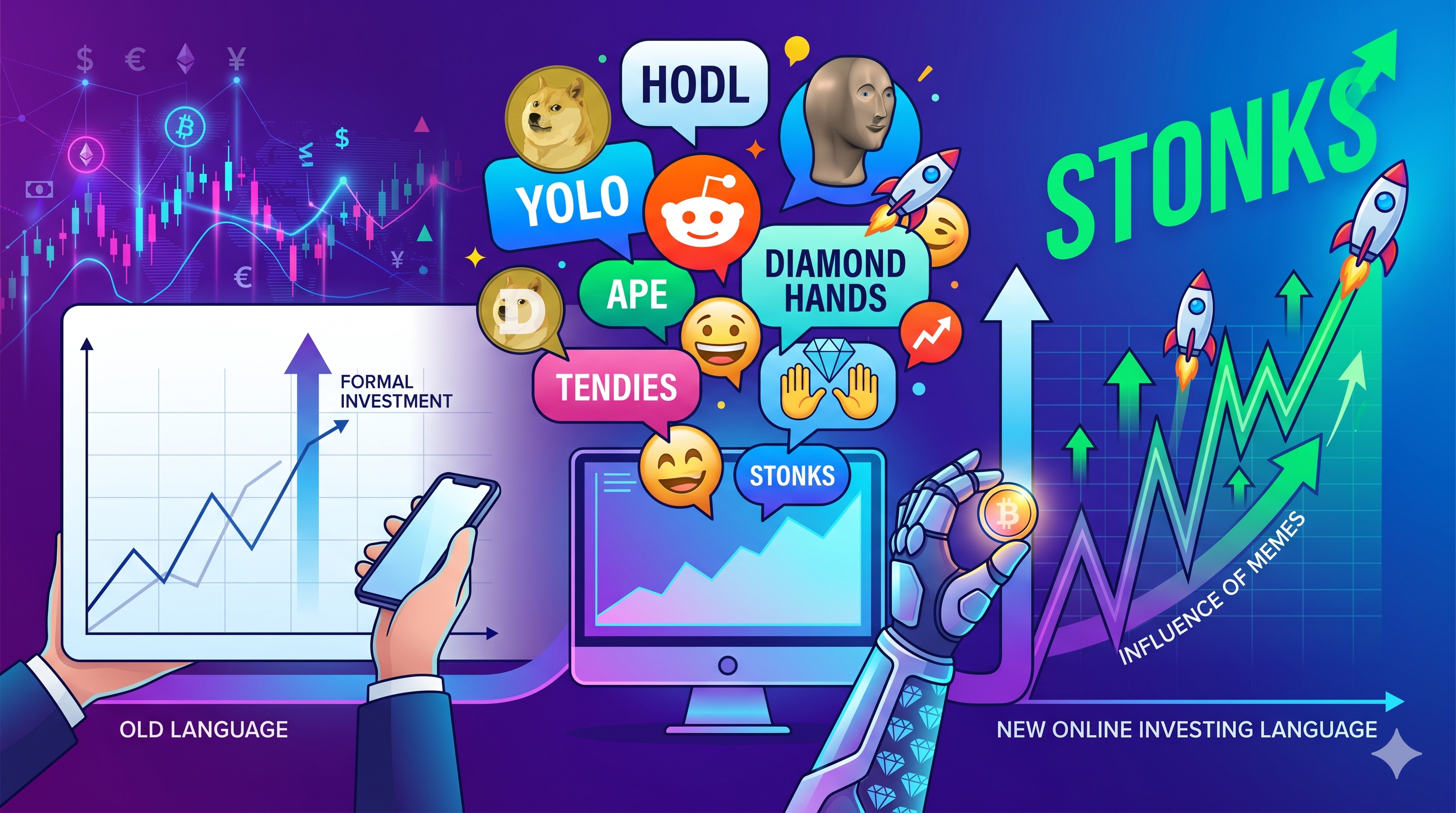
What if a typo on a forum and a cartoon meme of a man in a suit changed the way an entire generation thinks about investing? That is precisely what happened. "Stonks" — a deliberate misspelling of "stocks" — first appeared in a viral 2017 meme, exploded into global consciousness during the January 2021 GameStop short squeeze, and has since permanently embedded itself into the financial lexicon alongside terms like HODL, WAGMI, and LFG. These are no longer just jokes. They are shorthand for investment psychology, community behavior, and market sentiment.
Meme culture has rewritten the grammar of investing. As of April 2026, the meme coin market alone holds a capitalization of approximately $34.5 billion, with individual tokens routinely moving 10–30% on social media signals from a single tweet. Over 13 million meme coins launched in the year leading up to the State of Crypto 2025 report. This article traces exactly how internet humor transformed online investing language — and why every serious investor needs to understand the culture it created.
Key Takeaways
-
"Stonks" originated in a 2017 internet meme and became mainstream during the 2021 GameStop short squeeze — the event that proved meme culture could genuinely move markets.
-
The meme coin market holds approximately $34.5 billion in total capitalization as of April 2026, with DOGE, SHIB, PEPE, TRUMP, and BONK leading by market cap.
-
Terms like HODL, FOMO, WAGMI, NGMI, LFG, FUD, and DYOR originated in crypto and meme communities, but are now used across mainstream financial media and by professional analysts.
-
Pop culture moments directly move crypto prices — the January 2025 launch of $TRUMP helped push Bitcoin to an all-time high of $109,071, while Elon Musk's social media posts have historically moved DOGE by double-digit percentages within hours.
-
Global crypto ownership surpassed 560 million users by late 2025, with the 18–34 demographic comprising 40% of owners — the same generation that built internet meme culture.
-
Meme language functions as market signal: when WAGMI sentiment dominates forums and FOMO drives volume, it often signals a peak. When NGMI and FUD dominate, it often signals capitulation — and opportunity.
-
The cultural convergence of meme, finance, and politics has spawned an entirely new investing meta: PolitiFi, where tokens tied to political figures respond to news cycles the way traditional stocks respond to earnings reports.
From Typo to Trading Floor: The Origin of "Stonks"
"Stonks" is not merely a misspelling — it is a precisely calibrated piece of ironic financial commentary, and understanding its origins explains almost everything about how meme culture and investing became inseparable.
The 2017 Meme That Started It All
The word appeared in 2017 in a viral meme featuring "Meme Man" — a 3D cartoon character with an expressionless face — standing in front of a generic stock market chart, accompanied only by the word "Stonks." The image was intentionally absurd: the character looked clueless, the chart meant nothing, and the humor came from one clear message — "I have no idea what I am doing, but let us go anyway." It spread rapidly across Reddit, Facebook, and Twitter as the perfect encapsulation of irrational trading optimism.
The term operates on two distinct levels. At its surface, "stonks" functions as an affectionate, casual synonym for stocks or crypto assets that are rising. At its deeper, more common level, it is deployed ironically — to comment on blind optimism, hype-driven speculation, and the kind of market behavior where fundamentals are not just irrelevant but actively dismissed. In short, it captured the psychology of speculative investing better than any textbook term ever had.
GameStop and the Moment Stonks Moved Markets
The January 2021 GameStop short squeeze transformed "stonks" from niche internet humor into a word that mainstream financial media was forced to acknowledge. Traders organized through r/wallstreetbets — a Reddit community built as much on meme culture as on market analysis — to coordinate a massive buying campaign on GameStop (GME), a video game retailer that institutional investors had heavily shorted. The resulting squeeze triggered historic price surges and delivered enormous losses to several prominent hedge funds.
When Elon Musk publicly referenced "stonks" in commentary on the event, the word landed on the front page of every major financial publication. At that moment, a meme became a legitimate market concept. Crypto traders — already immersed in meme culture and equally drawn to high-volatility speculation — absorbed the term completely. "Stonks" did what serious financial language could not: it held the absurdity of meme-driven price action at arm's length while still acknowledging its reality.
The Crypto Lexicon: How Meme Slang Became Financial Language
The language of modern investing has been fundamentally restructured by the crypto and meme community. Terms that originated in forum threads and Discord channels are now used by institutional analysts, financial journalists, and retail investors alike. Understanding this vocabulary is not optional — it is essential for reading market sentiment accurately.
The Core Terms Every Investor Needs to Know
| Meme Language Term | Origin | What It Signals in the Market |
| Stonks | 2017 internet meme | Irrational optimism; peak FOMO sentiment |
| HODL | 2013 forum typo | Long-term conviction; community resolve during drawdown |
| WAGMI | 2021 NFT/crypto culture | Rising community optimism; potential local top signal if excessive |
| NGMI | 2021 NFT influencer culture | Capitulation, self-deprecation; often signals sentiment bottom |
| LFG | Gaming/military culture | Breakout excitement; momentum confirmation |
| FUD | Traditional finance, amplified by crypto | Deliberate negativity; potential dip-buying opportunity if unfounded |
| DYOR | Crypto community governance | Due diligence reminder; healthy skepticism signal |
| Rekt | Gaming culture | Significant losses absorbed; heavy selling pressure |
From Niche to Mainstream: When Finance Adopted Meme Language
The legitimization of meme language in finance reached a clear milestone when Merriam-Webster added "blockchain," "cryptocurrency," and "ICO" to the dictionary in 2018, followed by "altcoin" and "metaverse" in 2022. Financial media now routinely uses FOMO to describe retail investor behavior, hedge fund managers reference HODL strategies in investor letters, and CNBC anchors use "to the moon" without irony during bull markets.
This is not coincidence. The 18–34 demographic comprises 40% of global crypto ownership, according to a 2025 World Now report that tracked the milestone of 560 million global crypto users. This cohort built internet meme culture from scratch, and when they entered financial markets in significant numbers — first through Robinhood, then through crypto exchanges, then through meme stocks and meme coins — they brought their language with them. Finance did not adopt meme slang grudgingly; it was simply the natural vocabulary of a generation that now represents its largest retail investor base.
Meme Coins: When Humor Became a $34.5 Billion Asset Class
The most direct expression of meme culture's influence on investing is the meme coin sector itself — an asset class that, by every rational metric, should not exist, yet commands tens of billions in capital and has produced some of the most dramatic returns in financial history.
Dogecoin: The Original Joke That Became a Market Force
Dogecoin was created in 2013 by software engineers Billy Markus and Jackson Palmer as a direct parody of Bitcoin, named after the then-viral "Doge" meme featuring a Shiba Inu dog named Kabosu. The creators expected it to be forgotten within weeks. Instead, it became the world's most recognized meme cryptocurrency, with DOGE currently accepted at AMC Theatres via BitPay, tested for GameStop trading-card purchases, and usable to buy Tesla merchandise on Tesla's online store. Dozens of asset managers have filed for a spot Dogecoin ETF with the SEC.
Dogecoin's sustained relevance is inseparable from Elon Musk's influence. A single tweet mentioning DOGE can move its price by double-digit percentages within hours. In early 2026, news that Musk hinted at integrating Dogecoin into the X platform caused FLOKI — a related dog-themed token — to jump 20% in a matter of hours. When Dogecoin whales accumulated 160 million tokens over 96 hours in early May 2026, the token broke through technical resistance with doubled trading volume.
The 2025 Meme Season and Its 2026 Aftermath
The peak of meme coin mania in the current cycle arrived in January 2025, when President Donald Trump launched his Official Trump ($TRUMP) token just three days before his second inauguration on the Solana blockchain. The accompanying excitement — combined with Melania Trump's subsequent rival coin launch — helped push Bitcoin to an all-time high of $109,071. However, Melania's coin caused $TRUMP's price to fall 50% within hours of her launch, demonstrating both the power and the volatility of politically branded meme assets.
The meme coin sector peaked at a total market capitalization of $150.6 billion in December 2024 before declining to approximately $47.2 billion by November 2025 and settling further to around $34.5 billion by April 2026 — a 77% contraction from peak, yet still representing a durable, multi-billion-dollar market. As of April 2026, the top five meme coins by capitalization are Dogecoin (DOGE), Shiba Inu (SHIB), Pepe (PEPE), Official Trump (TRUMP), and Bonk (BONK).
How Meme Culture Changes Investment Behavior
The Sentiment-to-Price Pipeline
Meme culture has created a direct, fast-acting pipeline from cultural sentiment to price action. The mechanism works as follows: a pop culture moment, a celebrity post, or a viral meme creates cultural attention around an asset; social media platforms amplify that signal to millions within minutes; retail investors respond with buying pressure; prices move; the price movement generates media coverage; and the cycle reinforces itself until the catalyst exhausts or reverses.
This feedback loop is self-reinforcing and measurable. According to the a16z State of Crypto 2025 report, prediction markets broke into the mainstream during the 2024 U.S. presidential election cycle, with platforms like Polymarket and Kalshi processing billions in combined monthly trading volume — another example of real-world cultural events driving on-chain activity.
Reading Meme Language as Market Signal
Experienced investors now treat meme language as a genuine sentiment indicator. The distribution of WAGMI versus NGMI in community channels, the volume of FOMO-driven discourse, and the prevalence of "to the moon" posting are meaningful inputs to understanding market psychology. CoinGecko's GMCI Meme Index — which tracked the meme sector at a market value of approximately $33.8 billion with $5.9 billion in 24-hour trading volume at the start of 2026 — is one of the more formalized attempts to quantify this cultural signal.
A "meme season index" approach tracks how many large meme tokens are outperforming Bitcoin over a set window. When that number keeps rising, it typically indicates traders rotating into higher-risk market segments — a signal that has historically correlated with late-cycle speculation rather than fresh accumulation.
The 2026 Evolution: AI, PolitiFi, and the Next Phase of Meme Finance
When Memes Meet Artificial Intelligence
In 2026, meme culture has begun fusing with artificial intelligence to produce a new category of AI-native meme coins. The first clear example, Goatseus Maximus (GOAT), hit a $1.5 billion market cap in November 2024, demonstrating that the community was receptive to AI-generated or AI-themed meme assets. AI tools are now being used to organize liquidity pools, automate trading strategies, and track social media trends in real time, allowing AI-guided meme coins to react to cultural moments faster than any human-managed fund could.
PolitiFi: Politics Becomes a Trading Asset
The launch of $TRUMP formalized a new category that analysts now call PolitiFi — tokens tied to political identities and events, whose price action mirrors news cycles rather than on-chain development. In 2026, the U.S. midterm elections are expected to generate renewed volatility in politically branded meme assets. The language of this category blends traditional political commentary with pure meme speculation, producing some of the most volatile and attention-driven trading environments the market has ever seen.
Trading the Meme Cycle on a Platform That Keeps Up
Understanding meme culture and meme language is only half the equation — executing on that knowledge requires a platform with the speed, depth, and token access to match the pace of meme-driven markets. KuCoin lists a comprehensive range of meme coins alongside major assets, giving traders the ability to act on cultural signals the moment they appear — not hours later when liquidity has already moved. For investors who have mastered the language of WAGMI and the discipline of HODL, KuCoin's trading tools provide the infrastructure to put those convictions into practice efficiently. The platform's low-fee structure also matters in meme trading, where high-frequency position changes can erode returns quickly on higher-cost alternatives.
Tips: New to crypto? KuCoin's Knowledge Base has everything you need to get started.
Conclusion
Meme culture did not just influence investing language — it restructured how a generation thinks about markets, risk, community, and wealth. "Stonks" arrived as a joke and stayed as a philosophy. HODL became a genuine investment strategy embraced by everyone from anonymous forum posters to institutional portfolio managers. WAGMI turned speculative volatility into shared identity. And a $34.5 billion meme coin market proved that humor, culture, and community attention are genuine financial forces.
The language is not going away. With global crypto ownership past 560 million users and the 18–34 demographic firmly at the center of retail market activity, the vocabulary these investors brought with them — forged in Discord channels, Reddit threads, and Twitter feeds — will continue to define how markets communicate. The wise move is not to dismiss this as noise, but to decode it. FUD creates buying opportunities. Excessive WAGMI signals tops. LFG moments confirm breakouts. The meme is the message, and in 2026, the message is increasingly moving billions of dollars.
FAQs
What is the "White Whale" strategy in 2026 meme trading?
The White Whale strategy refers to a defensive investment approach where participants focus on long-term community "stickiness" and transparency of token distribution to avoid becoming "exit liquidity" for larger holders. It emphasizes patience and "market behavior education" over chasing overnight wealth.
How has "SocialFi" changed crypto investing this year?
SocialFi integrates social media engagement directly with financial incentives, allowing users to earn tokens for creating viral content or participating in community governance. In 2026, it has become a primary way for institutions to measure and "price" the cultural value of a cryptocurrency project.
Why is "AI-adjacent infrastructure" considered a meme stock trend now?
Retail investors have applied the same viral, community-led buying patterns to companies involved in AI data centers and power grids. This is driven by a collective narrative that "AI is the next moonshot," leading to high-volume, speculative trading that mirrors the behavior seen in classic meme stocks like GameStop.
What are the new "team identity disclosure" rules for meme coins?
In 2026, many global jurisdictions require the developers of meme coins listed on centralized exchanges to undergo "Know Your Business" (KYB) checks. This aims to reduce "rug pulls" by ensuring that the individuals behind a project are identifiable to regulators, even if they remain pseudonymous to the public.
How do NLP tools help professional traders manage "meme risk"?
Professional money managers use Natural Language Processing (NLP) to scan millions of social media posts in real-time. This allows them to create "sentiment indexes" that predict price movements based on the frequency and tone of specific keywords, helping them hedge against the extreme volatility of meme-driven assets.
Disclaimer: This article is for informational purposes only and does not constitute financial or investment advice. Cryptocurrency investments carry significant risk. Always conduct your own research before trading.