

Ethereum Staking Reaches 41.4 Million ETH, Accounting for 34% of Total Supply
2026/08/05 17:24:00
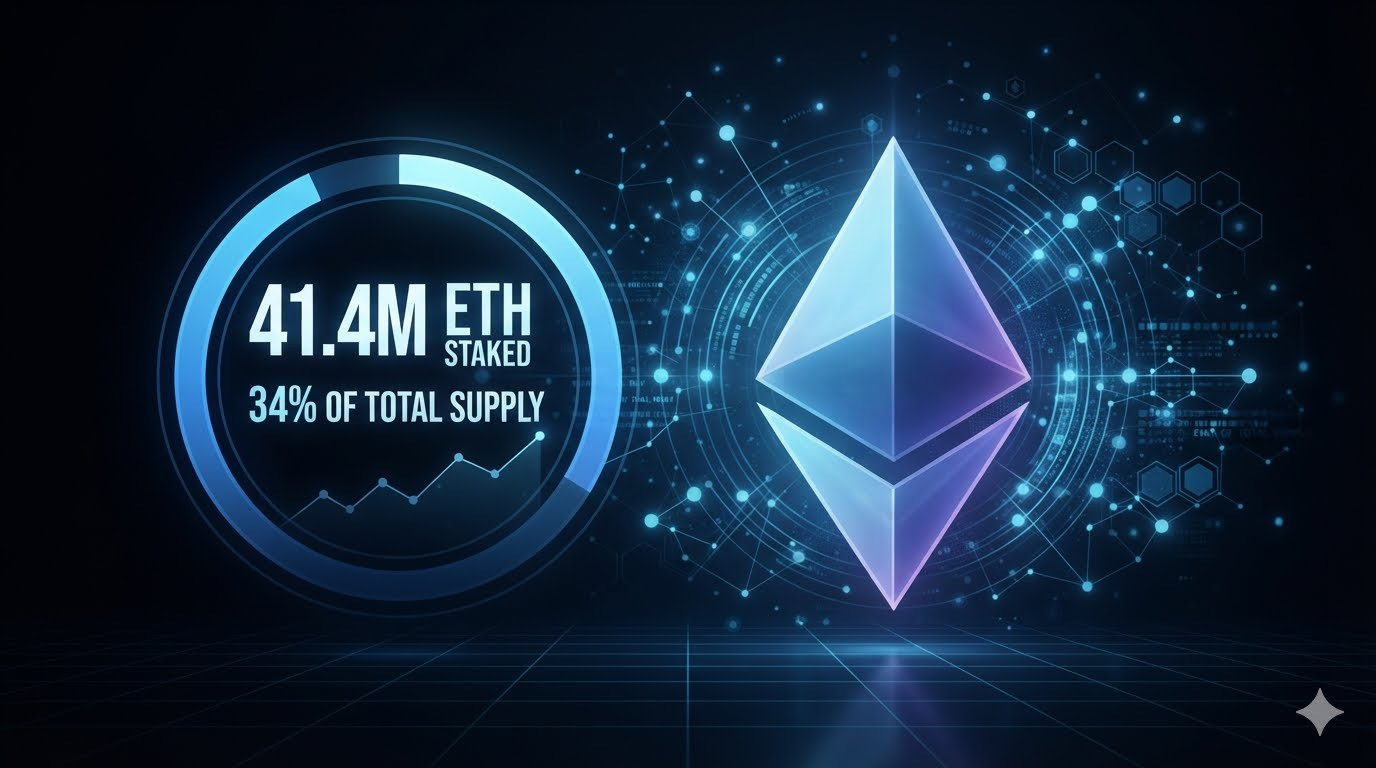
The economic architecture of Ethereum is undergoing a notable shift. According to recent on-chain data, Ethereum staking has reached a new milestone, with 41.4 million ETH locked within the network’s consensus layer. This accumulation represents approximately 34.4% of the total circulating Ethereum supply, an increase from the 30% threshold recorded at the beginning of the year. The pace of this capital deployment has been steady, with a net inflow of over 1.4 million ETH within a single week.
From an operational standpoint, this commitment of capital enhances Ethereum's security framework. Under the Proof-of-Stake (PoS) consensus mechanism, more locked capital translates directly into a higher cost of corruption, making the network more resilient against 51% attacks. However, these growing metrics have sparked an active debate within the Ethereum developer community.
What benefits network security is also prompting discussions regarding long-term economic sustainability, asset utility, and decentralization. As capital continues to pool into validation contracts, Ethereum core researchers note that the network is approaching an economic threshold. This article will examine the structural drivers pushing staking higher, explore the potential risks of a highly staked network, and evaluate the newly proposed EIP-8361 designed to moderate this staking growth.
Drivers of Staking: Why the Market is Locking Up ETH
The movement of circulating ETH into the Beacon Chain contract is driven by several institutional and architectural factors that have altered the opportunity cost of holding liquid, un-staked Ethereum.
Spot Ethereum ETFs and Corporate Treasuries
The expansion of regulated financial products throughout 2026 has influenced how traditional capital interacts with digital assets. The steady inflows into Spot Ethereum ETFs—such as BlackRock’s iShares Ethereum Trust (ETHB) and Grayscale’s Ethereum Mini Trust (ETH)—have created an efficient pipeline for institutional fiat capital.
To optimize returns for their underlying products, institutional custodians systematically convert their spot holdings into on-chain staking positions. Furthermore, corporate treasuries are increasingly treating Ethereum as a reserve asset. The ability to generate a predictable yield directly from a blockchain protocol makes ETH an attractive alternative to traditional yield-bearing instruments, bringing more corporate liquidity on-chain.
Liquid Staking (LSTs) and the Restaking Ecosystem
For retail investors and decentralized applications, the primary barrier to entry for native staking has historically been the 32 ETH minimum requirement and the lockup periods associated with running an independent validator. The growth of Liquid Staking Token (LST) protocols like Lido Finance has lowered this barrier. LSTs allow users to stake fractional amounts of ETH while receiving a liquid, synthetic derivative (such as stETH) that can be simultaneously traded or used as collateral in DeFi lending pools.
Additionally, the expansion of the "Restaking" ecosystem, pioneered by protocols like EigenLayer and ether.fi, allows users to take their already-staked ETH or LSTs and allocate them to secure secondary applications. By layering additional security premiums on top of the base consensus rate, restaking has pushed the aggregate yield higher, making the decision to stake an economically viable choice for many long-term holders.
Search for Native Yield in Fluctuating Macro Conditions
On a macroeconomic scale, global financial markets have navigated shifting interest rate expectations and localized inflationary pressures. Within the digital asset ecosystem, investors search for sustainable yields that do not rely on high-risk algorithmic structures.
Ethereum’s native staking reward is recognized by many funds as a baseline rate of the Web3 economy. Because this yield is programmatic and funded partially by network activity (transaction tips and MEV), it offers a dependable option for capital deployment during periods of broader market uncertainty.
The Current Economics of Ethereum Staking
To understand the discussions developing within the community, it is essential to analyze the economic realignments occurring as more capital joins the network. The mathematical design of Ethereum's consensus layer dictates an inverse relationship between the total volume of staked ETH and the individual yield distributed to each validator node.
Understanding Yield Dilution: Base APR vs. Real APR
As the total amount of staked ETH reaches 41.4 million, the base consensus annual percentage rate (APR) paid out via token issuance has been diluted to approximately 2.78%. This occurs because the protocol distributes a fixed pool of newly minted ETH across a growing pool of active validators.
However, the comprehensive yield captured by validators remains higher. When a validator is selected to propose a block, they capture execution layer rewards, which consist of priority transaction tips and Maximum Extractable Value (MEV). When these execution fees are compounded with the base consensus rewards, the total comprehensive yield currently ranges between 3.3% and 3.8%. This premium helps maintain institutional demand, even as the baseline issuance curve flattens.
The Staking Entry Queue Bottleneck
The volume of capital entering the validation layer has resulted in a backlog at the protocol level. Ethereum enforces a strict churn limit—a mechanical cap on how many new validators can be activated per epoch—to preserve network stability.
This churn limit has created a queue where new institutional capital and staking pools must wait for days, or occasionally weeks, before their deposited ETH begins actively validating blocks. This bottleneck indicates that market demand to lock up Ethereum currently exceeds the network's immediate structural capacity to process it.
Developer Concerns: Implications of a 34% Staking Rate
If a higher staking rate brings enhanced security, why are core Ethereum developers and researchers expressing concern? The answer lies in the economic dynamics that emerge when a large portion of a cryptocurrency's supply is locked inside its validation architecture.
The "Unstaking Tax" and Economic Dilution
Under Ethereum’s current monetary policy, the protocol guarantees a minimum issuance floor. This means that even if 100% of all circulating ETH were to enter the staking contract, the network would continue to mint and distribute new tokens to validators. For individuals and developers who choose not to stake their ETH, perhaps to pay for gas fees or run applications, this structure acts as a programmatic dilution.
As the staking ratio climbs, non-staking holders find their purchasing power diluted by the tokens issued to validators. This dynamic creates a systemic pressure to stake capital to preserve its baseline value, potentially reducing broader ecosystem transactional velocity.
The Role of LSTs in Decentralized Finance
One of Ethereum's early value propositions was that native ETH serves as trust-minimized collateral within DeFi, requiring no counterparty risk. However, as the staking pool absorbs more of the circulating supply, un-staked ETH is becoming less prevalent in open markets.
In its place, Liquid Staking Tokens, most notably Lido's stETH, have become the primary medium of exchange and collateral across lending markets. This creates a systemic dependency. If the financial foundation of DeFi relies on a synthetic wrapper issued by a secondary protocol, a smart contract vulnerability or governance issue within that protocol could trigger broader market impacts.
Centralization Vectors
Managing institutional capital often requires industrial-grade infrastructure. Consequently, a notable percentage of the 41.4 million staked ETH is concentrated within centralized exchanges (such as Coinbase and Binance) and dominant staking pools (like Lido).
This concentration introduces centralization vectors. If a minor group of institutional node operators controls the majority of the network's consensus power, they become more susceptible to regulatory pressure and compliance mandates. This shifts the balance of power toward a few corporate entities, which challenges the permissionless ethos of blockchain technology.
EIP-8361: Proposed Adjustments to Staking Issuance
Recognizing the potential risks of an unrestricted staking increase, a group of Ethereum Foundation researchers and core developers, including Justin Drake and Jerome de Tychey, introduced a proposal on August 4, 2026: EIP-8361, titled "Tapered Issuance Burn."
EIP-8361 represents a significant proposed change to Ethereum’s monetary policy. The proposal introduces a dynamic penalty system directly tied to the macro staking ratio.
Under this model, whenever a validator successfully performs their duties, the protocol calculates the current global staking percentage. As this percentage climbs, the network automatically subtracts a specified portion of the validator's issued rewards and burns them. Instead of rewarding validators with purely inflationary issuance, the network scales back the net rewards, shifting the economic mechanics of network security.
The mathematical curve embedded within EIP-8361 features an economic ceiling designed to manage the staking ratio. The proposal establishes a strict cliff at a 50% staking rate, which equates to roughly 60.25 million ETH locked.
As the global staking pool climbs toward this 50% mark, the programmatic burn rate scales up linearly. At the exact moment the network reaches 50% utilization, the net consensus issuance yield distributed to validators drops to 0%. Beyond this point, validators would rely exclusively on execution layer rewards—transaction tips and MEV—to cover operational expenses.
To ensure a smooth transition, EIP-8361 incorporates an 18-month linear buffer period. This transition phase ensures that validation rewards would decay gradually, giving institutional node operators and retail staking pools time to adjust their capital allocations. By modifying token issuance while preserving EIP-1559’s transaction fee burning, EIP-8361 aims to place Ethereum on a deflationary path.
Industry Reactions to the Proposal
Because EIP-8361 proposes a significant re-engineering of Ethereum's underlying economic model, its introduction has initiated active governance discussions across the Web3 ecosystem.
The Institutional Perspective
Supporters of the proposal, including researchers like Grayscale’s Head of Research, Zach Pandl, view EIP-8361 as a logical evolution of digital asset tokenomics. By removing the programmatic issuance floor and allowing market risk premiums to dictate staking equilibrium, the proposal aims to prevent continuous supply lockups.
From an investment standpoint, the resulting supply constriction could be viewed favorably. If token issuance drops while network demand remains steady, ETH’s scarcity profile changes. For institutional investors holding spot assets, the potential of structural deflation may outweigh the loss of a diluted staking yield.
The DeFi and Solo Staker Perspective
Conversely, the proposal has faced criticism from decentralized application founders and independent hardware operators. Aave Founder Stani Kulechov noted that making staking yields volatile and introducing a programmatic 0% cliff could disrupt DeFi credit markets. Many advanced borrowing and yield strategies rely on a predictable underlying LST interest rate curve. If that curve becomes erratic, capital pools might migrate to stablecoins or alternative layer-1 ecosystems.
Furthermore, independent Solo Stakers face fixed, real-world operational costs. While institutional operators can absorb a reduction in yields due to economies of scale, solo stakers operate with tighter margins. Critics argue that the proposal designed to combat centralization could inadvertently consolidate the validation layer among larger node operators who can afford to run nodes primarily on execution layer tips.
Roadmap Speculation and the Hegotá Upgrade Timeline
An immediate change to the network is not scheduled. The introduction of EIP-8361 occurred just prior to the formal scope-selection deadline for Ethereum's upcoming network upgrade. Community coordinators have clarified that the comprehensive screening and public debate process will extend through at least November 2026.
If the developer community reaches a consensus, EIP-8361 may be packaged into the subsequent Hegotá Upgrade, currently targeted for mainnet deployment in Q2 2027. This timeline provides the market with a window to evaluate and price in the potential economic transformation.
Strategic Takeaways for Market Participants
As Ethereum navigates this staking milestone and the accompanying governance discussions, market participants should adapt their strategies to account for these shifting dynamics.
-
Anticipate Spot Market Liquidity Adjustments: With over 34% of all ETH locked in validation contracts, the liquid supply available on centralized exchange order books is reduced. During periods of market demand, this illiquidity can contribute to price volatility in spot markets.
-
Diversify Yield Strategies: Given the potential long-term adjustments to consensus rewards and the regulatory uncertainties surrounding secondary protocols, investors may consider avoiding over-exposure to a single LST wrapper. Utilizing flexible staking alternatives allows traders to remain agile if governance upgrades impact specific on-chain smart contracts.
-
Monitor Governance Timelines: The review window leading up to the November deadline and the eventual 2027 Hegotá upgrade will serve as notable market catalysts. Traders can track developer consensus metrics to inform options strategies, managing exposure to fluctuations in implied volatility as the market processes potential changes to ETH's issuance model.
-
Assess DeFi Credit Risk: Participants utilizing LSTs or restaked tokens as collateral in decentralized lending protocols should review their liquidation thresholds. Shifts in the underlying yield curve can alter asset valuations, making conservative loan-to-value (LTV) ratios a practical safeguard for capital.
Join KuCoin 9th Anniversary Trading Campaign
KuCoin is celebrating its 9th anniversary with a special platform campaign filled with exclusive rewards, trading activities, and limited-time offers. Don’t miss the chance to participate and enjoy the benefits as the exchange marks nine years of growth and innovation. Visit the official campaign page now:

Conclusion
The achievement of 41.4 million staked ETH highlights the market’s confidence in the security and utility of the Ethereum network. It indicates that the transition to Proof-of-Stake has established a substantial security apparatus for financial applications.
However, this milestone also requires the ecosystem to evaluate the economic implications of its staking participation rate. The emergence of EIP-8361 demonstrates that Ethereum is entering a period of macroeconomic fine-tuning. Whether the community adopts the Tapered Issuance Burn or chooses to preserve the existing yield curves, the upcoming decisions will influence the relationship between capital, network security, and asset issuance. Market participants should continue tracking these protocol upgrades closely to navigate the evolving landscape of digital asset allocation.
FAQs
Why did Ethereum staking reach an all-time high?
Driven by sustained inflows from Spot Ethereum ETFs, the zero-barrier accessibility of Liquid Staking Tokens (LSTs), and attractive stacked returns from Restaking layers, institutional and retail investors are aggressively locking up capital for native Web3 yield.
What is the current comprehensive Ethereum staking yield?
While the base consensus APR has been diluted down to approximately 2.78%, validators capturing execution layer rewards, transaction tips, and MEV-Boost incentives enjoy a total comprehensive yield scaling between 3.3% and 3.8%.
What is the core objective of EIP-8361?
EIP-8361 aims to introduce a programmatic penalty that permanently burns validator rewards as the staking ratio climbs, preventing an uncontrolled supply lockup and preserving the economic utility of native ETH.
What happens if the Ethereum staking ratio hits 50% under EIP-8361?
If the global staking volume reaches 50%, the programmatic burn scales to 100%. The net consensus issuance yield drops to exactly 0%, forcing validators to rely solely on tips and MEV.
Why are DeFi founders opposing EIP-8361?
DeFi architects argue that unpredictable, volatile staking rewards will disrupt automated lending protocols, cross-tier interest rate spreads, and leveraged looping strategies, potentially forcing significant liquidity to abandon the Ethereum ecosystem for other yield-bearing assets.
Disclaimer
The information provided on this page may originate from third-party sources and does not necessarily represent the views or opinions of KuCoin. This content is intended solely for general informational purposes and should not be considered financial, investment, or professional advice. KuCoin does not guarantee the accuracy, completeness, or reliability of the information, and is not responsible for any errors, omissions, or outcomes resulting from its use. Investing in digital assets carries inherent risks. Please carefully evaluate your risk tolerance and financial situation before making any investment decisions. For further details, please consult KuCoin’s Terms of Use and Risk Disclosure.