

A Summary of Base Chain's Project Development and Ecosystem Construction
Introduction
While many Layer-2 networks are still competing for traction, Base has already distinguished itself as the highest revenue-generating L2 in crypto without launching a native token. This reflects the scale and efficiency of its ecosystem.
Since its mainnet launch in August 2023, Base has moved quickly from an experimental Ethereum Layer-2 backed by Coinbase into a fully developed on-chain economy. Its growth has not been limited to one vertical. Instead, it has expanded across decentralized finance, AI-driven applications, SocialFi, NFTs, gaming, and creator tools, forming a broad and interconnected ecosystem.
This article examines how that transformation happened. It breaks down the key infrastructure upgrades, ecosystem milestones, and adoption drivers that shaped Base’s rise. It also explores the structural challenges and emerging opportunities that could define its position in 2026.
For developers, investors, and anyone tracking the direction of Ethereum scaling, Base offers a clear case study. Its trajectory provides insight into how modern Layer-2 networks are evolving and what it takes to achieve sustained relevance in an increasingly competitive market.
What Is Base Chain? Understanding the Foundation of Coinbase's Layer-2 Network
Base Chain is a Layer 2 network built on Ethereum and developed by Coinbase. It is designed to improve scalability by reducing transaction costs and increasing speed while maintaining Ethereum’s security.
As part of the broader shift toward Layer 2 adoption, the Base Chain ecosystem supports a growing range of applications, including decentralized finance, social platforms, and emerging AI-driven use cases. Understanding its foundation is essential before exploring how it has scaled into one of the most active Layer 2 networks.
Base DeFi Ecosystem: TVL Growth, Liquidity, and Key Protocols
DeFi remains the core driver of activity within the Base Chain ecosystem, with total value locked serving as a key indicator of its growth. The network has attracted significant liquidity across decentralized exchanges, lending markets, and yield platforms, pushing Base TVL into the multi-billion dollar range. Recent data shows a sharp acceleration in activity, with total value locked rising by 23% to approximately $7.8 billion within a single week in March 2026, highlighting a period of intensified capital inflows.
This expansion reflects more than retail participation. A combination of institutional-focused developments, including the launch of compliant lending markets, improvements in cross-chain bridge infrastructure, and integrations with traditional finance yield strategies, has contributed to deeper and more stable liquidity across the network.
Low transaction costs and fast execution continue to make Base an efficient environment for on-chain trading, stablecoin transfers, and liquidity provisioning, supporting sustained growth beyond short-term incentives.
Key protocols within the Base DeFi ecosystem span major categories such as automated market makers, lending platforms, and derivatives infrastructure. These applications form the backbone of liquidity on the network and contribute to consistent transaction volume.
Unlike many Layer 2 networks that rely heavily on token emissions, Base has scaled DeFi activity through organic usage. This positions it as a more sustainable environment for long-term liquidity and protocol growth.
SocialFi on Base: Zora, Farcaster, and On-Chain Identity
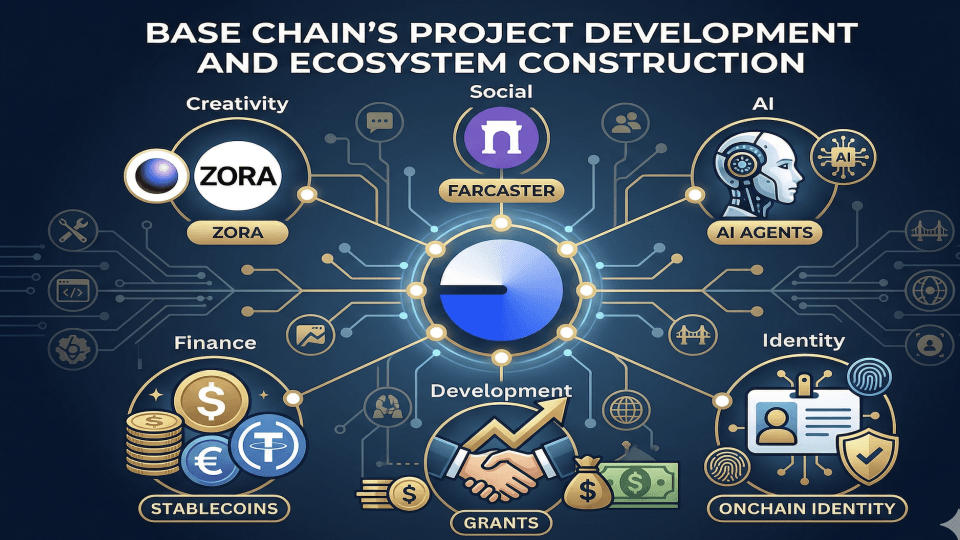
Social applications have become a defining layer of the Base Chain ecosystem, with platforms like Zora and Farcaster leading early adoption. These applications introduce new ways for users to create, distribute, and monetize content directly on-chain.
Zora focuses on creator monetization by enabling users to mint content as digital assets and earn from its distribution. Farcaster, on the other hand, provides a decentralized social network where user profiles, interactions, and relationships exist on-chain rather than being controlled by a single platform.
Together, these platforms highlight the shift toward on-chain identity. User activity, ownership, and reputation are tied to wallets instead of centralized accounts. This allows individuals to carry their social presence and data across applications within the Base ecosystem.
This model expands participation beyond trading. Users are not only engaging with financial protocols but also building communities, identities, and content economies that exist natively on-chain.
Rise of Base AI Agents and DeFAI Applications
AI-driven applications are an emerging growth layer within the Base Chain ecosystem, with developers building autonomous agents that can operate as independent economic actors on-chain. These agents are capable of holding funds, making payments, verifying identity, and interacting directly with smart contracts and services across the network.
Base provides the underlying infrastructure that enables this functionality. According to Base documentation, AI agents can be equipped with wallets to store and spend assets, identity standards that allow other agents and applications to verify them, payment protocols that support pay-per-request services, and discovery mechanisms that allow agents to find and interact with one another without manual integration.
This framework enables a range of practical use cases. Trading agents can monitor market conditions and execute token swaps automatically using funded wallets. Payment agents can handle transactions on behalf of applications by paying for APIs and services through protocols such as x402. Other implementations include multi-channel assistants that operate across platforms like Discord or Telegram while managing wallets and executing on-chain actions in real time.
The DeFAI category combines these autonomous agents with decentralized finance, allowing AI systems to participate directly in activities such as liquidity management, yield optimization, and asset allocation. Top Base AI projects in 2026, including Virtuals Protocol and agents such as aixbt by Virtuals and Luna by Virtuals, illustrate how AI agents are being actively deployed within the Base ecosystem to perform coordinated financial operations and interactive tasks on-chain.
Base’s low transaction costs and fast execution environment make it well suited for these use cases, as AI agents often require frequent on-chain interactions. As infrastructure matures and more developers adopt these patterns, AI agents are expected to play a growing role in how users and applications interact with the Base Chain ecosystem.
NFTs, Gaming, and Creator Economy on Base
Beyond finance and AI, Base has developed a growing presence in NFTs, gaming, and the broader creator economy. These sectors expand the Base Chain ecosystem by enabling users to create, own, and interact with digital assets in more direct and permissionless ways.
NFT platforms on Base allow creators to mint and distribute digital content with minimal friction, while users can trade and collect assets that represent art, memberships, or in-game items. This model supports new forms of ownership where assets are tied to wallets rather than centralized accounts, allowing creators to maintain control over their work and monetization.
The creator economy on Base extends these capabilities further by combining NFTs with social and content platforms. Creators can tokenize content, build direct relationships with their audience, and introduce monetization models that are not dependent on traditional intermediaries. This contributes to a more open and composable digital economy where value flows directly between creators and users.
While NFTs and gaming may not always dominate total value locked, they play an important role in driving user engagement, expanding the Base Chain ecosystem, and supporting consistent on-chain activity across non-financial use cases.
Memecoins and Retail-Driven Activity on Base
Memecoins contribute to retail-driven activity within the Base Chain ecosystem, attracting users who participate primarily through trading and community engagement rather than long-term utility narratives.
On Base, this segment drives frequent transactions on decentralized exchanges, increasing trading volume and liquidity movement across the network. As of March 2026, memecoins on Base account for nearly $300 million in activity, reflecting sustained retail participation in this category.
This level of activity supports broader ecosystem usage by generating consistent on-chain interactions and helping new tokens establish initial liquidity. While memecoins remain highly speculative and short-term in nature, they represent a significant share of retail engagement on Base and contribute to overall network activity.
Base Chain Ecosystem DeFi: TVL, Liquidity, and Growth Drivers
The Base Chain ecosystem has developed a mature DeFi layer that spans decentralized exchanges, lending markets, and stablecoin activity. These components work together to generate consistent liquidity and sustain on-chain usage across the network.
Growth within Base DeFi is reflected in key metrics such as total value locked, trading volume, and protocol revenue. As activity has expanded, Base Layer-2 has attracted both retail and institutional participation, supported by low transaction costs, fast execution, and access to Coinbase’s user base.
Unlike many Base Chain projects 2026 across competing Layer-2 networks, this growth has not depended heavily on token incentives. Instead, it has been driven largely by organic usage and protocol adoption. The sections below examine the main drivers behind this expansion, including liquidity infrastructure, lending integrations, and stablecoin driven activity.
Base TVL Growth and Revenue Dominance
Recent TVL expansion reflects not just increased capital inflows, but also a broader concentration of liquidity within the Base Chain ecosystem. The increase signals periods of accelerated participation from both retail and institutional users rather than gradual incremental growth.
This activity is further supported by revenue data, where Base generated approximately $196.2 million in revenue out of a total Layer-2 market revenue of $790.9 million, representing about 24.8% market share. These figures reinforce the role of Base as one of the leading contributors to Layer-2 economic activity, driven by sustained usage across decentralized applications.
Unlike ecosystems that rely heavily on token incentives to attract liquidity, Base has maintained growth through organic demand. The combination of Coinbase distribution, low transaction costs, and reliable execution has enabled capital to flow into decentralized exchanges, lending markets, and stablecoin applications without short-term emission strategies.
Aerodrome Finance and Liquidity Infrastructure on Base
Aerodrome Finance functions as the primary decentralized exchange and liquidity hub within the Base ecosystem. Its tokenomics model allows users to lock tokens for governance rights while directing emissions toward specific liquidity pools.
This structure aligns incentives between liquidity providers, traders, and protocol stakeholders, encouraging deeper and more stable liquidity compared to traditional incentive models. As a result, Aerodrome has become the default venue for new token launches and liquidity provisioning on Base.
While retail participation has normalized over time, trading activity remains strong. DEX volumes continue to reach high levels, indicating that liquidity is increasingly concentrated among more active and capital-efficient participants. In late 2025, the merger of Aerodrome with Velodrome under a unified platform called Aero further expanded its role, creating a cross-chain liquidity layer spanning Base and Optimism.
This positions Aerodrome as a core component of Base DeFi, supporting price discovery, token distribution, and capital efficiency across the ecosystem.
Coinbase Integration and the Morpho Lending Model
A defining feature of the Base ecosystem is the integration between Coinbase and decentralized protocols such as Morpho. Through this model, users can access lending services directly within the Coinbase interface while the underlying execution occurs on-chain via Base.
This approach is often described as a DeFi distribution model, where user experience is centralized while settlement remains decentralized. It allows users to borrow assets such as USDC using crypto collateral without interacting directly with a protocol interface.
The impact of this integration is significant. Coinbase users have generated hundreds of millions of dollars in loan activity through Morpho, accounting for a large share of lending activity on Base. Morpho’s total value locked on Base has also experienced substantial growth, increasing from tens of millions to over a billion dollars within a relatively short timeframe.
This demonstrates how Base leverages existing user distribution to accelerate DeFi adoption. The combination of trusted onboarding, familiar interfaces, and on-chain execution creates a pathway for broader participation in decentralized financial services.
Stablecoins, Prediction Markets, and Liquidity Expansion on Base
Stablecoins represent one of the most widely used asset classes within the Base Chain ecosystem. USDC in particular has seen significant adoption, with daily active usage increasing steadily over time, driven by payments, transfers, and on-chain settlement activity.
This usage extends beyond individual users, with enterprise integrations also emerging, including merchants such as Shopify accepting USDC on Base for commerce transactions. Together, these developments highlight Base’s role as a practical settlement layer for both retail and business use cases rather than purely speculative trading activity.
In addition to stablecoins, prediction markets have emerged as another growing segment. Platforms such as Limitless Exchange (LMTS) enable users to trade outcomes using order book models and oracle pricing systems. These applications introduce new forms of market participation while contributing to overall transaction volume and liquidity depth.
Together, stablecoins and prediction markets illustrate how liquidity on Base extends beyond traditional DeFi primitives. They support a broader range of financial interactions that include payments, hedging, and event based speculation, all of which contribute to sustained on-chain activity across the Base Chain ecosystem.
SocialFi on the Base Chain Ecosystem and the Creator Economy
SocialFi has become an important growth layer within the Base Chain ecosystem, combining social interaction with on-chain ownership and monetization. These applications allow users to create content, build audiences, and capture value directly through blockchain infrastructure rather than relying solely on traditional platforms.
Within Base Layer-2, SocialFi has evolved from early experimental models into more structured platforms centered around decentralized identity, content ownership, and creator incentives.
Protocols such as Farcaster and Zora now form the foundation of this segment, supported by broader Base Chain projects 2026 that integrate social, financial, and community driven activity. The Base App further consolidates access to these services, creating a unified entry point for users interacting with SocialFi applications.
Evolution of SocialFi on Base From Friend.tech to Farcaster and the Base App
The early phase of SocialFi on Base was defined by Friend.tech, an application that introduced the concept of tokenized social access. Users could buy and sell keys tied to individual profiles, effectively pricing social influence as a tradable asset. While Friend.tech generated significant attention during its initial surge, its activity declined over time, highlighting the challenges of sustaining engagement in early SocialFi models.
The next phase of development focused on more durable infrastructure. Farcaster emerged as a decentralized social protocol that enables users to own their identity and social graph, while applications like Warpcast provide a user interface for interaction. Around the same period, Coinbase introduced the Base App, which integrates wallet functionality with social features and access to Farcaster and Zora.
This integration expanded SocialFi accessibility across a global user base and positioned the Base App as a central hub for interacting with the Base Chain ecosystem. Users can now post content, engage with communities, and interact with on-chain applications within a single environment, reducing friction between social activity and blockchain usage.
Zora and Tokenization of Creator Content on Base
Zora represents a major shift in how creator content is monetized within the Base ecosystem. Originally an NFT marketplace, it has evolved into a platform focused on tokenizing social content through its Coins model.
Under this model, each piece of content is minted with a fixed supply of tokens. Creators receive an initial allocation and earn a share of trading and liquidity fees as their content circulates in secondary markets. This structure aligns creator incentives with user engagement, as increased visibility and trading activity directly contribute to creator earnings.
Following the integration with the Base App, Zora experienced rapid growth in activity. The platform recorded tens of thousands of tokens minted within short timeframes, reflecting strong adoption of tokenized content creation.
This model demonstrates how SocialFi on Base is evolving beyond simple content sharing into a system where content itself becomes a financial asset within the Base Chain ecosystem.
Developer Infrastructure, Grants, and Ecosystem Building Programs
Developer infrastructure plays a foundational role in the growth of the Base Chain ecosystem by enabling builders to create, fund, and scale applications across multiple sectors. Through structured grant programs, builder incentives, and interoperability initiatives, Base supports the development of Base Chain projects across categories such as DeFi, SocialFi, and emerging areas like Base AI agents and DeFAI applications.
These programs are designed to reduce friction for developers while aligning incentives with long term on-chain activity and real usage. Combined with Base Layer-2 scalability and Coinbase distribution, this ecosystem creates a strong environment for sustained innovation. The sections below outline the primary mechanisms supporting ecosystem growth, including builder programs, cross chain infrastructure, and considerations around a potential Base token.
Base Batches Builder Programs and Superchain Retro Funding
Base supports early stage developers through structured programs such as Base Batches, a cohort based initiative that provides guidance, resources, and exposure, culminating in demo days where teams present to investors and the broader ecosystem.
These programs accelerate applications across categories, from Base DeFi protocols to consumer focused products, reflecting the diversity of Base Chain projects 2026.
Within the Superchain, funding mechanisms such as Retroactive Public Goods Funding reward developers based on delivered impact rather than early stage speculation. Additional support through tooling grants and on-chain builder incentives further strengthens infrastructure development.
Together, these initiatives align builder incentives with real usage, contributing to Base TVL growth and overall ecosystem expansion.
Cross Chain Interoperability and the Superchain Ecosystem on Base
Interoperability is central to Base’s strategy within the Superchain framework. As a Base Layer-2 built on the OP Stack, it operates alongside interoperable chains that share security, tooling, and infrastructure.
This enables efficient movement of assets and applications across networks. Infrastructure providers such as Axelar and Stargate Finance support cross chain transfers, while bridging initiatives extend connectivity to ecosystems like Solana.
These developments reduce fragmentation, improve capital mobility, and enhance composability, allowing applications on Base Chain to reach a broader network of users and liquidity.
Base Token Potential and Network Token Design Considerations
The possibility of a native Base token remains under exploration, with no confirmed details on timing, distribution, or utility.
If introduced, it would likely extend beyond traditional liquidity incentives. Given Base’s strong organic adoption through Coinbase, a token could focus on developer incentives, user participation, and governance rather than attracting short term liquidity.
This would differentiate Base from other Layer-2 networks, aligning the token with ecosystem growth, creator activity, and application usage across Base DeFi, SocialFi platforms like Farcaster Base, and emerging Base AI agents and DeFAI use cases.
While still speculative, any future token design would likely reflect Base’s emphasis on sustainable growth, real economic activity, and integration within the Coinbase Base network.
Frequently Asked Questions
What is Base Chain?
Base Chain is an Ethereum Layer-2 network developed by Coinbase that enables faster and cheaper transactions while maintaining Ethereum’s security.
How does the Base network work?
The Base network uses optimistic rollup technology to process transactions off-chain and settle them on Ethereum, reducing costs and improving speed.
Why is Base DeFi growing so fast?
Base DeFi is growing due to low transaction fees, fast execution, and strong user onboarding through its Exchange, which supports sustained liquidity and increasing Base TVL.
What are the main use cases in the Base Chain ecosystem?
The Base Chain ecosystem supports DeFi, SocialFi platforms like Farcaster and Zora, AI agents and DeFAI applications, NFTs, gaming, and memecoins.
Is there a Base token and when will it launch?
There is no official Base token yet. Base Chain has confirmed exploration, but no launch date or details have been announced.