

Why Did ETH Crash? Unpacking the 2026 Ethereum Market Meltdown
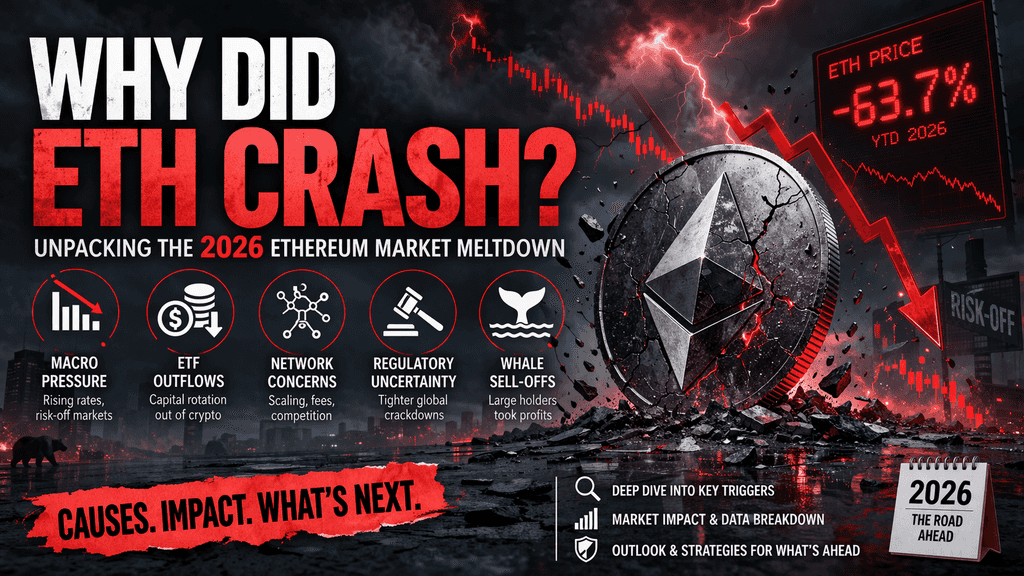
The global cryptocurrency market is reeling as Ethereum, the backbone of decentralized finance and smart contracts, experienced a staggering valuation drop throughout Q1 2026. Investors and developers alike are left asking the same urgent question: Why did ETH crash so violently after years of steady institutional adoption and technological milestones? This deep dive examines the convergence of geopolitical instability, macroeconomic shifts, and internal network dynamics that fueled the recent sell-off.
In the following sections, we analyze the specific catalysts—ranging from global trade wars to the $5.4 billion liquidation cascade—that explain why did ETH crash and what this means for the future of digital assets.
Key Takeaways
The 2026 Ethereum market meltdown was not the result of a single failure, but rather a "perfect storm" of external shocks and internal structural vulnerabilities. Understanding these factors is crucial for navigating the current volatility.
-
Macro Catalysts: A combination of U.S. tariff shocks (specifically the 15% global rate) and the bursting of the AI investment bubble triggered a massive "risk-off" pivot among institutional investors.
-
Geopolitical Strain: Escalating tensions in the Middle East and the U.S.-Iran conflict fueled global inflation fears, pushing Treasury yields higher and draining liquidity from speculative assets like ETH.
-
Deleveraging Event: The crash was exacerbated by a brutal deleveraging cycle, where over $5.4 billion in leveraged long positions were wiped out in a 72-hour liquidation cascade across major exchanges.
-
Fundamental Shifts: Ethereum's correlation with the Nasdaq reached record highs, while the increasing efficiency of Layer 2 adoption ironically reduced the ETH burn rate, challenging the "ultrasound money" narrative.
-
The "Flippening" Threat: Market dominance is shifting; for the first time in history, ETH’s #2 market cap spot is being seriously challenged by the rising supply of Tether (USDT).
The Macroeconomic "Perfect Storm"
To understand why did ETH crash, one must look beyond the blockchain and toward the broader financial landscape. Ethereum has increasingly become a "macro" asset, meaning its price action is tethered to global trade policy and investor appetite for risk.
The 15% Global Tariff Shock and Inflation Fears
On February 23, 2026, the White House announced a sweeping 15% global tariff rate, a move intended to bolster domestic manufacturing but one that immediately sent shockwaves through the global supply chain. For the crypto markets, this policy was a harbinger of "stagflation." As the cost of imported goods rose, so did inflation expectations.
Historically, ETH performs best in a low-interest-rate, high-liquidity environment. With the 15% tariff shock, the Federal Reserve was forced to signal a "higher-for-longer" interest rate stance to combat potential price hikes. This caused a rapid exit from ETH as investors moved capital into the safety of 10-year Treasuries, which saw yields spike to levels not seen since the early 2000s.
The AI Bubble Burst: Contagion from Tech to Crypto
By late 2025, Ethereum had successfully positioned itself as the foundational layer for the AI-Crypto intersection, specifically through DePIN (Decentralized Physical Infrastructure Networks). However, when several "Big Tech" AI darlings missed their Q4 2025 earnings by significant margins, the "AI fatigue" became a contagion.
As retail and institutional investors liquidated their AI-heavy stock portfolios, Ethereum—seen as the "tech stock of crypto"—was the first to be sold off. The narrative that ETH would serve as the settlement layer for AI agents crumbled temporarily under the weight of a broader tech sector correction, causing ETH to fall significantly faster than Bitcoin during the initial panic.
Technical Triggers: The Liquidation Cascade
When asking why did ETH crash, the "how" is just as important as the "why." While macro factors started the fire, the internal mechanics of the crypto market—specifically leverage—acted as the accelerant that burned through support levels.
| Metric | Pre-Crash (Jan 2026) | Peak Crash (Feb 2026) | Change |
| ETH Price | $3,450 | $1,850 | -46% |
| Open Interest | $12.8 Billion | $4.2 Billion | -67% |
| Funding Rates | +0.03% (Bullish) | -0.05% (Bearish) | Flip to Short |
| Exchange Inflow | 120k ETH/day | 850k ETH/day | 6.08 |
Breaking the $2,000 Psychological Floor
In technical analysis, $2,000 was more than just a number; it was the "line in the sand" for the 2026 bull cycle. For months, ETH had consolidated above this level, leading many traders to set their stop-loss orders just below it.
Once the price slipped to $1,995, a "waterfall" effect began. These stop-loss orders triggered market sell orders, which pushed the price lower, hitting the liquidation prices of leveraged long positions on perpetual futures markets. Within a 72-hour window, this frantic intraday plunge wiped out billions in equity, creating a price gap that buyers were too terrified to fill.
Exchange Net Positions: From Passive Holding to Active Selling
Blockchain forensics provide a clear picture of the panic. Data from Glassnode and CryptoQuant revealed a massive shift in "Exchange Net Position." Throughout 2025, ETH was steadily moving off exchanges into cold storage or staking contracts. In Q1 2026, this trend reversed with record-breaking velocity. Long-term "HODLers" began moving their assets to centralized exchanges at a rate of 850,000 ETH per day, indicating that even the most conviction-heavy investors were seeking an "exit at any cost" during the height of the volatility.
Ecosystem Evolution or Erosion?
Ethereum is currently undergoing a massive structural transition. While the "Dencun" and subsequent upgrades improved the network, they introduced new economic complexities that contributed to the recent price instability.
The L2 Paradox: High Activity, Low ETH Burn
The rise of Layer 2 (L2) solutions like Arbitrum, Optimism, and Base has been a double-edged sword. On one hand, network activity is at an all-time high; on the other hand, the technical efficiency of these networks—specifically through "blobs" and data availability sampling—has drastically reduced the fees L2s pay to the Ethereum mainnet.
This has led to the "L2 Paradox": the ecosystem is growing, but the amount of ETH being burned via EIP-1559 has plummeted. For investors who bought into the "ultrasound money" narrative (where ETH becomes deflationary), the return to an inflationary supply was a major psychological blow. If the network isn't burning ETH faster than it issues it, the fundamental value proposition of the token shifts, prompting a reassessment of its long-term price floor.
The Rise of Solana and Alternative L1s
Competition in the smart contract space has never been fiercer. Throughout the 2026 crash, Solana and other high-throughput Layer 1s managed to retain a higher percentage of their TVL (Total Value Locked) compared to Ethereum.
Developer attention is a leading indicator of price, and recent data suggests that new dApps are increasingly choosing "integrated" chains over Ethereum's "modular" approach to avoid the complexities of bridging and fragmented liquidity. This erosion of Ethereum's "moat" has made it harder for the asset to rebound as quickly as it did in previous cycles, as capital now has viable, high-performance alternatives.
Institutional Sentiment vs. Retail Panic
The behavior of "Smart Money" during this crash has been uncharacteristically skittish. Historically, institutions provide the support during retail panics, but 2026 saw a role reversal.
ETF Outflows: The Institutional "Exit Door"
The U.S. Spot Ethereum ETFs, which were the primary driver of growth in 2025, became a significant liability during the crash. As the macro environment soured, these ETFs shifted from strong inflows to a $1 billion net outflow streak over ten consecutive days. Unlike retail users who might "HODL" through a 50% drop, institutional fund managers have strict risk-management mandates. When ETH breached certain volatility thresholds, these funds were forced to sell, creating a massive, regulated sell-wall that suppressed any attempts at a price recovery.
The Fear & Greed Index: Navigating "Extreme Fear"
The Crypto Fear & Greed Index is a powerful tool for understanding the emotional state of the market. During the 2026 meltdown, the index plummeted into the "Extreme Fear" zone, hovering in the low 40s and occasionally dipping into the 20s.
For the savvy investor, this level of sentiment often signals a "bottom-fishing" opportunity. However, the duration of this fear has been longer than usual. The lack of a "V-shaped" recovery suggests that the market is not just afraid, but fundamentally uncertain about Ethereum's role in a high-interest-rate world.
Looking Ahead: Recovery or Further Decline?
Despite the carnage, the Ethereum roadmap continues to move forward. The core developers are focused on the next stage of the "Surge" and "Scourge," aiming to address the very issues that contributed to the crash.
The Fusaka and Hegota Upgrades: Can Tech Save the Price?
The upcoming "Fusaka" and "Hegota" upgrades are designed to implement Verkle Trees and increase the "MaxEB" (Maximum Effective Balance) for validators. These changes are aimed at making the network more decentralized and efficient. Historically, ETH price action rallies in the months leading up to a major hard fork. If these upgrades can prove that Ethereum can maintain its security dominance while regaining its deflationary status, we may see a significant reversal in trend by late 2026.
Price Predictions: Between $1,500 Support and $7,500 Targets
The analyst community is sharply divided. Bearish analysts point to the $1,500 level—the 200-week moving average—as the ultimate "pain point" before a true bottom is found. On the other side, firms like Standard Chartered and Bernstein maintain a bullish long-term outlook, citing that the core utility of Ethereum remains unchallenged. Their models suggest that if the U.S. Fed pivots to rate cuts in response to the tariff-induced slowdown, ETH could rebound to $7,500 by 2027. The remainder of 2026 will likely be a battle between these two divergent realities.
Conclusion
In summary, the question of why did ETH crash in 2026 finds its answer in a complex mix of high-stakes global politics and the natural growing pains of a maturing blockchain. While the $5.4 billion liquidation event and the 15% global tariff shock provided the immediate catalyst for the drop, the underlying shift in Ethereum's burn rate and the rise of formidable competitors cannot be ignored. However, for those who view Ethereum as the foundational "Global Settlement Layer," this crash may eventually be seen as a necessary deleveraging that paved the way for the next era of sustainable, institutionally-backed growth.
FAQ
Was the ETH crash caused by a hack?
No, the crash was not caused by an Ethereum-specific exploit. While the $285M DRIFT exploit on Solana in early 2026 hurt overall market sentiment, the primary reasons why did ETH crash were macroeconomic pressures, U.S. tariff announcements, and a massive liquidation of leveraged positions.
Is Ethereum still a good long-term investment?
Many analysts believe so. Despite the price volatility, institutional accumulation patterns—specifically in private "Over-The-Counter" (OTC) markets—suggest that long-term conviction remains high among large-scale players who value the network's security and established developer ecosystem.
How does the U.S.-Iran war affect ETH?
Geopolitical conflict typically drives up energy prices, which fuels inflation. This forces the Federal Reserve to keep interest rates high to stabilize the dollar. High interest rates are generally "bad for crypto," as they make safe assets like bonds more attractive than "risk-on" assets like Ethereum.
Why did ETH fall faster than Bitcoin during this crash?
Ethereum has a higher correlation with the Nasdaq and tech-heavy AI sectors. When the "AI bubble" showed signs of bursting, ETH was sold off as a proxy for tech innovation, whereas Bitcoin was partially shielded by its reputation as "digital gold" and a store of value.
What is the "L2 Paradox" mentioned in the article?
The L2 Paradox refers to a situation where Layer 2 usage is booming, but because they are so efficient at compressing data, they pay fewer fees to the Ethereum mainnet. This reduces the amount of ETH burned, potentially making ETH inflationary again, which can negatively impact the price.