

AMD Q2 2026 Earnings: Data Center Revenue Doubles as AI Chips Challenge Nvidia
2026/08/05 15:39:00
Introduction
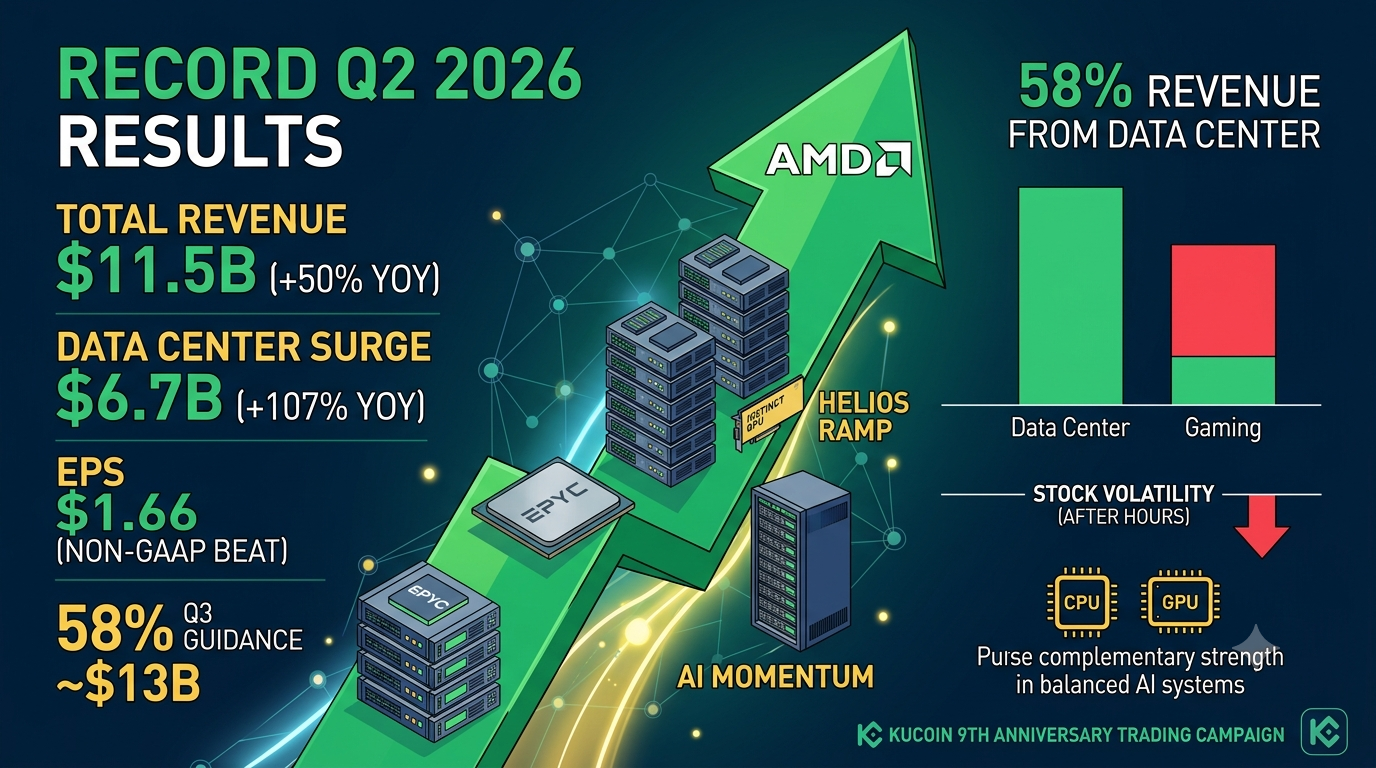
AMD reported record second-quarter 2026 results on August 4, with total revenue reaching $11.5 billion, a 50% year-over-year increase that beat expectations. Data center revenue more than doubled to $6.7 billion, up 107%, driven by strong demand for EPYC processors and Instinct GPUs as the company accelerates its challenge to Nvidia in AI accelerators. Non-GAAP earnings per share hit $1.66, exceeding forecasts, while the company guided for approximately $13 billion in third-quarter revenue. Despite the beat, shares fell more than 8% in after-hours trading as investors sought even stronger AI growth signals.
This performance underscores AMD’s shift toward AI infrastructure. Data center now accounts for 58% of total revenue. Gaming declined 31% to $779 million amid softer console demand, but client and embedded segments provided support. CEO Lisa Su highlighted momentum from EPYC, Instinct deployments, and the Helios rack-scale platform beginning to ramp, with shipments to major customers including Meta and OpenAI expected soon.
What Were AMD’s Key Q2 2026 Financial Results?
AMD delivered record revenue of $11.5 billion in the second quarter of 2026, up 50% from $7.685 billion a year earlier and 13% sequentially from the prior quarter, according to the company’s official earnings release. Non-GAAP diluted earnings per share reached $1.66, beating analyst consensus around $1.61–$1.62. GAAP diluted EPS stood at $1.38, with net income of $2.3 billion.
Gross margin expanded significantly. GAAP gross margin rose to 54%, up 14 percentage points year-over-year, while non-GAAP gross margin hit 56%. Operating income on a non-GAAP basis reached $3.1 billion. These figures reflect higher mix from data center products and operational leverage after prior-year inventory charges related to export controls.
CFO Jean Hu noted that data center strength, representing 58% of company revenue, powered the overall results. Free cash flow and cash positions remained solid, with the company ending the quarter holding substantial liquidity. The beat on both top and bottom lines confirmed accelerating demand for AMD’s compute portfolio amid the ongoing AI buildout.
How Did AMD’s Data Center Segment Perform in Q2 2026?
Data center revenue more than doubled year-over-year to $6.7 billion, rising 107% from approximately $3.2–$3.24 billion in the year-ago period and up roughly 16% sequentially from $5.8 billion in the first quarter. This segment alone drove the majority of growth and now forms the core of AMD’s business.
Strong demand for AMD EPYC server processors and Instinct GPUs fueled the surge. Cloud and enterprise CPU sales each rose more than 70% year-over-year in several reports of the results. AI accelerator revenue also more than doubled as MI350-series and related products saw broader adoption for both training and inference workloads.
Lisa Su stated that the company enters the second half with strong momentum as EPYC demand accelerates and Instinct deployments scale. Helios, AMD’s first rack-scale AI system combining Venice CPUs, MI450-series GPUs, networking, and software, has entered production. Shipments of second-generation Helios servers with MI455X accelerators are expected to begin in the coming months to customers, including Meta and OpenAI. Management expects data center sales to accelerate further in the second half of 2026.
In What Ways Are AMD’s AI Chips Challenging Nvidia?
AMD is gaining ground against Nvidia’s dominant position in AI accelerators through its Instinct GPU lineup and full-stack Helios platform. While Nvidia still holds the large majority of the AI GPU market, AMD’s data center AI revenue growth and multi-gigawatt customer commitments demonstrate expanding traction.
The company raised its long-term view of the data center AI accelerator market, projecting it could reach approximately $1.4 trillion by 2030 with annual growth exceeding 45%. Instinct MI355 and upcoming MI450/MI455X products target both training and inference, with ROCm software improvements aiding adoption. Helios provides rack-scale solutions that compete more directly with Nvidia’s integrated systems rather than standalone chips.
Strategic wins include multi-year compute deals with OpenAI and Meta, plus a new partnership with Anthropic for up to 2 gigawatts of MI450-series capacity on Helios, with initial deliveries targeted for the first half of 2027. These commitments provide revenue visibility and signal that hyperscalers and AI labs are diversifying suppliers. AMD’s fifth consecutive quarter of record server CPU revenue further positions EPYC as a complementary strength in AI agent and inference environments where CPUs play a larger role.
How Did Other AMD Business Segments Perform?
Client and gaming segment revenue totaled $3.8 billion, up 6% year-over-year. Within this, client (PC) revenue rose 23% to $3.1 billion, driven by strong demand for Ryzen processors, including record mobile sales and share gains in the commercial market.
Gaming revenue fell 31% to $779 million due to lower semi-custom sales for consoles such as Xbox Series X/S, PlayStation 5, and Steam Deck, along with component constraints and pricing pressure that weighed on consumer demand. Embedded segment revenue increased 19% to $977 million on broader end-market strength.
These mixed results highlight the ongoing portfolio shift. Growth in client and embedded helped offset gaming weakness, while data center expansion more than compensated overall. Management expressed optimism about AI PCs supporting the client business longer term even as traditional PC markets face seasonal pressures.
What Is AMD’s Outlook for Q3 2026 and Beyond?
AMD guided third-quarter 2026 revenue to approximately $13 billion, plus or minus $300 million, above consensus estimates near $12.5–$12.6 billion. At the midpoint, this implies about 41% year-over-year growth and sequential expansion of roughly 13%. Non-GAAP gross margin is expected around 56%.
Data center sales are projected to accelerate in the second half, driven by continued EPYC strength, scaling Instinct deployments, and the Helios ramp. Su emphasized that AI is expanding compute demand across markets and that AMD’s product leadership and customer visibility position the company for substantial revenue and earnings growth in the years ahead. The company also expects its overall data center segment revenue to more than double again in 2027.
Investors reacted cautiously despite the beat and raised guidance. After rising during regular trading, shares dropped more than 8–9% in after-hours sessions. Some market participants had hoped for even higher near-term AI contribution or more aggressive guidance, given the stock’s strong year-to-date performance prior to the report.
Why Did AMD Stock React Negatively After Strong Earnings?
AMD shares declined sharply after hours despite beating estimates and issuing above-consensus guidance because investor expectations had run high. The stock had already nearly tripled or more over the prior year on AI optimism, leaving limited room for disappointment on growth trajectory details.
Guidance for the third quarter, while solid, fell short of the most optimistic analyst views that had eyed figures closer to $14 billion in some cases. Comments on the precise pace of Instinct AI GPU ramp and Helios volume appeared measured relative to the elevated narrative around challenging Nvidia. Gaming weakness and the need for further evidence of sustained share gains against the market leader also factored into the reaction.
This pattern is common in high-growth AI names where strong absolute results can still disappoint if they do not exceed lofty forecasts. Longer-term fundamentals remain supported by customer wins, product roadmap, and expanding total addressable market.
How Does AMD’s Q2 Performance Fit Into the Broader AI Chip Landscape?
AMD’s results reinforce its role as the primary alternative supplier in the AI data center market. Data center revenue doubling while contributing nearly 60% of total sales shows successful execution on the AI transition. Combined CPU and GPU strength differentiates the offering, particularly as inference and agentic workloads increase the importance of balanced systems.
The Helios platform marks a step toward competing at the system level. Multi-gigawatt deals with leading AI companies provide clearer visibility than earlier product cycles. At the same time, Nvidia retains substantial lead in software ecosystem maturity, performance leadership in many training workloads, and overall market share estimated in the 80–90% range for AI GPUs.
AMD’s raised TAM outlook for AI accelerators signals confidence in long-term expansion. Supply chain execution, software maturity via ROCm, and continued design wins will determine how much share it captures in the coming years.
Should You Invest or Trade AMD-Related Opportunities on KuCoin?
AMD’s accelerating data center and AI momentum creates broader market interest in semiconductor and AI themes that often influence related digital assets and tokenized exposure vehicles available on major platforms. KuCoin provides access to a range of cryptocurrency pairs connected to technology, AI, and broader market sentiment that frequently moves with major chipmakers’ results.
Users can explore trading pairs tied to AI narratives, blockchain infrastructure supporting compute marketplaces, or tokens reflecting semiconductor sector trends. Registration on KuCoin enables access to spot trading, futures, and other products with competitive fees and deep liquidity. Always conduct independent research, understand volatility risks, and never invest more than you can afford to lose, as crypto markets remain highly speculative and can diverge from traditional equity performance.
Join KuCoin 9th Anniversary Trading Campaign
KuCoin is celebrating its 9th anniversary with a special platform campaign filled with exclusive rewards, trading activities, and limited-time offers. Don’t miss the chance to participate and enjoy the benefits as the exchange marks nine years of growth and innovation. Visit the official campaign page now:

Conclusion
AMD’s second-quarter 2026 results delivered record $11.5 billion revenue and a 107% surge in data center sales to $6.7 billion, confirming the company’s successful pivot toward AI infrastructure. Non-GAAP EPS of $1.66 and raised third-quarter guidance to about $13 billion highlight operational strength and demand visibility. EPYC processors and Instinct GPUs, supported by the emerging Helios platform and major customer commitments, position AMD as a credible challenger to Nvidia even as the market leader maintains clear dominance.
Segment performance showed the expected mix shift: robust data center and solid client growth offsetting gaming declines. Management’s outlook for accelerating data center sales in the second half and further doubling in 2027 underscores confidence in the multi-year AI opportunity. The after-hours stock decline reflects high expectations rather than weak fundamentals.
Overall, the quarter validates AMD’s strategy of combining high-performance CPUs and GPUs into full-stack solutions while expanding its customer base among hyperscalers and AI labs. Continued execution on product ramps, software, and supply will determine the pace of further share gains in the expanding AI compute market.
FAQs
What was AMD’s total revenue in Q2 2026?
AMD reported record total revenue of $11.5 billion in the second quarter of 2026, up 50% year-over-year.
By how much did AMD data center revenue grow?
Data center revenue grew 107% year-over-year to $6.7 billion and represented 58% of total company revenue.
Did AMD beat earnings estimates?
Yes. Non-GAAP earnings per share of $1.66 exceeded analyst expectations of approximately $1.61–$1.62, and revenue also beat consensus.
What is AMD’s guidance for the third quarter of 2026?
AMD expects third-quarter revenue of approximately $13 billion, plus or minus $300 million, with non-GAAP gross margin around 56%.
Why did AMD shares fall after the earnings release?
Shares declined more than 8% after hours primarily because guidance and AI growth commentary, while positive, did not fully meet the highest investor expectations following a strong prior run in the stock.