


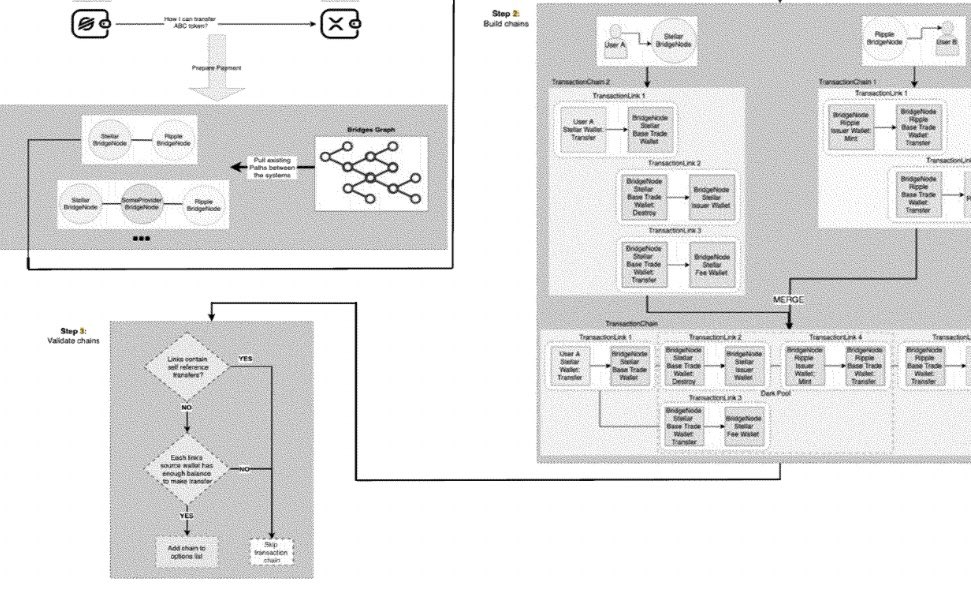
DTCC— $XRP & $XLM This image is FIG. 17 from DTCC’s patent US20250078162A1 (“Systems, Methods, and Storage Media for Managing Digital Liquidity Tokens in a Distributed Ledger Platform”). It is a schematic illustration of the transaction chain building process for cross-ledger transfers of tokenized assets. What the Diagram Shows (Overall Flow) The figure demonstrates how the system handles a cross-chain transfer of a tokenized asset (called “ABC token”) between two different blockchains: • From User A on the Stellar DLT System (associated with XLM) • To User B on the Ripple DLT System (associated with XRP) It is not a simple direct arrow from XRP to XLM. Instead, it shows a sophisticated, automated middleware process that finds the best route, builds a chain of sub-transactions, and ensures everything executes safely with fees, compliance, and liquidity in mind. The diagram is divided into three main parts: 1. Bottom-left: Step 1 – Analyze possible payment paths • User A (with a wallet icon) wants to send ABC token to User B. • The system builds a Bridge Graph (a network diagram with nodes and connections representing different ledgers and bridges). • It pulls existing paths between systems (Stellar Bridgehole, Ripple Bridgehole, and others shown as circles). • This creates possible routes across heterogeneous networks using bridges. 2. Bottom-right: Step 3 – Validate chains • A decision-tree flowchart checks each potential chain: • “Does each link contain all reference variables?” (YES/NO) • “Does each link have enough balance to make transfer?” (YES/NO) • If valid → “Add chain to options list” • If not → skip or stop transaction chain. • This ensures the transfer is feasible before execution. 3. Top/main section: Step 2 – Build chains (the core visual) • Multiple Transaction Chains (e.g., TransactionChain 1, 2, etc.) are constructed. • Each chain consists of several TransactionLink boxes (1 through 5). • Inside the links you see terms like: • “Bridgehole Stellar Base Trade Wallet” • “Bridgehole Ripple Issue Trade Wallet” • “Bridgehole Fee Wallet” • Transfers between wallets (e.g., User A Stellar Token Transfer → Bridge → User B Ripple Token Transfer) • Arrows show the flow of the ABC token (or equivalent) across bridges. • A “MERGE” point combines viable chains into a final optimized transaction chain. • On the right side, you see the expanded final chain with sub-steps like issuing, trading, fee collection, and delivery to User B’s wallet. Source: Grok & DTCC (FIG.17)

Share


Source:Show original
Disclaimer: The information on this page may have been obtained from third parties and does not necessarily reflect the views or opinions of KuCoin. This content is provided for general informational purposes only, without any representation or warranty of any kind, nor shall it be construed as financial or investment advice. KuCoin shall not be liable for any errors or omissions, or for any outcomes resulting from the use of this information.
Investments in digital assets can be risky. Please carefully evaluate the risks of a product and your risk tolerance based on your own financial circumstances. For more information, please refer to our Terms of Use and Risk Disclosure.