


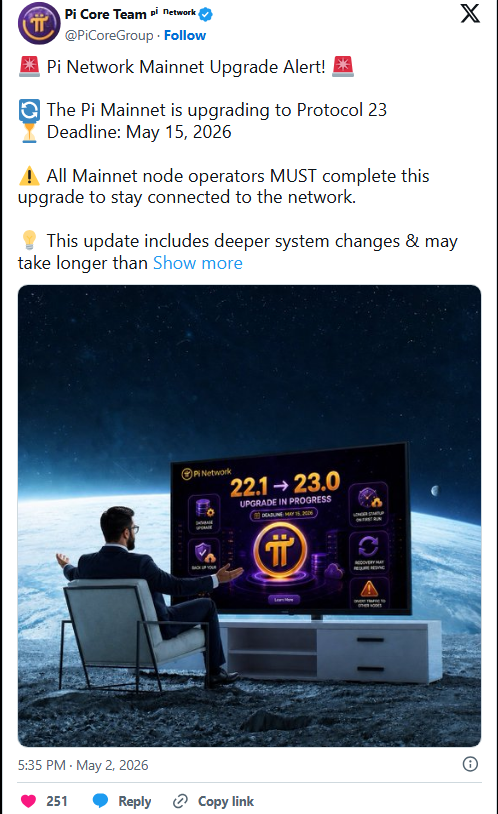
Pi Network Protocol 23: Why Are Traders Watching Closely? Pi Network has announced a mandatory upgrade to Mainnet Protocol 23, with a deadline of May 15. Let’s explore what this means for investors and traders. The Pi Network development team has announced a mandatory Mainnet upgrade. All node operators must upgrade their systems as soon as possible, transitioning from Protocol 22.1 to Protocol 23. The deadline is May 15, 2026. Failure to do so may cause nodes to lose network synchronization, potentially disconnecting them from consensus participation. As a result, this update is critically important—it marks a major infrastructure shift this year. What exactly does Protocol 23 change? Protocol 23 introduces significant system-level changes, going far beyond a routine software patch. This upgrade substantially modifies core infrastructure components. Key changes include: • Database migration and restructuring • Mandatory backup procedures • Longer initial startup times • Recovery and resynchronization tools • Improved node stability and consistency During the first launch, nodes may start slowly due to data migration and validation processes. Additionally, some nodes may require full resynchronization, depending on local data conditions. Therefore, operators must prepare thoroughly before upgrading. Why is this upgrade important for Pi Network? The Pi network is built on an architecture inspired by Stellar. Protocol 23 upgrades this foundational platform, preparing the network for more advanced capabilities. Analysts link this upgrade to upcoming features, including: • Smart contract functionality • Support for decentralized applications • Tokenization of real-world assets • Higher transaction speeds • Enhanced security architecture • Expanded developer tools Thus, Pi is moving beyond a closed ecosystem model, laying the groundwork for a broader blockchain economy. How does Protocol 23 align with Pi Network’s roadmap? Pi Network follows a structured development roadmap, progressing through defined network stages: Testnet, Closed Mainnet, and Open Mainnet. Protocol 23 significantly strengthens the Mainnet foundation, supporting the transition to open network access. Community discussions highlight upcoming integrations, such as: • Integration of the .pi domain ecosystem • AI-powered application tools • Launchpad-style ecosystem funding • DeFi and marketplace integrations If successful, Pi could expand dramatically—evolving beyond a mobile mining system into a full-fledged smart contract platform. Why does this matter to investors, traders, and builders? Investors closely monitor major infrastructure upgrades, as they signal long-term commitment from development teams. If Pi successfully implements Protocol 23, confidence may rise. As utility increases, speculative activity could gradually decline. Thus, investors are closely tracking implementation progress and ecosystem development. Traders respond quickly to network upgrade events. Mandatory upgrades often trigger short-term volatility and generate strong social media attention. If node participation remains high, market sentiment may turn optimistic. However, delays or failures could shift sentiment negatively. Therefore, traders actively monitor upgrade progress. Developers stand to benefit most from these infrastructure improvements. Protocol 23 builds the foundation for new applications, supporting smart contracts and decentralized systems. Key opportunities may emerge in: • Payment applications • Gaming ecosystems • DeFi platforms • Digital identity solutions • Real-world asset integration Thus, developers may soon gain access to new development opportunities. Final thoughts on the Pi Network upgrade Pi Network is moving beyond its initial development phase, now focusing on scalable infrastructure upgrades. Protocol 23 requires all operators to act swiftly—upgrade or risk disconnection. Network participation is therefore crucial at this stage. If successfully deployed, Pi could grow rapidly, evolving into an open blockchain ecosystem—and ultimately achieving real-world utility and adoption. By Triparna Baishnab

Share


Source:Show original
Disclaimer: The information on this page may have been obtained from third parties and does not necessarily reflect the views or opinions of KuCoin. This content is provided for general informational purposes only, without any representation or warranty of any kind, nor shall it be construed as financial or investment advice. KuCoin shall not be liable for any errors or omissions, or for any outcomes resulting from the use of this information.
Investments in digital assets can be risky. Please carefully evaluate the risks of a product and your risk tolerance based on your own financial circumstances. For more information, please refer to our Terms of Use and Risk Disclosure.