


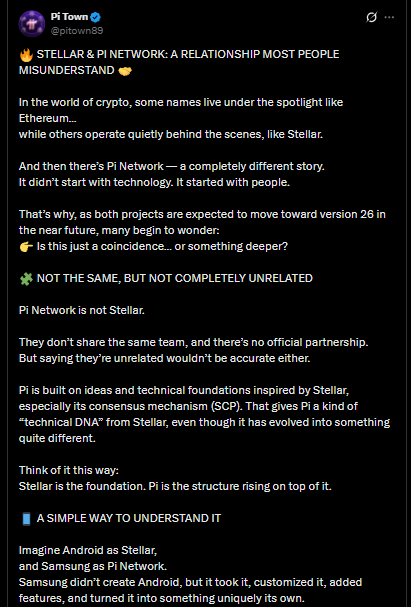
EXPLAINING THE CONNECTION BETWEEN STELLAR AND PI NETWORK: WHAT IS THE CRYPTOCURRENCY COMMUNITY MAY BE MISSING? Let’s take a closer look at the relationship between Stellar and Pi Network, as both ecosystems are approaching Version 26, sparking speculation within the cryptocurrency community. In the rapidly evolving world of cryptocurrency, comparing and linking major blockchain projects is inevitable. Some ecosystems attract intense public attention, while others grow more quietly, gradually building their infrastructure and user base. Recently, discussions have emerged around two such projects: Stellar and Pi Network—and whether their developmental paths may be more closely connected than they appear. Stellar is widely recognized in the cryptocurrency industry for its focus on fast, low-cost cross-border payments. It has established a reputation as a practical financial infrastructure designed to facilitate efficient global transactions. Over time, Stellar has positioned itself as a bridge between traditional finance and blockchain-based systems, emphasizing speed, accessibility, and integration with existing financial networks. In contrast, Pi Network represents a fundamentally different approach. Rather than starting with institutional partnerships or technical infrastructure, Pi Network began with a mobile-first mining model centered on user participation. Its core philosophy has always been community-driven, prioritizing broad accessibility and adoption over complex technical barriers. This difference in origin is one of the main reasons comparisons between the two projects often lead to misunderstandings. While Stellar emerged from a technical and institutional perspective, Pi Network grew from a social, community-based model—one prioritizing user engagement and ecosystem building over institutional integration. Despite these differences, some members of the cryptocurrency community have begun speculating about potential indirect connections or similarities between the two ecosystems. This speculation has intensified as both projects are expected to upgrade to Version 26 in the near future—a detail that has sparked curiosity among observers. However, it is crucial to clarify that similarities in developmental stages do not necessarily imply direct relationships or collaboration. In the blockchain industry, version upgrades are common and typically occur independently across different networks. These updates usually reflect internal development roadmaps rather than external alignment. Nevertheless, this moment has prompted some to question whether there may be deeper structural parallels in how these ecosystems are evolving. The idea is not that Stellar and Pi Network are identical, but that they may be addressing different aspects of a broader transformation in how blockchain technology is being adopted globally. Stellar continues to focus on institutional-grade financial solutions, operating within established frameworks to improve the efficiency of cross-border transactions. Its ecosystem is designed to integrate with financial institutions, payment service providers, and global remittance systems, making it a key player in the foundational layer of the cryptocurrency economy. In contrast, Pi Network is still in the process of building its complete ecosystem. Its focus is on expanding user participation, developing decentralized applications, and transitioning toward practical utility. Rather than prioritizing institutional integration first, Pi Network emphasizes community scale and accessibility. This distinction highlights an important trend within the broader Web3 space: different projects are addressing distinct challenges within the same technological ecosystem. Some focus on infrastructure, others on adoption, and still others on application development. Together, they form a layered structure contributing to the overall advancement of decentralized technology. Speculation about a possible connection between Stellar and Pi Network may also stem from a broader expectation that blockchain systems will eventually become more tightly interconnected. As the industry matures, interoperability between networks is becoming increasingly important. However, interoperability does not necessarily imply direct collaboration or shared architecture. It is also worth noting that stories in the cryptocurrency space often grow rapidly based on limited information. Community discussions, social media posts, and speculation can sometimes exaggerate perceived relationships between projects that are, in reality, operating independently. For Stellar and Pi Network, the most accurate assessment is that they represent different approaches to applying blockchain technology—one focused on infrastructure and institutional integration, the other community-led and still expanding its ecosystem’s capabilities. Yet, the interest in comparing these two projects reflects a deeper curiosity within the cryptocurrency community.As blockchain technology continues to evolve, users are increasingly seeking models, connections, and overarching frameworks that explain how different networks can fit into the broader digital economy. From a technological standpoint, both projects contribute to the advancement of decentralized systems, but in distinct ways. Stellar enhances financial connectivity and transaction efficiency, while Pi Network explores scalable user participation and ecosystem growth through accessibility. As both ecosystems continue to develop—particularly with upcoming version updates—observers will likely continue analyzing their developmental trajectories. However, it is essential to distinguish between speculation and verified technical relationships. In summary, although Stellar and Pi Network are often discussed together in community conversations, they fundamentally differ in design, purpose, and development philosophy. Any perceived connections reflect broader industry trends rather than direct collaboration between the two projects. The cryptocurrency world is complex and multi-layered, with each project contributing to different aspects of the rapidly evolving digital economy. Understanding these distinctions is key to grasping how blockchain technology is shaping the future of finance, communication, and decentralized systems. By Victoria Hale

Share


Source:Show original
Disclaimer: The information on this page may have been obtained from third parties and does not necessarily reflect the views or opinions of KuCoin. This content is provided for general informational purposes only, without any representation or warranty of any kind, nor shall it be construed as financial or investment advice. KuCoin shall not be liable for any errors or omissions, or for any outcomes resulting from the use of this information.
Investments in digital assets can be risky. Please carefully evaluate the risks of a product and your risk tolerance based on your own financial circumstances. For more information, please refer to our Terms of Use and Risk Disclosure.