


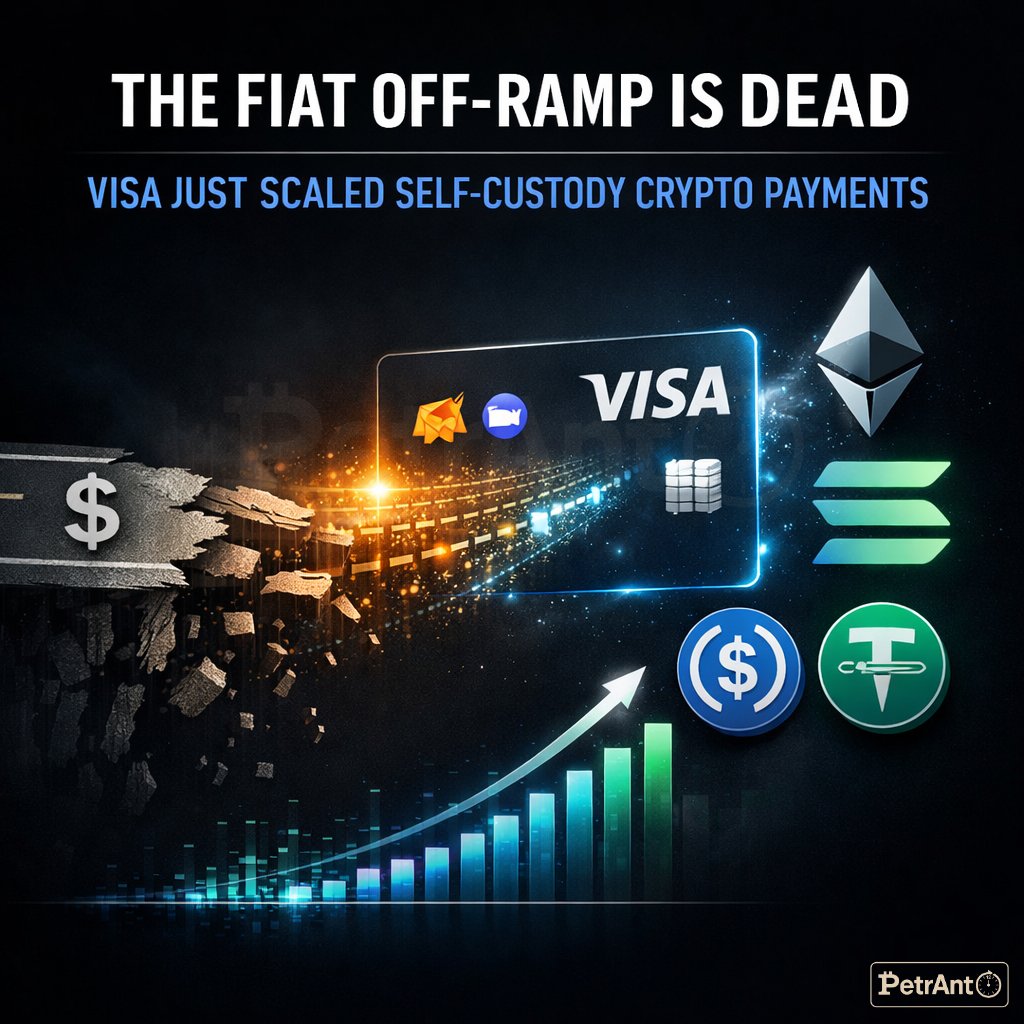
The Fiat Off-Ramp Is Dead: Visa Just Scaled Self-Custody Crypto Payments The legacy payment infrastructure is no longer fighting stablecoins - it is actively absorbing them. Visa and Bridge (Stripe’s recent $1.1B acquisition) just announced a massive expansion of their stablecoin-linked card program. The friction of moving capital between traditional finance and decentralized ledgers has essentially been reduced to zero. Here is the operational breakdown of what this means for the digital asset market. ⬇️ ◽️ The Mechanics of the Integration The fundamental shift here is the elimination of the centralized exchange as a necessary middleman for daily liquidity. ▫️ Direct Self-Custody Spend: Users can now link self-custody wallets - specifically MetaMask and Phantom - directly to a Visa card. When you swipe at any of Visa’s 175 million global merchant locations, you spend stablecoins (primarily USDC). The merchant seamlessly receives their local fiat currency. ▫️ The Settlement Rails: Visa is not batching these transactions through legacy clearinghouses. Settlement occurs directly on-chain over Solana and Ethereum via Lead Bank. Visa’s annualized stablecoin settlement volume has already crossed the $3.5 billion mark, growing at over 460% YoY. ▫️ The Rollout Scale: The program is already live in 18 countries with a heavy focus on Latin America (Argentina, Mexico, Colombia). By the end of 2026, it will be fully operational in over 100 countries across Europe, APAC, and the Middle East. ◽️ The Asset Matrix The market is accustomed to trading short-term narrative pumps, but this integration is a slow-burn, structural capital lock-in. 👉 $SOL and $ETH: The primary infrastructure layers. By explicitly supporting Phantom and MetaMask, Visa is anchoring its settlement activity to Solana and Ethereum. This drives sustained, organic network demand, burns fees, and keeps liquidity locked inside on-chain DeFi ecosystems instead of leaking to fiat bank accounts. 👉 $USDC (Circle): The absolute winner. This creates permanent, structural demand for USDC as an everyday medium of exchange rather than just a trading pair on a DEX. Circle benefits directly from massive supply expansion, institutional preferred status, and reserve yields without relying on speculative crypto cycles. 👉 $USDT (Tether): While Visa is prioritizing regulated instruments like USDC, Tether indirectly benefits from the total addressable market of stablecoin payments becoming normalized globally. ➡️ The Macro Reality This is not disruption; it is co-option. Crypto-linked cards are currently a fraction of Visa’s $16 trillion annual volume, but the trajectory is set. This integration acts as a Trojan horse for global stablecoin adoption. By allowing users to spend directly from self-custody without ever selling back to fiat, capital remains permanently within the digital asset ecosystem. The bridge between the blockchain and the real world is finally built, and Stripe and Visa own the toll booth.

Share


Source:Show original
Disclaimer: The information on this page may have been obtained from third parties and does not necessarily reflect the views or opinions of KuCoin. This content is provided for general informational purposes only, without any representation or warranty of any kind, nor shall it be construed as financial or investment advice. KuCoin shall not be liable for any errors or omissions, or for any outcomes resulting from the use of this information.
Investments in digital assets can be risky. Please carefully evaluate the risks of a product and your risk tolerance based on your own financial circumstances. For more information, please refer to our Terms of Use and Risk Disclosure.