


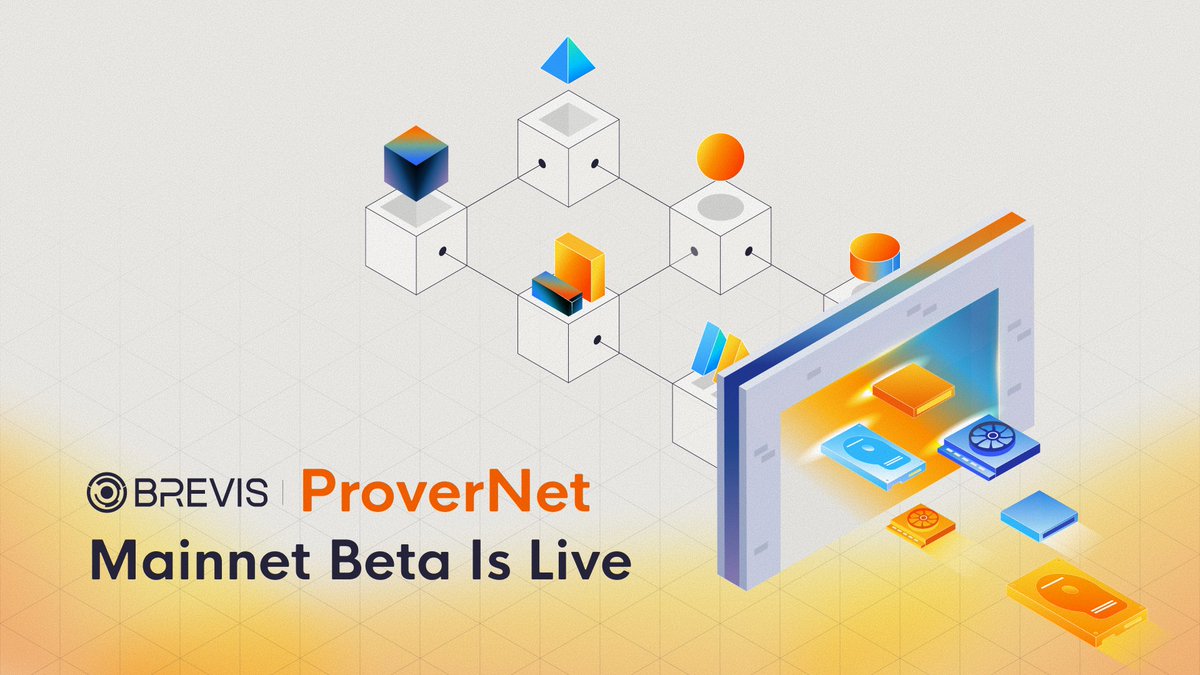
In the field of ZK (Zero-Knowledge Proofs), there has long been an "invisible threshold" that has driven developers to frustration: not only do you have to write complex circuit codes, but you’re often required to build and maintain costly Prover infrastructure yourself. It’s akin to wanting to open a bakery but being required to build a power plant in your backyard first. However, on December 8, 2025, this problem was finally solved. The beta version of the @brevis_zk mainnet officially went live. This is more than just the announcement of a mainnet launch; it marks a paradigm shift for ZK computing power, transitioning from "private deployment" to a "decentralized market." ### 1️⃣ Why do we need an "Uber-style" Prover marketplace? The Brevis team presented an intriguing data point in their whitepaper: they’ve already processed over 250 million proofs, serving more than 30 top-tier partners, including Uniswap, PancakeSwap, and Linea. Through this process, they discovered a major pain point: ZK workloads are highly heterogeneous. Simply put, some proofs require extremely high single-core CPU performance, while others heavily depend on GPU parallel computing. If every application had to maintain its own hardware infrastructure, the costs would be exorbitant, and efficiency would be abysmally low (it’s like buying a Ferrari to deliver takeout or using a bicycle to haul cargo). The core logic behind Brevis ProverNet is to establish a two-sided matching marketplace for computation power: - **For application side:** You no longer need to worry about the type of machines running in the background. Just submit your request into the network—similar to placing an order on a ride-hailing app—and the system will automatically match you with the most suitable Prover. - **For miner side:** Whether you’re a CPU or GPU miner, as long as your hardware meets the specific task requirements, you can bid for jobs in the auction and receive real-time payouts. ### 2️⃣ Beta phase: A hands-on "gray-scale test" Unlike many projects that "issue tokens first and deliver later," Brevis’s beta launch reflects a pragmatic, hands-on approach: - **Real monetary settlements:** While the future will use the BREV token for payments, during the beta phase, the market directly settles payments in USDC. This means that Provers participating now can earn stablecoin income in real monetary terms, rather than just points or test tokens. - **Seamless integration:** Developers no longer need to deal with running Docker or fixing bugs. Documentation shows that applications can now directly submit requests to ProverNet. - **Production-grade testing:** Brevis is migrating a portion of the Ethereum block execution proofs from [https://t.co/bNgG0d4Zga](https://t.co/bNgG0d4Zga) into this network. This isn’t a drill; it’s a real production-level stress test. ### 3️⃣ Insights for developers: Filling the last piece of the decentralization puzzle For years, the "decentralized applications" we talk about often fail in one key aspect: while smart contracts are decentralized, the generation of ZK proofs often relies on a centralized server owned by the project team. If that server goes down, the entire pipeline breaks. Brevis ProverNet essentially fills this gap. By leveraging decentralized bidding and matching, it prevents single points of failure and eliminates vendor lock-in. ### 4️⃣ What’s next? Although still in the beta phase, this could be the best opportunity for early participants, particularly hardware owners, to reap the benefits: - **If you have computational power:** The documentation for running GPU and CPU nodes has already been published. You can register now as a Prover to compete for orders across the network. - **If you’re a developer:** It’s time to shut down your own expensive and unreliable AWS instance and try offloading your workloads to the network. ➡️ From "0 Knowledge" to "Zero Knowledge," we’ve come a long way—nearly 10 years of slogans and narratives. The launch of Brevis ProverNet signifies that ZK technology is finally transitioning from "showing off technical prowess" to "industrialization." When computing power becomes as accessible and pay-as-you-go as electricity, the true Cambrian explosion of ZK applications will finally have its physical foundation.

Share


Source:Show original
Disclaimer: The information on this page may have been obtained from third parties and does not necessarily reflect the views or opinions of KuCoin. This content is provided for general informational purposes only, without any representation or warranty of any kind, nor shall it be construed as financial or investment advice. KuCoin shall not be liable for any errors or omissions, or for any outcomes resulting from the use of this information.
Investments in digital assets can be risky. Please carefully evaluate the risks of a product and your risk tolerance based on your own financial circumstances. For more information, please refer to our Terms of Use and Risk Disclosure.