



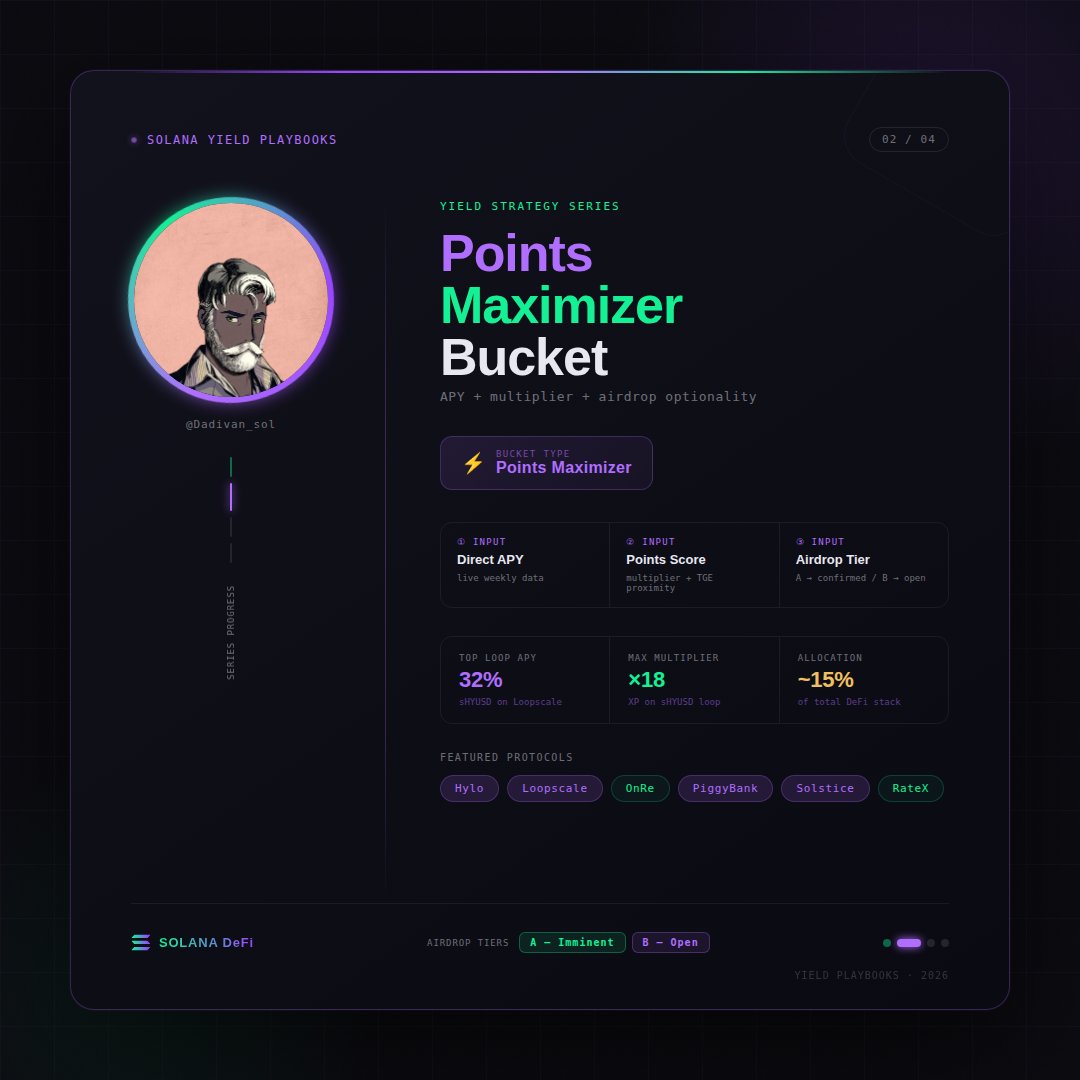
🫡 Solana Yield Playbooks #2 of 4 Points Maximizer Bucket Most people treat points like a bonus. Deposit, earn APY, hope the airdrop hits. That's not maximizing. That's waiting. The Points Maximizer stacks direct yield + points multiplier + token optionality on the same capital. Total expected return looks nothing like headline APY. Here's how I build it. ⸻ The Framework Three inputs per protocol: ① Direct APY – tracked weekly ② Points Score – accumulation rate, multipliers, TGE proximity ③ Airdrop Tier – A (token confirmed/imminent), B (pre-token, open runway), C (post-drop, diminishing) Total upside rank ≠ APY rank. That gap is the alpha. One rule before positions: Points are optionality, not yield. Size this bucket for what you can afford to return zero on the token side. If base APY alone justifies the position, everything else is upside. If you're only here for the airdrop, you're speculating. ⸻ Position 1 - $sHYUSD @hylo_so 13.43% APY | ▲ 0.12% | Points: 9/10 | Airdrop: B Highest multiplier stack on Solana right now. Base position: hold sHYUSD, earn 1 XP/$/day. Fine alone. The real play is integrations: → sHYUSD-hyUSD looping on @loopscale → 28.13% APY + x18 XP multiplier → sHYUSD-USDC looping on @loopscale → 32.13% APY + x7.8 XP multiplier → sHYUSD YT on @RateX_Dex → 13.68% APY + x16.65 XP multiplier x18 on a 28% APY loop. That's not a points farm. That's yield with asymmetric optionality on top. Hylo Season 1 active. No end date. Token unconfirmed. Long runway still open. → My largest points position. Base yield justifies the size. The multiplier is why I'm not reducing it. ⸻ Position 2 - $ONyc @onrefinance 10.19% APY | ▼ 0.02% | Points: 9/10 | Airdrop: B Most underpriced points structure on Solana. Base APY looks moderate. The strategy layer changes everything: → ONyc/USDC or ONyc/USDG looping on @kamino or @loopscale → 17–18% APY + 6x multiplier → Yield trading on @ExponentFinance or @RateX_Dex → 5x multiplier → Lending ONyc on Kamino → 3x multiplier RWA-backed yield. Zero Drift exposure. Points stacking on institutional reinsurance cash flows. Token unconfirmed. Program active. → ONyc appears in my Conservative Bucket at base lending. In Points Maximizer, I run the 6x looping strategy instead. Same protocol. Different execution. Different total return. ⸻ Position 3 - $USDC @loopscale (OnRe vault) 8.74% APY | ▲ 0.26% | Points: 8/10 | Airdrop: B The hidden position. Most people miss it. One deposit earns two unconfirmed tokens simultaneously: → Loopscale points (lending + looping activity) → ONyc external points (tracked through Loopscale, distributed by OnRe) Post-Drift: only SOL/JitoSOL/wETH vaults had exposure. USDC OnRe vault unaffected. APY trending up since. 8.74% base yield. Two pre-token protocols stacking rewards on same capital. When two independent points programs run on one position, that's not a detail. That's the strategy. → ~20% of my points bucket. Lowest APY in the tier, highest optionality-per-dollar. ⸻ Position 4 - $pbUSDC @piggybank_fi 19.73% APY | ▼ 0.20% | Points: 8/10 | Airdrop: A Only A-tier airdrop signal in this bucket. Oink Season 1 just launched after Season 0 ended March 31. Season 1 countdown: 172 days. That runway matters. Points accumulating on the highest APY position on the entire leaderboard. USDC vault earns base Oinks, no multiplier, but 19.73% APY while stacking pre-TGE points is hard to argue with. Tier A because Season 0 ended on a specific date with Season 1 launching immediately. Not a protocol delaying. A protocol with a plan. → pbUSDC already anchors my Conservative Bucket at 55%. In Points Maximizer I'm counting the Oink accumulation as the layer on top. Not sizing up further. Position already right-sized for yield. Points are the bonus. ⸻ Position 5 — $eUSX @solsticefi ~3.5% APY | Points: 0/10 | Airdrop: A - Season 1 distributing now Flares Season 1 just closed. Registration live. 7-day window. If you farmed Season 1 — connect wallet, pay 0.075 SOL fee, lock your allocation. The honest picture: → Cohort 1 and 2 early participants: meaningful allocation, likely worth registering → Cohort 6 late entrants: allocation may not cover the fee. Do the math before paying. This is what C-tier diminishing optionality looks like in real time. Season 2 announced. New accumulation window opening. For new entrants: Season 2 is where the asymmetric bet now lives, not Season 1 registration unless you're Cohort 1–2. → eUSX stays in the bucket as a Season 2 play. Size it for what you can afford to write off on the yield side. Base APY at 3.5% is the cost of optionality. The lesson this week: Early cohort positioning in points programs isn't decoration. It's the entire difference between a meaningful allocation and one that doesn't cover the fee. Entry timing in the Points Maximizer matters as much as protocol selection. ⸻ What doesn't enter this bucket ❌ Protocols where points are the only reason to hold – if base APY is under 3% with no multiplier available, it's speculation not allocation ❌ Closed programs – Perena Petals closed. USD* Junior is a claim event, not a points play ❌ Post-first-airdrop programs with no clear Season 2 signal – diminishing optionality ⸻ Sizing This Bucket I keep ~15% of my total DeFi allocation here. But most of these protocols already live in my Conservative Bucket. The 15% isn't a separate pool. It's the incremental sizing decision: how much extra I hold specifically for points optionality, and which strategy I run to capture the multiplier. pbUSDC: already sized for yield. Points are free. ONyc: sized up to looping strategy for the 6x. Conservative position was base lending. sHYUSD: sized for the x18 Loopscale loop, not just base hold. Loopscale USDC OnRe: pure points play on top of acceptable base yield. eUSX: small. Asymmetric. Sized for zero. ⸻ Key Signals I Watch Weekly → sHYUSD Loopscale multiplier - if x18 drops, reassess sizing immediately → ONyc loop APY spread – borrow cost vs ONyc yield. If spread compresses below 5%, 6x multiplier matters less → pbUSDC Oink S1 milestones – any TGE hint moves this from A to A★ → Solstice S1 registration closes in 7 days - Cohort 1–2 register immediately, Cohort 6 calculate first → Solstice Season 2 incoming - the next asymmetric entry point → Any protocol adding Loopscale USDC OnRe to external points – third token stack on one position changes the math entirely ⸻ Most people see APY. I see APY + points rate + multiplier + TGE proximity. The total return number looks completely different when you run the full stack. ⸻ Playbook #3 next: RWA Income Bucket Real-world cash flows, tranching logic, and why this is where DeFi starts behaving like actual finance. Follow to get each one as it drops.

Share


Source:Show original
Disclaimer: The information on this page may have been obtained from third parties and does not necessarily reflect the views or opinions of KuCoin. This content is provided for general informational purposes only, without any representation or warranty of any kind, nor shall it be construed as financial or investment advice. KuCoin shall not be liable for any errors or omissions, or for any outcomes resulting from the use of this information.
Investments in digital assets can be risky. Please carefully evaluate the risks of a product and your risk tolerance based on your own financial circumstances. For more information, please refer to our Terms of Use and Risk Disclosure.