


Western Union just announced USDPT, a dollar-pegged stablecoin on Solana, issued through @Anchorage. The instinct is to file it under "legacy company chasing crypto." That misses the point. @WesternUnion holds $3.45 billion in settlement balances prefunded across destination corridors worldwide. Capital locked up for days so recipients can collect on the other end. Settling on-chain compresses that from days to minutes, freeing real working capital. Western Union already owns that no stablecoin protocol can easily replicate: hundreds of thousands of physical agent locations across 200+ countries, and 170 years of jurisdiction-by-jurisdiction compliance infrastructure. And though the GENIUS Act raises compliance burdens for stablecoin issuers, for Western Union, that is a moat. You may also want to compare it against @PayPal too, especially with its booming PYUSD supply. However, PYUSD targets more of the digitally native user. On the other hand, USDPT targets the harder problem: corridors where cash and crypto need to coexist, and where last-mile delivery still runs through physical networks. From there, they could also expand for digital cross-sell. They are different bets on different customers with different infrastructure logic. Would this move be able to drive Western Union's revenue back up, thereby bolstering its stock price?

Share


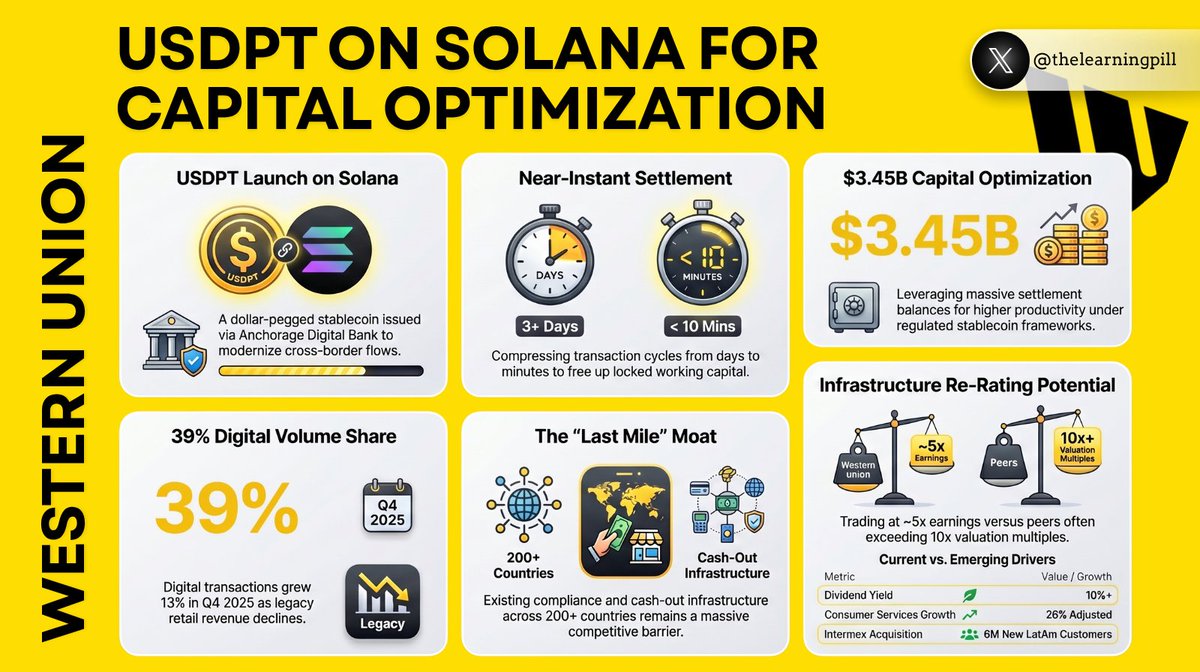
Source:Show original
Disclaimer: The information on this page may have been obtained from third parties and does not necessarily reflect the views or opinions of KuCoin. This content is provided for general informational purposes only, without any representation or warranty of any kind, nor shall it be construed as financial or investment advice. KuCoin shall not be liable for any errors or omissions, or for any outcomes resulting from the use of this information.
Investments in digital assets can be risky. Please carefully evaluate the risks of a product and your risk tolerance based on your own financial circumstances. For more information, please refer to our Terms of Use and Risk Disclosure.