





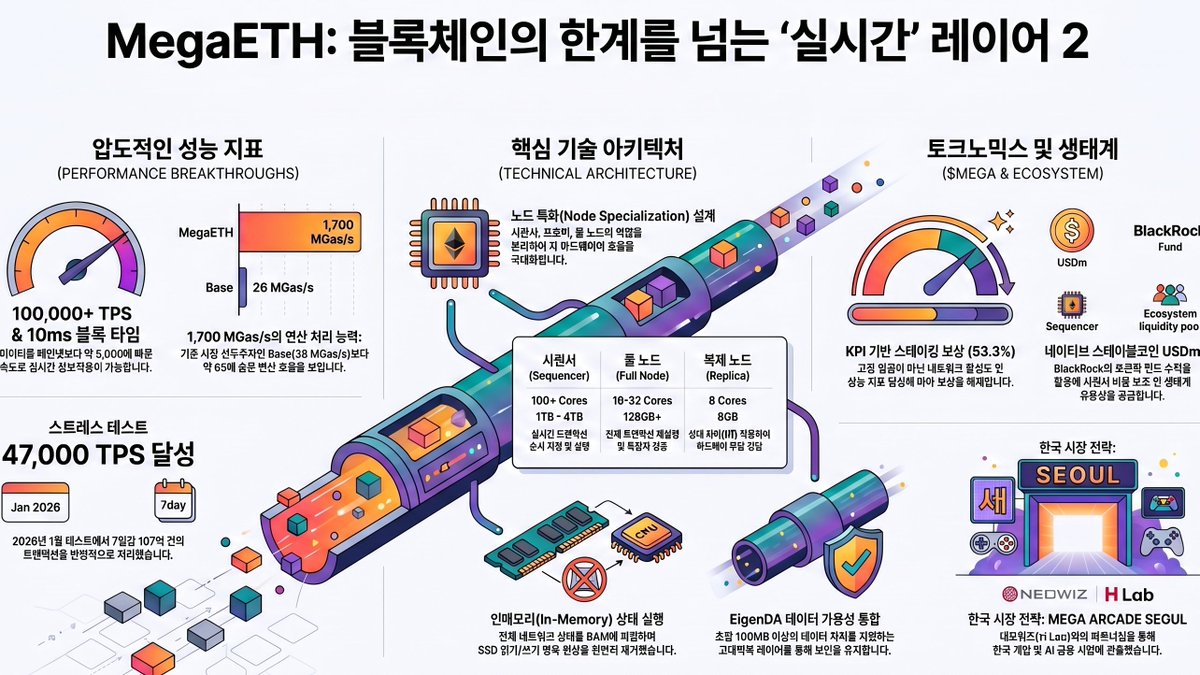
Is MegaETH Handling the Entire Blockchain Trilemma? 2026.05.10 SUN | We eagerly anticipate whether #MegaETH @megaeth (mainnet launch in Feb 2026) will establish itself stably among various mainnets. Designed as an EVM-based high-performance mainnet targeting 100,000 TPS for rapid scalability, it secures security based on Ethereum L1 (Eigen DA) and enhances decentralization through “node specialization” on the mainnet—raising hopes that it can become a blockchain inclusive of both individuals and institutions. Prior to this, I’ve compiled a brief overview based on the recent meetup and introduction to MegaETH. | A recent #MegaArcadeSeoul event for MegaETH was held. Despite being underground, the spacious venue provided a comfortable atmosphere with many engaging activities. Before diving into details, a brief explanation of MegaETH (Make MegaETH Great Again?): MegaETH is a platform leveraging its own native stablecoin, $USDm, which is backed and managed by BlackRock, the world’s largest asset manager, through its U.S. Treasury (Buidl) fund as institutional tokenized assets. When users convert Tether’s USDT or Circle’s USDC into USDm, the circulating supply of USDm increases, thereby expanding the collateral backing the Buidl fund. This augmented ecosystem asset base is then used to purchase #MegaETH $MEGA, creating a virtuous cycle that enhances overall ecosystem stability. -------------------- | The event featured multiple activities: attendees received 20 USDm of MegaETH’s native stablecoin via the Euphoria app, participated in Euphoria @Euphoria_fi’s one-click trading competition, and enjoyed various fun events such as a first-come-first-served quiz, bingo games, and Pokémon card draws. Merchandise included MegaETH tumblers, power banks, MegaETH eye masks, and baseball caps won through the card-drawing game. Even though this was my first time writing about MegaETH, the projects introduced at the event were explained simply and intuitively, making them easily understandable for everyone. Beyond simple on-chain trading, MegaETH offers tangible real-world benefits: Ubitel @getubitel provides eSIM-based mobile data accessible in over 200 countries as a DePIN network, eliminating roaming fees; Monster @mnstr is an on-chain Pokémon card platform where users can purchase card packs online with USDm, verify authenticity grades from PSA, CGC, or BGS, and either receive insured physical cards by mail or sell them at 85% of market price. Lastly, Brix @brix_money—potentially responsible for MegaETH’s mainnet TVL—is an on-chain carry trade and arbitrage platform based on Turkey’s Lira (TRY), offering a high-yield platform at 29.7% annual interest. It tokenizes assets via iTRY tokens functioning like a stable savings account backed by Turkish MMFs. However, given the long-term expectation of persistent inflation in Turkey’s Lira, it remains to be seen whether even higher yields will remain attractive—even if users hedge their Lira-denominated tokens with a 1x short position. It was a refreshing and thoroughly enjoyable event after a long time. Though I’m still facing personal challenges and multiple headwinds, attending such events like this remains a valuable way to recharge. In this way, MegaETH aims not merely to be labeled a high-performance chain but to become a real-time mainnet rivaling Web2.0 standards. Designed to transcend the limitations of Ethereum Layer 2 (L2), MegaETH’s mainnet invites deeper understanding through examining its technical innovations and tokenomics alongside comparisons with competing mainnets. -------------------- 1. Block Time in Blockchain and MegaETH | For blockchain to achieve mass adoption, it must first improve user experience (UX) by reducing latency and enabling faster operation.If the original Ethereum L1 guaranteed a maximum of 15 seconds, MegaETH is advancing toward a high-performance mainnet with real-time responsiveness and even faster speeds. 💡 Key Blockchain Latency and Performance Category | Block Time | Performance (TPS) Ethereum | ~12 seconds | 15–30 Base | ~2 seconds | Up to 159 MegaETH | 0.01 seconds (10ms) | 47k sustained, 15k–35k (target: 100k) MegaETH successfully processed 11 billion transactions over one week during its January 2026 network stress test, proving its credibility as a true high-performance mainnet. A key innovation here is the “dual-block model”: it maintains compatibility with existing tools via 1-second EVM blocks, while simultaneously accepting transactions in real time through 10ms mini-blocks, demonstrating tangible operational value. -------------------- 2. Beyond Hardware Limits: Node Specialization and Optimization MegaETH breaks the conventional assumption that “all nodes must perform the same tasks” by adopting “node specialization,” shifting the system’s bottleneck from memory speed paradigms. 🛠️ Node Specialization and Hardware Specifications * Sequencer: The network’s single execution engine. Uses data center-grade hardware (100-core CPU, 1TB–4TB RAM, 10Gbps bandwidth) to keep the entire network state resident in memory (in-memory approach), eliminating SSD read/write latency. * Prover: Performs stateless validation. Leverages “witnesses” — data packages generated by the sequencer — to asynchronously verify block validity without storing the full state. * Replica Node: Applies only “state diffs” from the sequencer without re-executing transactions. Enables participation with standard hardware (8-core CPU, 8GB RAM), ensuring decentralized scalability. * Witness Verifier: Can operate with the lowest specs (2-core CPU, 1GB RAM), ensuring system integrity. 🚀 Core Technologies: evmone and SALT 1) AOT/JIT Compilation and evmone: MegaETH uses evmone, a high-performance interpreter written in C++, enhanced with a JIT (Just-In-Time) compiler to accelerate smart contract execution to near-native code speeds. 2) SALT (Small Authentication Large Trie): A novel indexing structure designed to eliminate bottlenecks when accessing large state data, maximizing memory efficiency. 3) EigenDA Integration: Adopted as the data availability (DA) layer to support real-time performance requiring over 100MB/s DA bandwidth, securing both security and speed. -------------------- 3. Ecosystem Mainnet Comparison While MegaETH is often compared to Monad within the high-performance blockchain ecosystem, its technical architecture and direction are fundamentally distinct. 📊 High-Performance Infrastructure Mainnet Comparison Comparison | Arbitrum (L2) | Monad (L1) | MegaETH (L1) Architecture | Optimistic Rollup | Parallel Execution | Real-time Optimized L1 Block Time | ~250ms – 2s | 400ms | 10ms (mini-block) Security Anchor | Ethereum L1 | MonadBFT | L1 (leveraging EigenDA) Scalability | Software-optimized | Software-heavy | Hardware-heavy 🎯 Real-Time Infrastructure: MegaETH 1) Fully On-Chain Gaming: Perfectly supports simulation games (e.g., Crossy Fluffle) requiring under 100ms latency. 2) High-Frequency Trading (HFT): Enables order execution and cancellation at 10ms intervals, matching centralized exchange (CEX) speeds — enabling institutional-grade liquidity to be absorbed on-chain. 3) AI Agent Finance: Offers the only environment capable of operating AI-driven asset management services without delay, with real-time data feeds and state updates. -------------------- 4. Institutional-Grade Economic Model: $MEGA and $USDm MegaETH is building a tokenomics model focused not on speculation, but on aligning value with the network’s actual growth. 💰 KPI-Based Rewards and Value Linkage * Performance-Linked Rewards: The MEGA token lock-up schedule is not merely time-based dilution; it is directly tied to tangible network performance metrics (KPIs), including TVL achieved, USDm circulating supply, and sustained TPS levels.In the long term, the team and investors can focus not just on short-term token price appreciation, but on sustainable infrastructure expansion. * USDm Buyback Program: We have an automated buyback mechanism that uses revenue generated from issuing the native stablecoin, USDm, to repurchase MEGA tokens from the market. This structure increases token scarcity in line with network TVL and active usage. Yesterday’s first buyback: https://t.co/RRj7MpnDqX 🏦 Institutional Trust and Regulatory Compliance * BlackRock & Ethena Partnership: USDm is collateralized by BlackRock’s tokenized Treasury fund (Buidl) and issued by Ethena, delivering institutional-grade trust. * MiCA Compliance and European Expansion: Compliant with Europe’s MiCA regulations, we provide regulated access for European retail investors. Collaboration with regulated custodians like OKCoin Europe opens the door to institutional capital inflows. -------------------- 5. Toward a Future Where Blockchains Feel Like the Internet | MegaETH is launching its mainnet on the security foundation of Ethereum, signaling the beginning of a high-performance, institutional-grade chain that delivers Web2.0-level performance. While modular mainnets make it easy for anyone to launch a chain, the real challenge lies in building a competitive, sustainable mainnet that proves its value through organic capital circulation—fast, efficient, and self-reinforcing. MegaETH aims to become the most transparent, trusted, and fastest next-generation infrastructure to accomplish this difficult yet essential task. * USDm Circulating Supply Reaching 500M: Currently at ~480M, we are close to our target and expect to reach it well before the next MEGA token unlock. * Real-time dApp Activity: Key metrics include transaction market share from major protocols like GMX and Aave V3, as well as user retention in on-chain games. * Sequencer Rotation Decentralization: The degree to which sequencer operations are distributed among globally specialized operators will be critical to monitor. We look forward to seeing whether MegaETH will fulfill its goal of being a “real-time high-performance chain”—not merely a place where assets reside, but a global nexus connecting finance, gaming, and AI infrastructure.

Share




Source:Show original
Disclaimer: The information on this page may have been obtained from third parties and does not necessarily reflect the views or opinions of KuCoin. This content is provided for general informational purposes only, without any representation or warranty of any kind, nor shall it be construed as financial or investment advice. KuCoin shall not be liable for any errors or omissions, or for any outcomes resulting from the use of this information.
Investments in digital assets can be risky. Please carefully evaluate the risks of a product and your risk tolerance based on your own financial circumstances. For more information, please refer to our Terms of Use and Risk Disclosure.