


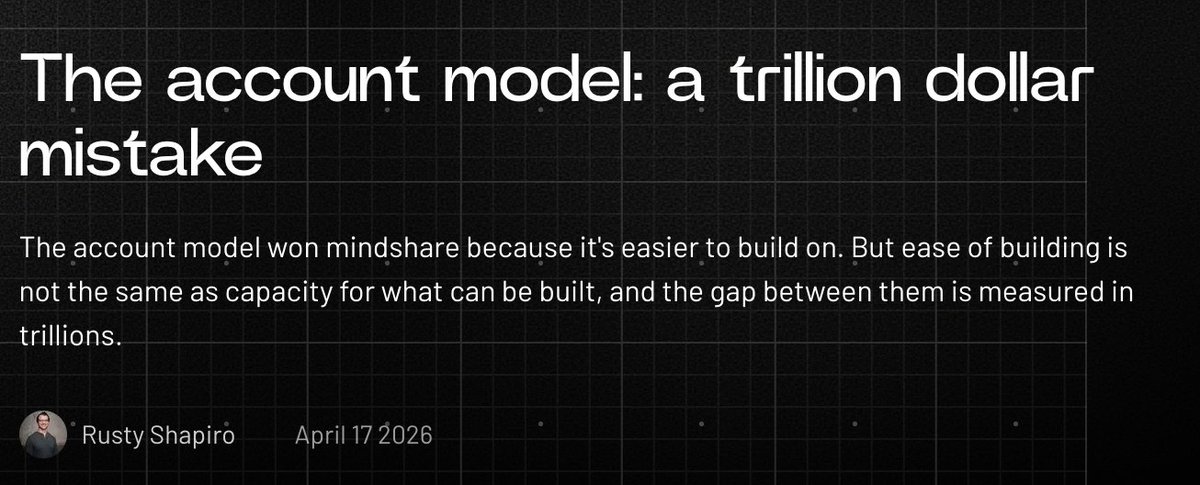
Account Model (Ethereum) vs. eUTxO (Cardano) - The account model dominates the market simply because it’s easier to build on—but ease of construction is entirely different from what you can build on top of it. - Ethereum stores all state in a shared Merkle trie. As the number of users grows, everyone’s access cost rises together. This means success itself becomes a burden. Right now, it’s only hidden because validators subsidize it like a grant. - More seriously, there’s dead state: roughly 80% of Ethereum’s entire state hasn’t been touched in over a year. With incentives for cleanup broken, this dead data accumulates forever—every live transaction must traverse this graveyard. - eUTxO has none of this. Each UTxO is an independent object, so access cost is effectively constant. Moreover, consumption equals deletion, so state automatically cleans itself up. The depositor even gets their collateral back—so the person cleaning up actually profits. - The commonly criticized “eUTxO contention problem” is a straw man. Contention exists in every financial market—the difference is who pays the cost. In Ethereum, even losing transactions pay gas fees. In eUTxO, losing transactions are filtered out cheaply at stage one, so losers pay $0. - MEV, front-running, and sandwich attacks are ultimately structural byproducts of the account model’s approach to resolving contention at execution time. eUTxO makes these structurally impossible. - Optimizing on top of the account model isn’t a fundamental solution. Gas scheduling improvements, state expiration, Verkle trees, statelessness, L2s—all are optimizations within the limits of a flawed data model. The problem lies in the foundation itself, which cannot be fixed without replacing it. - eUTxO is the assembly language of financial infrastructure. It’s not intuitive, but it maps faithfully to economic reality. Complaints about developer experience aren’t about tearing down the foundation—they’re about building compilers and frameworks on top of it to solve the problem. - Ultimately, the true beginning of DeFi economics (P2P credit markets + order books) is difficult to achieve on the account model. Traditional finance has $42 trillion in non-margin debt and $100 trillion in securities settlement infrastructure. Failing to support this flow is a $1 trillion mistake. https://t.co/SITDfTUQF4

Share


Source:Show original
Disclaimer: The information on this page may have been obtained from third parties and does not necessarily reflect the views or opinions of KuCoin. This content is provided for general informational purposes only, without any representation or warranty of any kind, nor shall it be construed as financial or investment advice. KuCoin shall not be liable for any errors or omissions, or for any outcomes resulting from the use of this information.
Investments in digital assets can be risky. Please carefully evaluate the risks of a product and your risk tolerance based on your own financial circumstances. For more information, please refer to our Terms of Use and Risk Disclosure.