



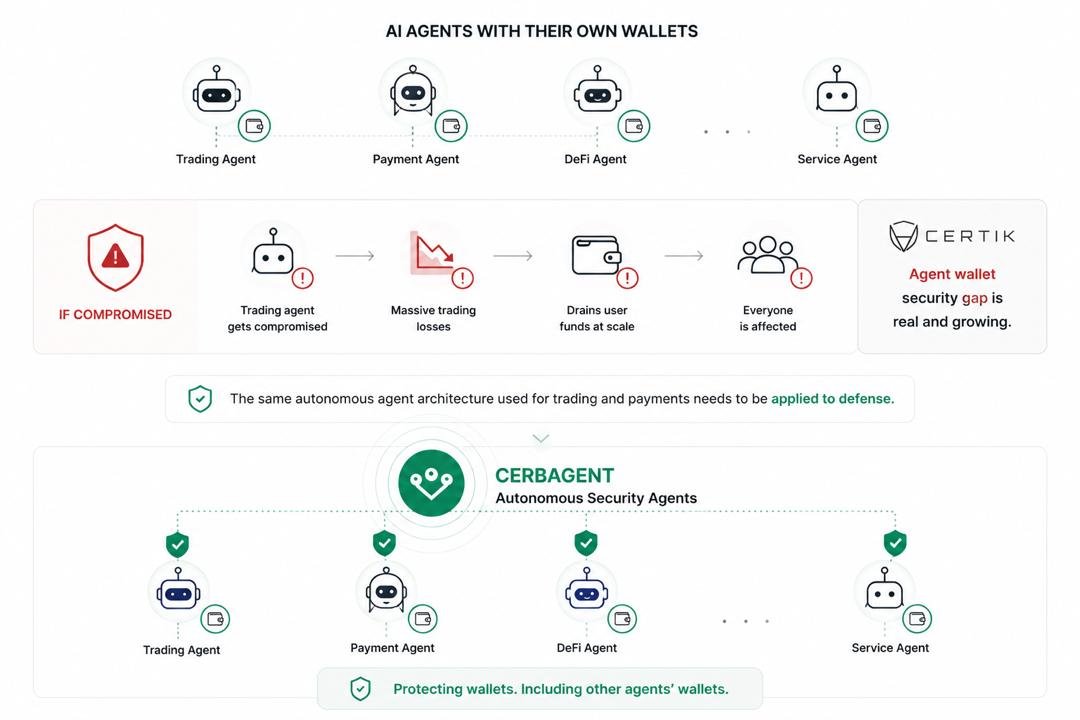
AI agents are getting their own crypto wallets now. These are pieces of software that hold funds, execute trades, pay for services, and interact with protocols on their own. No human clicks required. They can run 24/7, moving money across chains while you sleep. But here's the question nobody is asking: who is securing those agent wallets? If a trading agent gets compromised, it does not just lose one user's funds. It can lose everyone's. The agent might control a shared pool or have permission to pull from multiple connected wallets. One bad update or injected command, and it starts sending assets to an attacker. If a payment agent gets a malicious skill slipped in, it can drain wallets at scale. Think of it like giving a helpful assistant full access to your bank account, then someone tricks it into wiring money to a scammer. Researchers have already shown how prompt injections and hidden tool calls can make agents hand over keys or approvals without anyone noticing. CertiK flagged this exact risk recently. Their reports on tools like OpenClaw highlighted how attackers seed malicious skills that target browser wallets such as MetaMask or Phantom. One case involved routers quietly stealing credentials and draining $500,000 from a single wallet. The problem is growing as more agents handle real money. Losses from wallet exploits already hit billions last year, and most came from approvals that sat unnoticed for months. The same autonomous agent architecture used for trading and payments now needs to be applied to defense. You cannot rely on manual checks or dashboards when everything moves at machine speed. That is the entire point of CerbAgent $CERB Their system deploys three AI agents that protect wallets around the clock across Ethereum, Solana, Base, and four other chains. The Shield agent watches approvals in real time and revokes dangerous ones instantly, often in the same block as an exploit. The Sentinel agent simulates every transaction before it happens, spotting phishing attempts or risky contracts that a trading agent might otherwise approve. The Recovery agent steps in if something slips through, using private mempools to pull assets back before drainers can act. It works for regular wallets and for agent wallets too. A security agent can sit in front of a trading agent, monitoring its permissions and blocking anything suspicious. No more hoping the trading bot stays safe. The defense runs autonomously, just like the offense. If you are building or using AI agents in crypto, this is worth a look. Head to https://t.co/KXgeUJlSqL to see how the agents operate, and follow @CerbAgent for updates on $CERB
 🔅LAMIS
Share
Source:Show original
Disclaimer: The information on this page may have been obtained from third parties and does not necessarily reflect the views or opinions of KuCoin. This content is provided for general informational purposes only, without any representation or warranty of any kind, nor shall it be construed as financial or investment advice. KuCoin shall not be liable for any errors or omissions, or for any outcomes resulting from the use of this information.
Investments in digital assets can be risky. Please carefully evaluate the risks of a product and your risk tolerance based on your own financial circumstances. For more information, please refer to our Terms of Use and Risk Disclosure.