


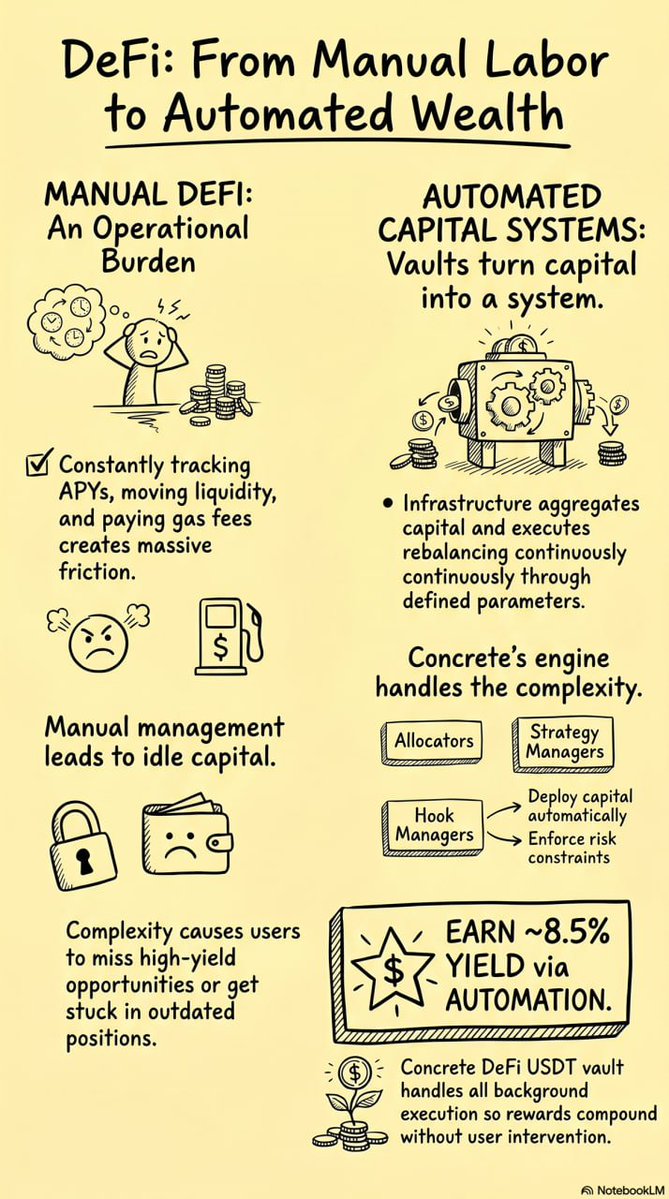
If You Can’t Explain Yield, You Are the Yield DeFi has made yield extremely visible. Every dashboard shows APY, every vault shows growth, and every deposit flow feels clean. Because of that, many users treat yield like a displayed number, while the real outcome is produced by a full financial system operating underneath. 1) Yield starts with a clean interface A user opens an app, deposits USDC or ETH, and receives vault shares. That interaction feels simple because the interface compresses complexity into a few actions. • The user sees a supported base asset • The user receives ERC-20 vault shares • The user tracks performance through vault growth Concrete uses ERC-4626 precisely for this reason. The standard makes deposits, withdrawals, and yield accounting easier to structure across DeFi, and it turns vault shares into an interoperable asset that can move across other applications more smoothly. 2) The number on screen is only the first layer The displayed APY gives users a reference point. The realized outcome, however, comes from a moving combination of allocations, strategy selection, execution quality, and market conditions. @ConcreteXYZ’s docs frame this as automated asset management and continuous accounting. The system allocates deposited funds across strategies, then updates fees, yield, and accounting through on-chain automations. Their Earn docs also describe continuous monitoring and rebalancing to adapt to changing APYs and avoid inefficient capital placement. That distinction matters because displayed yield is a surface metric, while real yield is a system output. 3) Yield comes from economic activity, not from the dashboard itself Once capital enters a vault, the return comes from what the capital actually does. Concrete describes several strategy paths, including: • lending into money markets • providing liquidity on Pendle • holding yield-bearing assets • reallocating capital as opportunities shift That means yield is generated by market activity such as lending demand, trading-related flows, tokenized yield assets, and the strategy layer that routes capital between them. The dashboard displays the result, while the strategy stack creates the return. 4) Understanding determines outcome Two users can enter the same yield environment and still walk away with very different results. One user follows headline APY. Another user studies the structure: • what asset is deposited • what strategies receive that capital • how frequently the system rebalances • what form the vault share takes • where that share can be reused in DeFi That second layer matters even more on Concrete because the vault share itself becomes a primitive. Concrete states that tokens appreciate as the vault generates yield and can also be used for liquidity, trading, leverage, and new structured products. So the position is not only a passive deposit. It becomes composable capital. 5) DeFi is shifting from yield display to yield engineering This is where the market is evolving. Earlier DeFi cycles rewarded users who could discover yield. This phase increasingly rewards users who can understand how yield is produced, managed, and packaged. Concrete’s own positioning fits that shift. The platform describes Earn as automated infrastructure that allocates, rebalances, and compounds yield across on-chain opportunities, with a focus on risk-adjusted returns and scalable vault architecture. 6) Why Concrete matters in this context Concrete Vaults move the user experience from manual vault hopping toward structured exposure. Instead of asking “Which farm has the highest APY today?” The better question becomes “Which system manages capital, accounting, and strategy design most effectively over time?” That is the deeper takeaway. Yield is revenue, shaped by strategy, updated by execution, and refined by risk management. Once a user sees yield through that lens, the entire DeFi stack looks different. Explore Concrete at https://t.co/upj8Qi8Xc5

Share


Source:Show original
Disclaimer: The information on this page may have been obtained from third parties and does not necessarily reflect the views or opinions of KuCoin. This content is provided for general informational purposes only, without any representation or warranty of any kind, nor shall it be construed as financial or investment advice. KuCoin shall not be liable for any errors or omissions, or for any outcomes resulting from the use of this information.
Investments in digital assets can be risky. Please carefully evaluate the risks of a product and your risk tolerance based on your own financial circumstances. For more information, please refer to our Terms of Use and Risk Disclosure.