


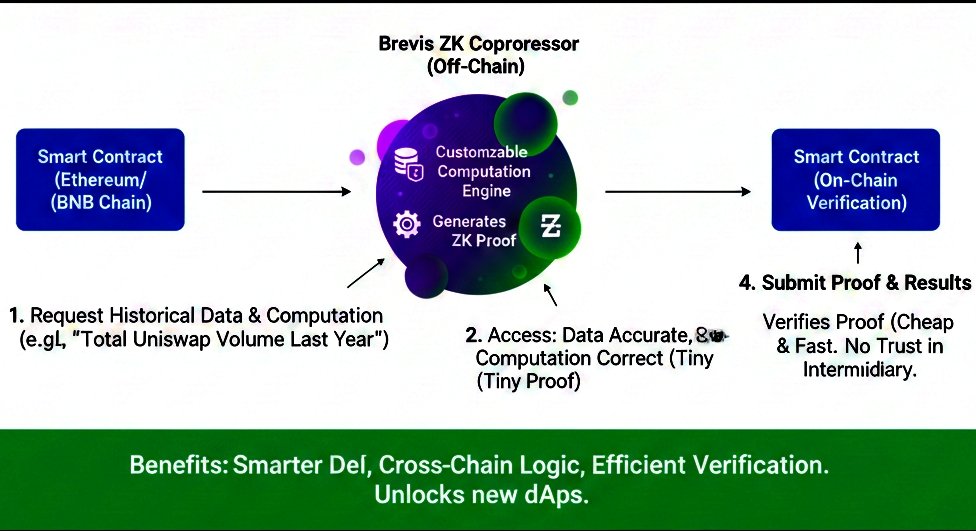
smart contracts on blockchains like ethereum or bnb chain are powerful but severely limited: >>- they can only easily access the current state of the blockchain (e.g., current balances, recent events). >>- querying historical data (e.g., a user's past trading volume, total transactions over months, or events from years ago) is extremely expensive, slow, or impossible on-chain due to gas costs and storage limits. >>- cross-chain data is even harder contracts on one chain can't natively "see" history from another. >>- as a result, many advanced features rely on off-chain oracles, indexers, or centralized servers, which reintroduce trust assumptions (e.g., trusting an oracle not to lie about past data). @brevis_zk fixes this by offloading heavy computation to a zk-powered coprocessor: 1. a smart contract sends a request specifying what historical data it needs and what computation to run (e.g., "calculate this user's total trading volume on uniswap over the last year"). 2. brevis accesses full archival blockchain data off-chain, performs the customizable computation. 3. it generates a tiny zero-knowledge proof (zk proof) that mathematically proves: ✓- the data used is accurate and truly from the blockchain's history. ✓- the computation was done correctly. 4. the proof (and results) is submitted back on-chain, where the smart contract verifies it quickly and cheaply no need to trust any intermediary. this is all done trustlessly: you verify the math, not the operator. no off-chain data sources or oracles required for the history itself. why this unlocks the points mentioned 1. smarter defi logic protocols can now base decisions on real user history. examples already live: → volume-based fee discounts on dexs (like vip tiers on centralized exchanges something impossible before due to cost). → personalized yields, rewards, or risk adjustments based on past behavior (e.g., loyal lps get higher boosts). → dynamic incentives distributed continuously and verifiably (brevis has powered over $231m in such rewards). 2. better cross-chain applications brevis is omnichain — it supports data from multiple chains (ethereum, bnb, linea, etc.). this enables true cross-chain logic without fragile bridges or trusted relayers, like verifying activity on one chain to unlock benefits on another. 3. faster, more efficient verification heavy work happens off-chain (fast and cheap), but verification is on-chain and succinct (tiny proof = low gas). everything stays decentralized and secure, while feeling as responsive as web2 apps. in short, brevis gives blockchains "memory" of their own past without the usual trade-offs. it's already in production with partners like uniswap hooks, pancakeswap, metamask, linea, and more processing billions in volume and millions of proofs. this is why people are bullish: it removes a fundamental bottleneck, enabling a new wave of sophisticated, data-driven dapps that were previously impractical. the blockchain can finally "interact with its own history" securely and efficiently.

Share


Source:Show original
Disclaimer: The information on this page may have been obtained from third parties and does not necessarily reflect the views or opinions of KuCoin. This content is provided for general informational purposes only, without any representation or warranty of any kind, nor shall it be construed as financial or investment advice. KuCoin shall not be liable for any errors or omissions, or for any outcomes resulting from the use of this information.
Investments in digital assets can be risky. Please carefully evaluate the risks of a product and your risk tolerance based on your own financial circumstances. For more information, please refer to our Terms of Use and Risk Disclosure.