


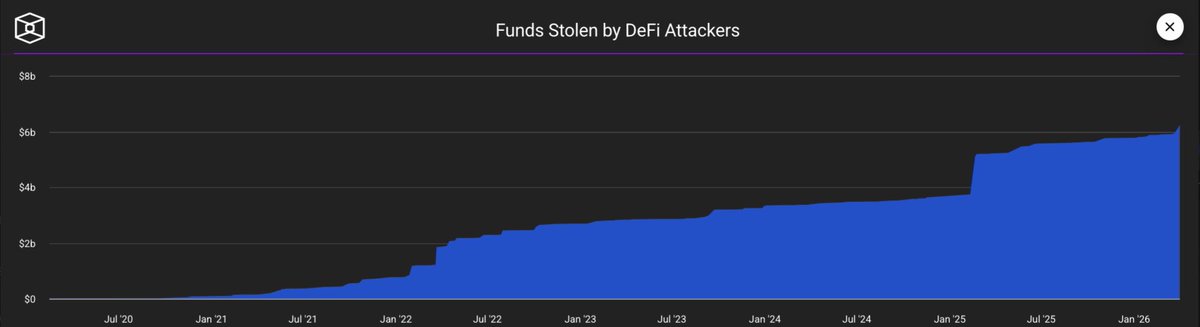
It’s just barely been a week since the Hyperbridge exploit, where attackers minted over 1 billion fake bridged $DOT on eth and walked away with roughly $237k Now, @KelpDAO has suffered one of the largest DeFi hacks of the year, with attackers draining approx $292M in rsETH through a vulnerability in its LayerZero powered bridge That’s already over $600M in major exploits in April alone when $285 million from @DriftProtocol hack is added This year alone, DeFi losses have surged past $700M January: > StepFinance lost approx $27–40M due to private key compromise of treasury wallets > Truebit lost approx $26M due to smart contract bug in old minting contract allowing cheap TRU minting and drain February: > IoTeX (bridge) lost approx $4.3M due to private key compromise on bridge contract, similar to stepfinance exploit March: > ResolvLabs exploited by approx $25M+ through minting vulnerability allowing unbacked stablecoin creation, leading to $USR depeg > SolvProtocol lost approx $2.7M through vault contract logic flaw not all are mentioned, but April alone is accounting for the biggest amount exploited in DeFi history This is starting to feel like a dangerous trend. crosschain bridges, restaking derivatives, and interconnected lending protocols are repeatedly proving to be weak points Is this the beginning of the end for DeFi as we know it or is something else at play?

Share


Source:Show original
Disclaimer: The information on this page may have been obtained from third parties and does not necessarily reflect the views or opinions of KuCoin. This content is provided for general informational purposes only, without any representation or warranty of any kind, nor shall it be construed as financial or investment advice. KuCoin shall not be liable for any errors or omissions, or for any outcomes resulting from the use of this information.
Investments in digital assets can be risky. Please carefully evaluate the risks of a product and your risk tolerance based on your own financial circumstances. For more information, please refer to our Terms of Use and Risk Disclosure.