


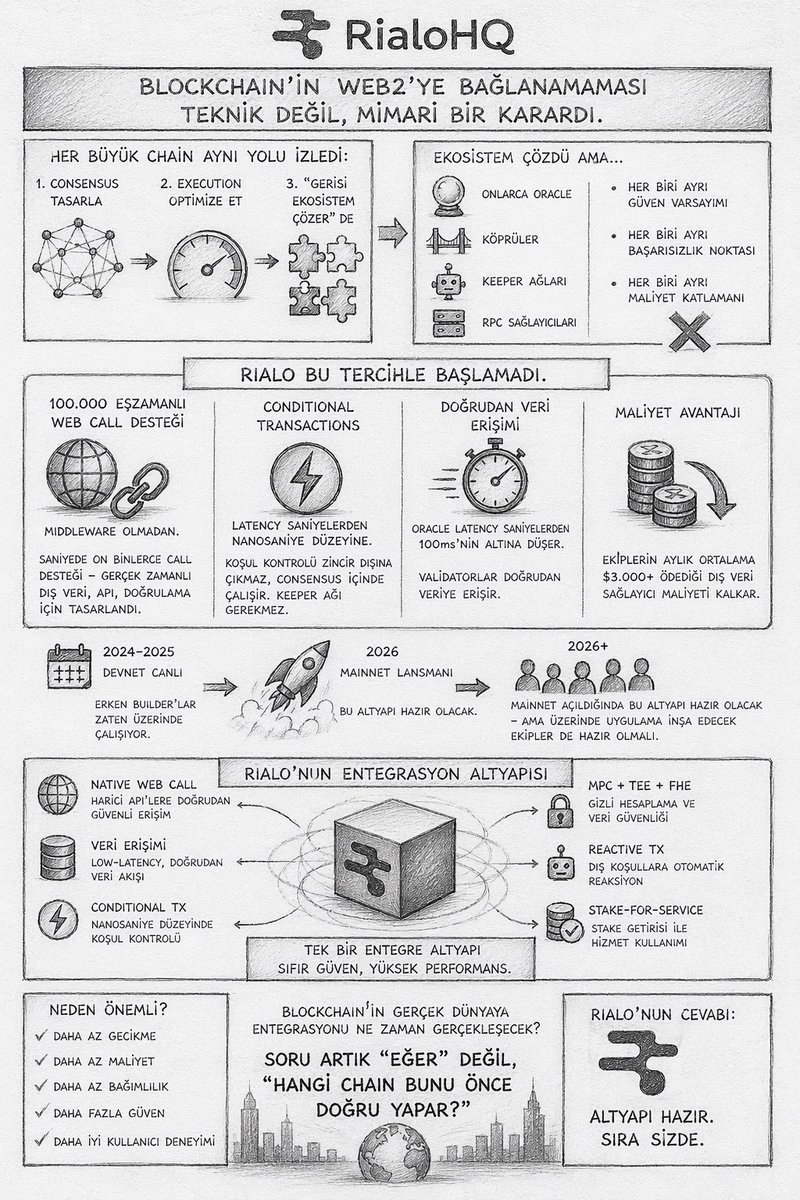
The inability of blockchains to connect to Web2 was never a technical problem—it was an architectural decision. Every major chain followed the same path: first design consensus, then optimize execution, then declare “the rest will be solved by the ecosystem.” And the ecosystem did solve it—with dozens of oracles, bridges, keeper networks, and RPC providers. But each of these introduced a separate trust assumption, a separate point of failure, and an additional cost layer. Rialo did not start with this trade-off. When you look at the technical specifications on the homepage, you see this: support for 100,000 concurrent web calls—without middleware. This number is not accidental. For an application to function in real time with external data, it requires tens of thousands—not dozens—of calls per second for price feeds, user authentication, and API integrations. Today, every system that handles these externally adds both latency and cost. Rialo claims conditional transactions reduce latency from seconds to nanoseconds. How is this possible? Because condition evaluation never leaves the chain—it operates within consensus. The question of whether a keeper network is “awake right now” disappears entirely. Validators provide direct data access, reducing oracle latency from seconds to under 100 milliseconds—and eliminating the external data provider costs that teams typically pay over $3,000 per month. All of this is leading toward the Mainnet launch in 2026. DevNet is already live. Early builders are already working on it. When Mainnet launches, this infrastructure will be ready—but so too must the teams building applications on top of it. The question is no longer “When will blockchains integrate with the real world?”—it’s now “Which chain will do it right first?”

Share


Source:Show original
Disclaimer: The information on this page may have been obtained from third parties and does not necessarily reflect the views or opinions of KuCoin. This content is provided for general informational purposes only, without any representation or warranty of any kind, nor shall it be construed as financial or investment advice. KuCoin shall not be liable for any errors or omissions, or for any outcomes resulting from the use of this information.
Investments in digital assets can be risky. Please carefully evaluate the risks of a product and your risk tolerance based on your own financial circumstances. For more information, please refer to our Terms of Use and Risk Disclosure.