


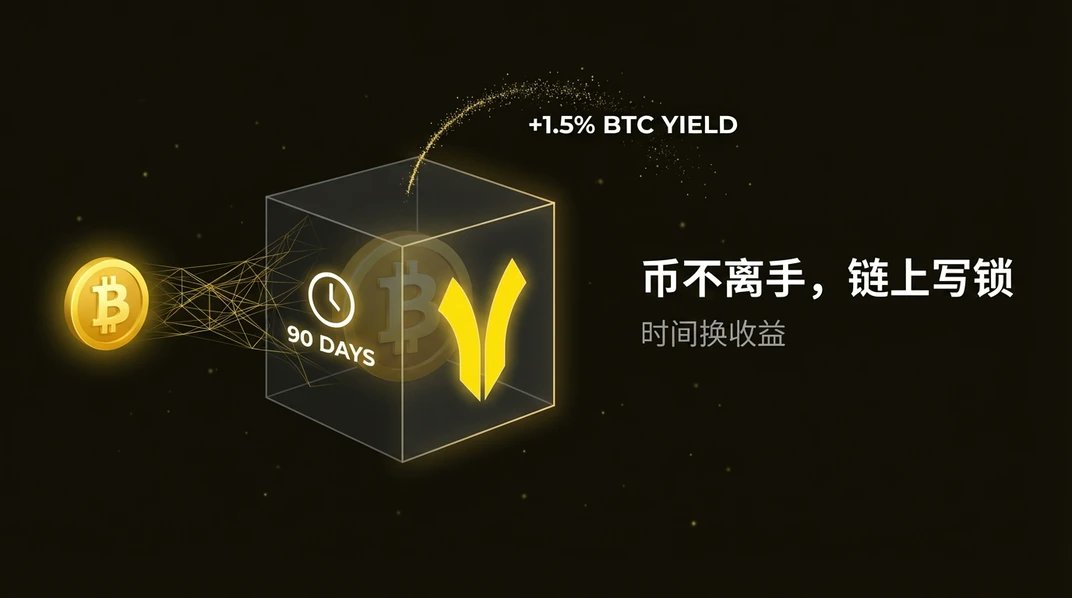
Over the weekend, I caught up on some work and spent time following @GOATRollup. I've been feeling something quite subtle lately. Initially, I was just “trying out a new chain,” but gradually, it’s become more like “using it as a daily tool.” It’s not because of short-term incentives but because it’s starting to address some long-standing issues in the Bitcoin world that no one has tackled before. Take Safebox, for example. Many people have previously asked: “Is there a way for Bitcoin to be both securely self-custodied and yield stable returns?” The traditional answers were either centralized custody (earning interest while bearing platform risk) or fully self-custodial (safe but with idle assets). Safebox offers a solution much closer to Bitcoin’s ethos: assets staying in your wallet, using a time-lock script to write a UTXO that automatically unlocks after 90 days, while generating transparent and verifiable native BTC returns. This makes “yield” no longer rely on trust but rather on mechanisms. If you’re interested, you can give it a try: https://t.co/06BsXXOx7b. This same philosophy can be seen in GOATUP, OKU, Lucky Draw, and other activities. S4 doesn’t treat participants as “task executors” but instead integrates their actions as part of an economic cycle: trading, listing orders, providing liquidity (LP), earning points, and entering lotteries. Every step leaves real records on-chain. Contributions accumulate, and rewards are more inclined toward genuine network users rather than those just trying to inflate their activity artificially. This is particularly evident in the transaction scoring mechanism. It’s not about “who clicks the most gets the highest rewards” but rather “who makes the chain more usable.” The logic shifts from “operating” to “participating,” from “executing tasks” to “keeping the network running.” Gradually, many GOAT users’ actions are no longer about “completing tasks” but have become habitual behaviors: checking positions on GOATUP, placing an order on OKU, trying a few Lucky Draw spins, reviewing accumulated yields, or, like me, revisiting the Safebox page every few days to confirm the status of time locks. This change has made me rethink the significance of BTCFi. Perhaps it’s not about “transforming Bitcoin” but about enabling Bitcoin to truly be an asset that can be used, participated in, and voiced on-chain. Bitcoin’s original vision was as “decentralized money,” but over the years, it has become more like a legendary artifact sitting in a museum. GOAT’s approach isn’t about slapping on a new label but about putting Bitcoin back into circulation—not for “spending,” but for participating in networked economic relationships. If you ask me what GOAT Network is doing right now, I’d say: It’s not building just an application ecosystem; it’s making “using Bitcoin to participate in the economy” possible again. It’s not empty slogans, nor is it flashy promises. It’s continuously delivering: real yields, on-chain proof, self-custody, secure inheritance, and visible user behavior. That’s why I increasingly feel that this isn’t just a short-term activity but more like a network that is being continually used, continually written to, and continually validated. And we, the ones leaving traces on-chain, may very well be the first participants in the future BTCFi narrative. #GOATNetwork @KaitoAI
Share


Source:Show original
Disclaimer: The information on this page may have been obtained from third parties and does not necessarily reflect the views or opinions of KuCoin. This content is provided for general informational purposes only, without any representation or warranty of any kind, nor shall it be construed as financial or investment advice. KuCoin shall not be liable for any errors or omissions, or for any outcomes resulting from the use of this information.
Investments in digital assets can be risky. Please carefully evaluate the risks of a product and your risk tolerance based on your own financial circumstances. For more information, please refer to our Terms of Use and Risk Disclosure.