


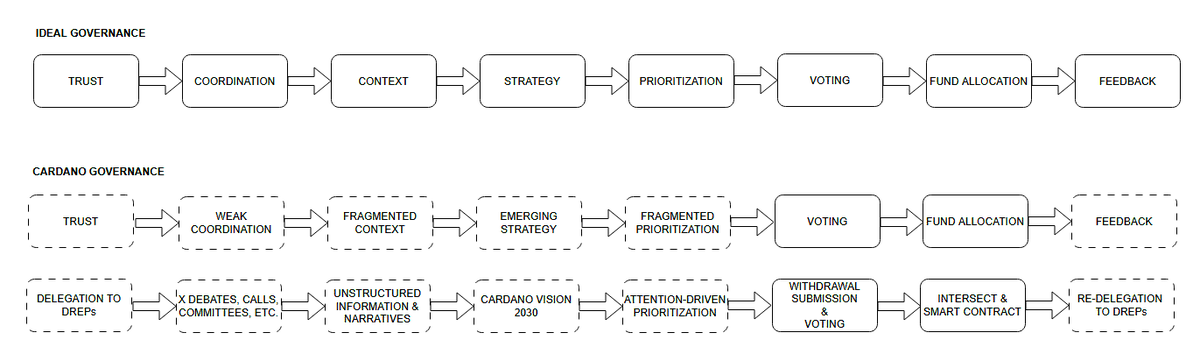
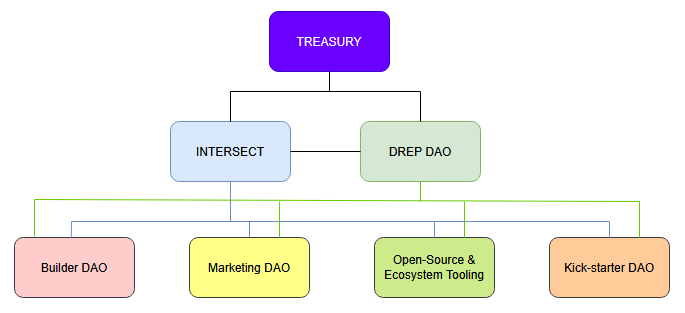
Cardano governance has a solid technological layer, but an underdeveloped social layer. On-chain mechanisms allow for DReps registration, delegation, proposal submission, voting, executing operations based on voting results, etc. This was the bare minimum to get governance up and running. Cardano needs to build a governance social layer. Governance requires a structured decision support and coordinated strategy. Without clear context, shared priorities, and effective alignment, our system risks producing suboptimal decisions. Cardano governance has gained the trust of ADA holders. Now we need to put in place mechanisms for: ▪️coordination ▪️gaining context ▪️defining strategy ▪️prioritizing These steps should precede any allocation of funds. Many may argue that we don’t need coordination or strategy. Decentralization should let the best ideas win. This assumes the market of ideas self-organizes perfectly. I don’t think it works in practice. Decentralization is about removing central control. However, it does not remove the need for coordination. Without a unified context, decisions are noise. If DReps don’t have structured information and the ability to compare proposals, then decisions are random, narrative-driven, or attention-driven. Example: We approved the budget for 2 alt nodes without having any idea of what budget the IOG will require. We don’t know what the total cost of decentralization will be. Without a strategy, we have no direction. So far, we only have the Cardano Vision 2030 document, which has ambitious KPIs, but we can only use it with difficulty in making decisions for this year. It must be clear whether we need funding infra or adoption, or how these things correlate. We need to know our short-term goals and long-term goals. We need to know what the ecosystem needs. Without this, we will not gain neutrality and certainty. DReps would rather approve what everyone wants, because they hope it is the right decision. Without prioritization, resources fragment. All proposals look important. We might fund many projects, but potentially with low impact. Notice the debates on X. Influencers claim that a given proposal is a must-have or essential. We cannot afford to have the Treasury looted in the name of decentralization. Governance needs a strong social layer. What is challenging is maintaining the elements of decentralization. Intersect is preparing a Budget Framework process. This is an important attempt at coordination, context, and prioritization. The goal is to put several proposals side by side, compare them with each other, and fund the best ones. In my view, this process lacks strategy, but that is for another debate. The problem with the Intersect process is that submitters are not forced to participate in it. Anyone can submit an on-chain proposal at any time. This is often the preferred option. Another shortcoming is that the process is created with minimal participation of DReps. They do approve it, but they can do so despite the shortcomings. There is a huge difference between DReps in terms of expertise, time availability, engagement, etc. There are DReps who are comfortable with on-chain voting, while we have DReps who want to be more engaged. I believe that building a governance social layer should be done from the bottom up. This should be in the hands of DReps, not FEs or Intersect. I would like to introduce you to a solution: The Initiative DAO Framework The framework organizes capital into specialized DAOs, each focused on a clear domain, with transparent reporting, aligned incentives, and built-in accountability. The goal is to create a more effective, more transparent, and more scalable way to steward ecosystem capital. DReps, builders, marketers, and developers across the ecosystem have come together to propose a pilot implementation of the Initiative DAO Framework this year. The DAOs could be overseen by a DRep DAO. Each DAO could be accountable to the DReps via the oversight layer. DRep DAO is intended to define reporting requirements, set KPIs and goals, and enforce transparency standards across the broader framework. In the current conception, any DRep would be able to join the DRep DAO. The DRep DAO could evolve into an entity that would define a fiscal year strategy, short-term and long-term goals, or even a bucket system. The bucket system would define what portion of the Treasury should be used for a given category. This mechanism would provide coordination, context, strategy, and prioritization. Importantly, it would be under the control of DReps, so that the decentralization of the system would be maintained. This would reduce the ecosystem's dependence on Intersect while also enabling dialogue between the organization and DReps.

Share


Source:Show original
Disclaimer: The information on this page may have been obtained from third parties and does not necessarily reflect the views or opinions of KuCoin. This content is provided for general informational purposes only, without any representation or warranty of any kind, nor shall it be construed as financial or investment advice. KuCoin shall not be liable for any errors or omissions, or for any outcomes resulting from the use of this information.
Investments in digital assets can be risky. Please carefully evaluate the risks of a product and your risk tolerance based on your own financial circumstances. For more information, please refer to our Terms of Use and Risk Disclosure.