



Stanford HAI, the Center for Human-Centered Artificial Intelligence, has just released the 2026 AI Index Report, the most authoritative annual assessment of the AI field. Over the past year, Stanford researchers, through a series of observations, concluded that AI is being adopted globally at a pace faster than that of PCs and the internet, but human societal institutions, labor markets, and measurement tools are lagging far behind.
AI is sprinting ahead, while humans are still looking for their shoes. Here are ten visuals showing where AI is outpacing humans.
1
Measuring AI with exams is pointless.
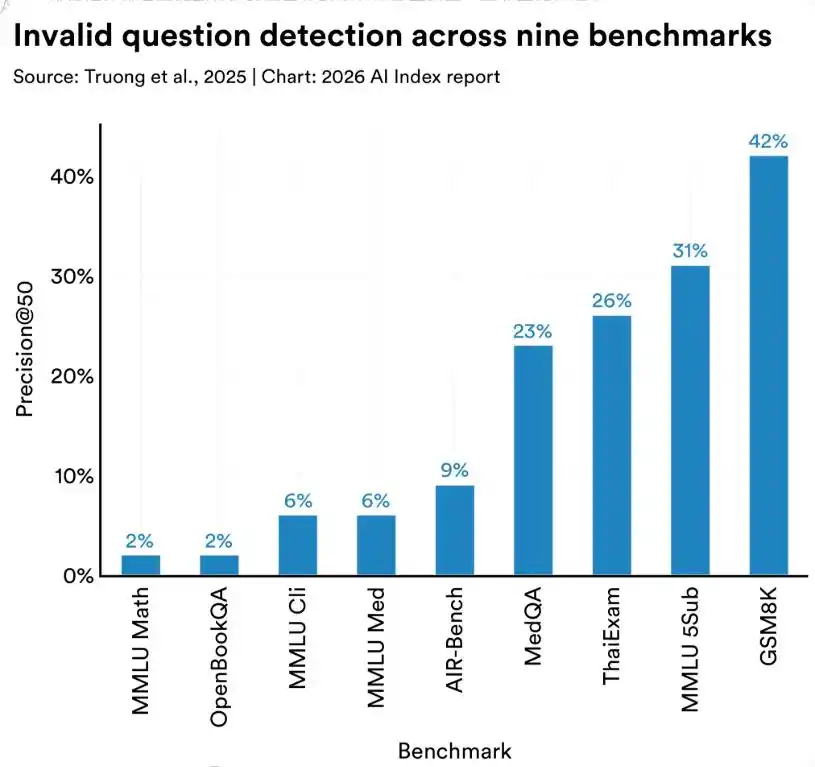
Titles like “AI Surpasses Humans” rely on the credibility of benchmarks. However, a Stanford report found that nearly 42% of the questions in GSM8K, a widely used math benchmark, are invalid. Other tests also show signs of being “gamed”—models can achieve high scores after being trained on the test data, but this doesn’t mean they’ve become smarter. Many companies refuse to disclose their benchmark results. One of the report’s authors, Gil, said: “Not disclosing the results themselves may say something significant.”
2
The actual gap between China and the U.S. has disappeared, at just 2.7%.
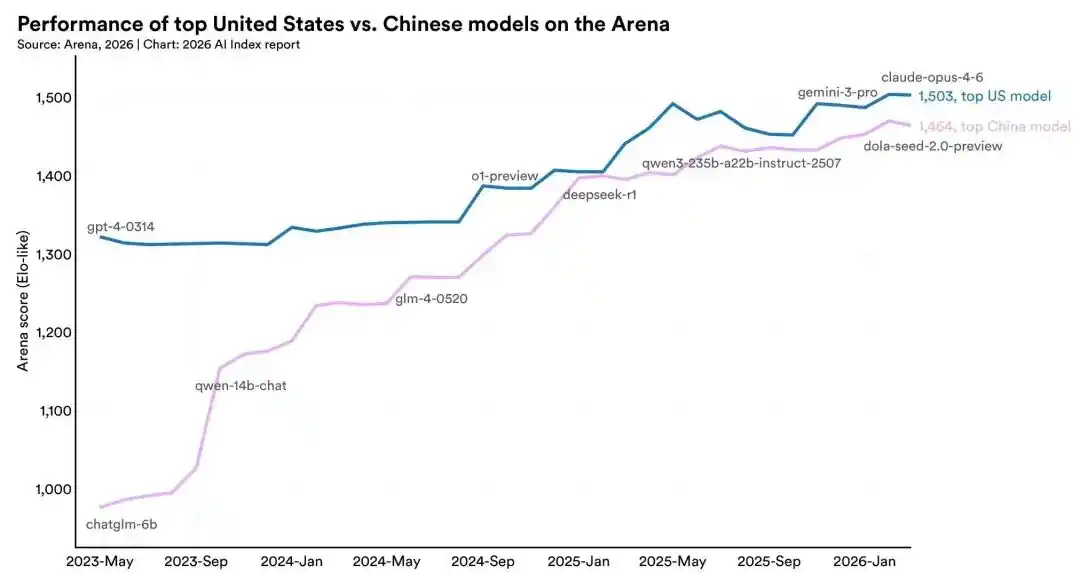
As of March 2026, the United States' top model, Claude Opus 4.6, has an Elo rating of 1503, with China's top model closely following, just 2.7% behind. Over the past year, models from both countries have repeatedly traded the lead, with DeepSeek R1 briefly tying the U.S.'s top model in February 2025.
However, the two countries have entirely different AI strengths. The U.S. has more advanced models, greater capital, and 5,427 data centers—more than ten times that of any other country. China leads in AI papers, patents, and robot deployment. In short, the U.S. wins in computing power and funding, while China wins in research and manufacturing.
3
Frontier models are converging, with comparable levels of intelligence.
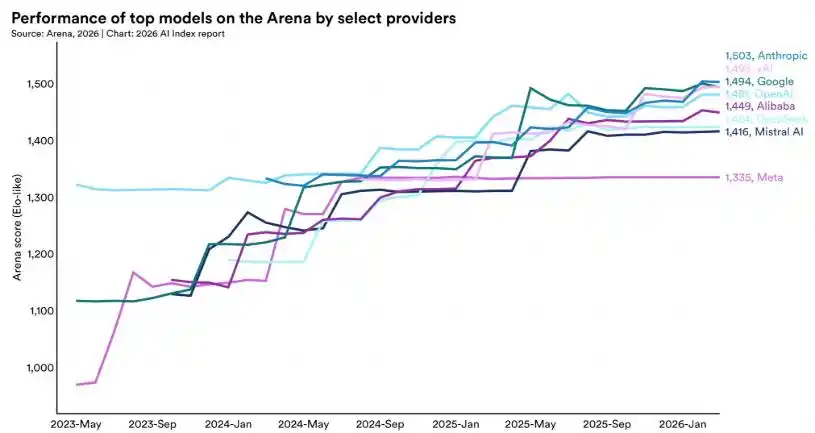
As of March 2026, Anthropic (1503), xAI (1495), Google (1494), and OpenAI (1481) are clustered within an extremely narrow range. This means that “which model is stronger” is no longer the focus of competition. The emphasis is shifting toward cost, reliability, and domain-specific optimization—explaining why Anthropic is developing Advisor Tool (to reduce costs), Google is acquiring Wiz (for cloud security), and OpenAI is buying various application-layer companies (to expand use cases). As model intelligence performance converges, differentiation must be created elsewhere.
4
Employment of developers aged 22–25 has declined by nearly 20%.
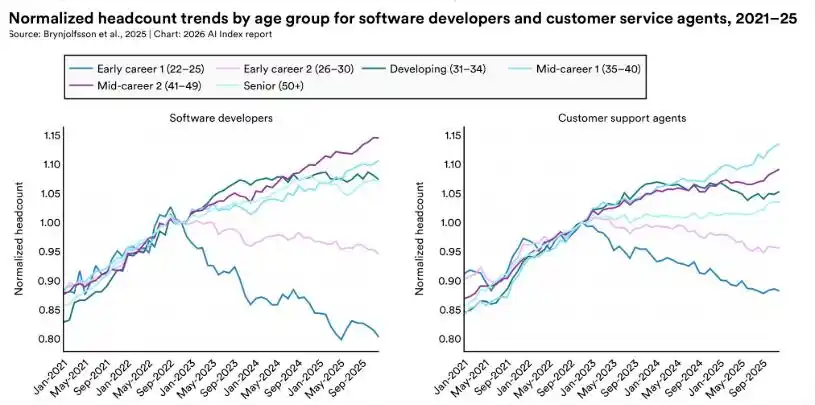
Generative AI reached a population adoption rate of over 53% within three years, and 88% of organizations are now using AI. However, the impact on employment is not uniform. A 2025 study by Stanford economists found that the number of software developers aged 22–25 has declined by nearly 20% since 2022, while employment in older age groups continues to grow. A 2025 McKinsey survey found that one-third of organizations expect to reduce their workforce due to AI over the next year, with layoffs concentrated in service operations, supply chain, and software engineering.
Overall data has not yet shown mass layoffs, but this is enough to indicate that the job market is like a frog slowly being boiled in warm water—the crisis is gradually developing.
5
Adoption speed exceeds that of PCs and the internet; the U.S. ranks only 24th.
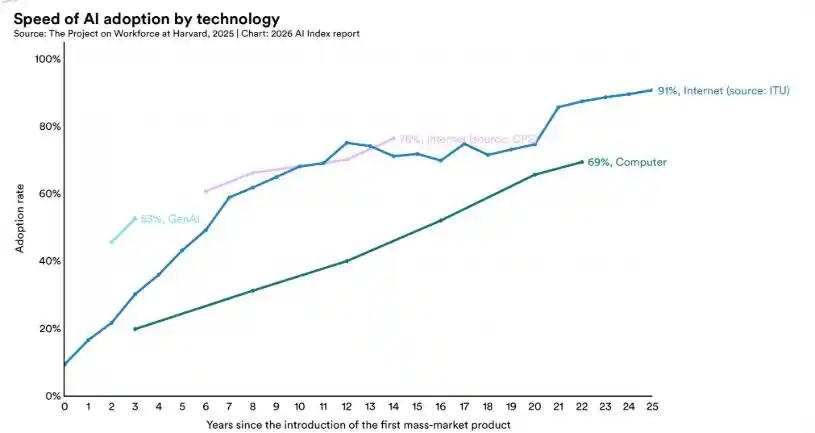
Generative AI reached a population adoption rate of 53% within three years, surpassing the adoption speeds of personal computers and the internet. But the most counterintuitive data point: the U.S. leads the world in AI investment and model development, yet its population adoption rate is only 28.3%, ranking 24th globally. The UAE stands at 64%, and Singapore at 60.9%. The country spending the most is using it the least.
6
Global AI investment amounts to $581.7 billion, with the U.S. at 23 times China's investment—but...
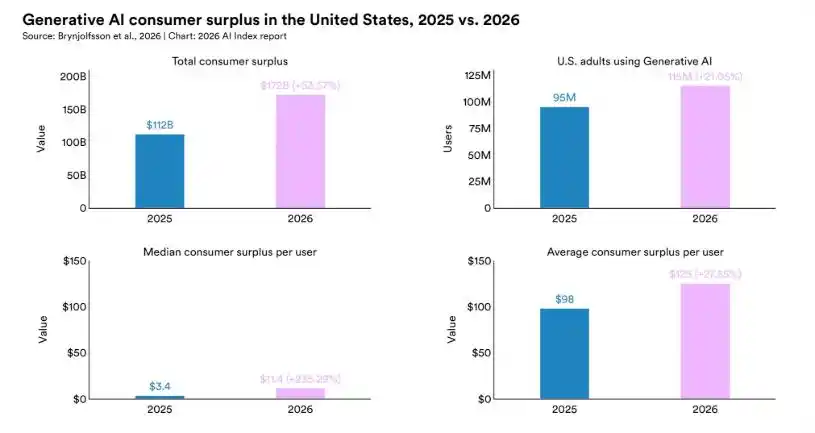
Global investment in AI companies reached $581.7 billion in 2025, a 129.9% year-over-year increase. Private AI investment in the United States amounted to $285.9 billion—23 times that of China and 48.5 times that of the UK. California alone accounted for over 75% of U.S. investment. Major funding rounds were also intense: OpenAI raised $40 billion at a $300 billion valuation; Anthropic raised $13 billion at an $183 billion valuation; and Cursor raised $2.3 billion at a $29.3 billion valuation.
However, there is a hidden detail: between 2000 and 2023, state-owned capital funds in China invested approximately $184 billion in AI companies—a figure not included in private investment statistics. When this amount is added, the funding gap between China and the U.S. may be significantly smaller than the reported numbers suggest.
7
AI Agent: From being able to chat to being able to act, but still with a 1/3 failure rate
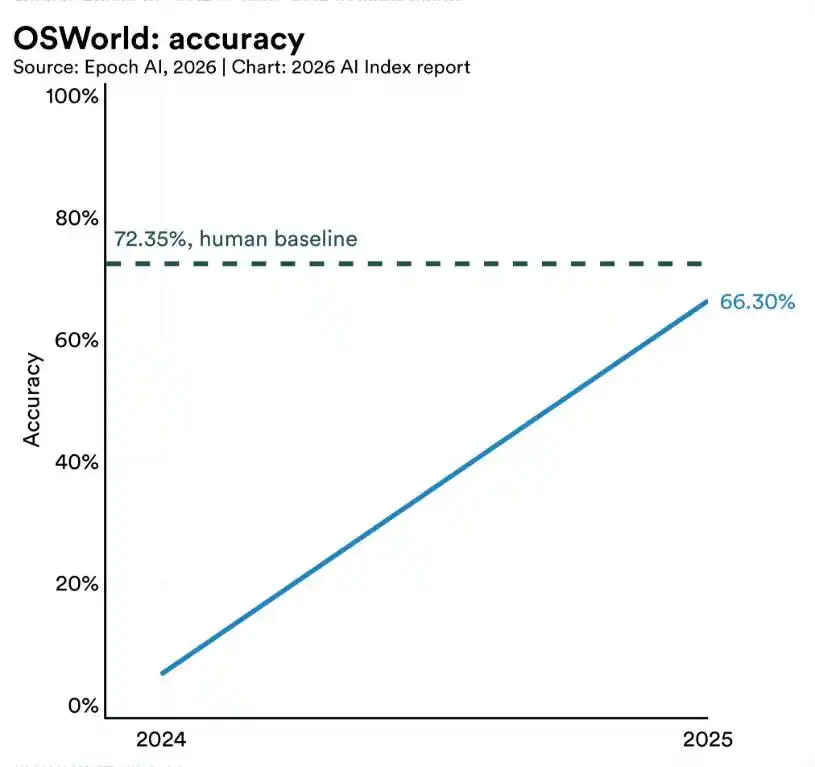
2025 is the Year of AI Agents. Accuracy on OSWorld (which tests AI’s ability to complete tasks on an operating system) surged from 12% to 66.3%, just 6 percentage points behind human performance. WebArena reached 74.3%, and Cybench (cybersecurity tasks) jumped from 15% to 93%.
Overall, however, agents still have a failure rate of about one-third. Moreover, actual enterprise deployments remain in the single digits—over two-thirds of respondents reported no use of AI agents in most business scenarios. There remains a significant gap between progress on benchmarks and real-world deployment.
8
89% of robots live in laboratories.
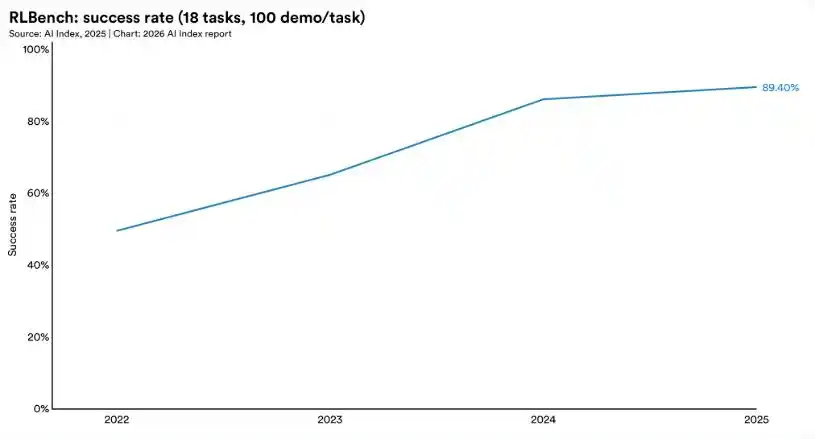
AI is already powerful in virtual worlds but remains weak in the physical world. While robots achieve an 89.4% success rate in software simulation environments, their success rate in real-world household tasks is only 12.4%. One is a clean laboratory; the other is a messy home—in this real-world environment, robot participation is still negligible.
However, autonomous driving is an exception: Waymo averages about 450,000 trips per week, while Apollo Go completed approximately 11 million fully driverless trips in 2025.
9
Experts vs. Public: A 73% vs. 23% awareness gap
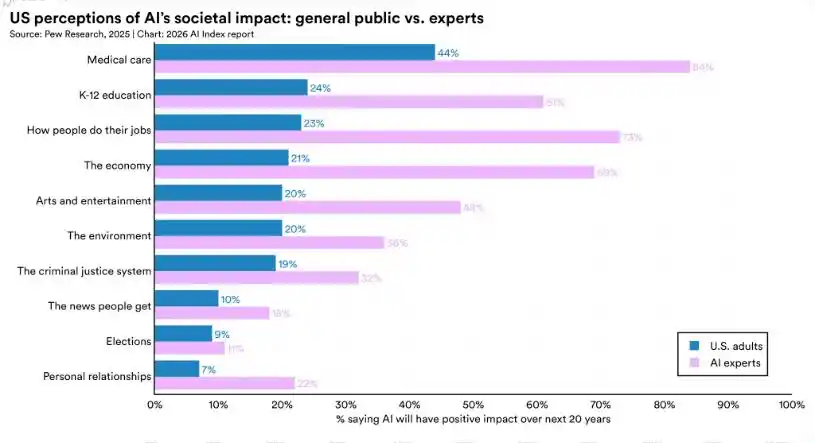
The Pew survey cited in the report reveals a striking divide: 73% of AI experts believe AI will have a positive impact on jobs, but only 23% of the American public agree—a complete polarization.
Another interesting data point: Among all surveyed countries, Americans have the lowest trust in government regulation of AI. Experts are similarly more optimistic about AI’s potential in education and healthcare, but both groups believe AI will harm elections and interpersonal relationships.
10
GPT-4o uses more water annually than 12 million people and consumes enough electricity to power the entire state of New York.
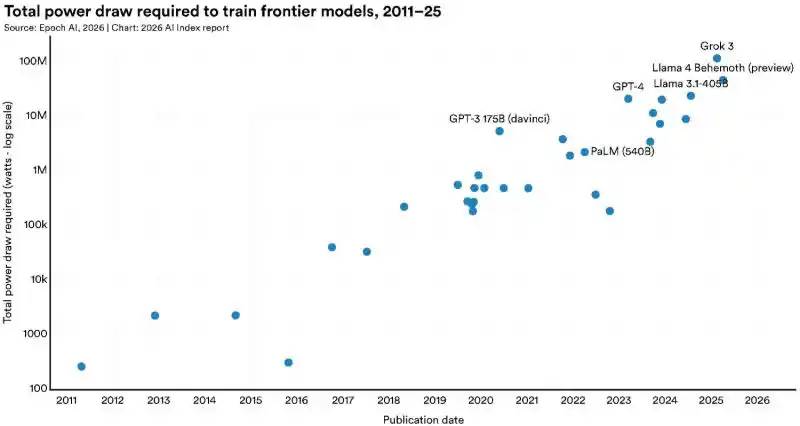
Advances in AI come at an environmental cost. Global AI data centers now consume 29.6 GW of electricity—enough to power the entire state of New York during peak demand. Just one model, OpenAI’s GPT-4o, may use more water annually than the drinking needs of 12 million people.
These massive consumption levels fuel one model training after another, yet the chip supply chain behind these models remains extremely fragile. The United States hosts the majority of the world’s AI data centers, but nearly every cutting-edge AI chip is manufactured by just one company: TSMC in Taiwan. All computational power, all investments, and all model advancements rest on this physical foundation.
This is only the tip of the iceberg, yet it's enough to show that we are embracing a technology we don't yet fully understand at an unprecedented speed.
The full report also covers additional dimensions such as AI safety, regulatory developments, and research trends. We strongly recommend interested readers to review the complete report: 👉🏻 https://hai.stanford.edu/ai-index
This article is from the WeChat public account "APPSO," authored by APPSO, discovering tomorrow's products.