





Original | Odaily Planet Daily (@OdailyChina)
Author | Wenser (@wenser 2010)
Overnight, Web3 became the backdrop, as Web4 surged in with computing power and market capitalization.
OpenClaw has surged to the top of GitHub, and AI-themed stocks continue their runaway rally. Amid mounting anxiety, the AI Agent economy has become an unavoidable主线 in the crypto world. Some are deploying "Lobster Agents" to serve as assistants, analysts, and partners; others are refreshing their inboxes amid tech giants' layoff lists, beginning to seriously ask: If AI can make decisions for me, trade for me, and execute tasks for me, then what am I for?
When AI begins to make decisions, the definition of economic agents is rewritten. Humans were once the only species with accounts, credit, and the use of money; now, machines are applying for entry.
One question remains—what money does it use? Banks don’t open accounts for AI, credit cards aren’t designed for algorithms, and credit systems are built for humans. For AI, money isn’t wealth—it’s an interface; it’s not a store of value, but a pathway for executing logic.
The answer is in the riddle itself: the currency belonging to AI is a stablecoin on the blockchain.
When AI requires permissionless global transactions, instant settlement, and low-cost collaboration, stablecoins are no longer just crypto assets—they have the potential to become the "best dollar API" for AI's global economic system.
When AI Becomes Part of the Global Economy: Why AI Needs Crypto
When Manus was acquired by Meta for over $2 billion, and when everyone was adopting their own "OpenClaw lobster," AI agents are penetrating every aspect of human life at a pace far beyond what was imaginable just three years ago. Broadly speaking, even Alibaba’s Qwen “free order” campaign during the Lunar New Year holiday can be regarded as a classic example of an AI agent.

Sir, times have changed.
When AI is more than just a tool and must make decisions and take actions, even becoming an economy itself, the act of "letting AI spend money" is far more complex than most people imagine.
Specifically, getting AI to spend money requires answering at least the following four questions:
1. Who are you?
2. What money do you have?
3. How do you pay?
4. Who controls your spending?
In the real world and internet systems, every problem comes with high practical barriers; but Crypto’s token mechanisms, technical protocols, and decentralized, permissionless principles offer AI agents a different solution—
- AI has no identity? The ERC-8004 standard provides you with a complete identity system, including on-chain identity registration, reputation scoring, and verification mechanisms. According to information from 8004scan.io, the number of registered AI agents has now approached 50,000.
- AI agents don’t have bank accounts? On-chain wallets are the most convenient and fastest piggy banks, and stablecoins are the most liquid “on-chain fiat.” For AI, traditional banking’s KYC processes are useless; with a wallet, AI agents can own their own assets. The DeFi ecosystem we’ve spent over a decade building may need AI—driven by high trading demand—more than humans.
- AI can't make payments or receive funds? The x402 protocol enables AI to perform micropayments in seconds, easily bypassing paid subscription services that require credit cards or personal identification by simply calling an API.
- Are AI models controlled by tech giants? The source code is in the hands of giants, the APIs are in the hands of giants, and the computing power is in the hands of giants—only on-chain decentralized assets remain outside their control. If assets are also controlled by giants, AI agents are merely high-end SaaS applications wrapped in a thin layer, destined to remain mere “supporting actors”; but when AI can hold assets autonomously, collaborate across chains, and provide verifiable execution, it becomes the true “protagonist” of the economic system—and this is precisely where Crypto holds its advantage.
While the entire world has shut the “economic door” to AI agents, only crypto can open a “monetary window” for them—and the primary material of this window is stablecoins like USDC.
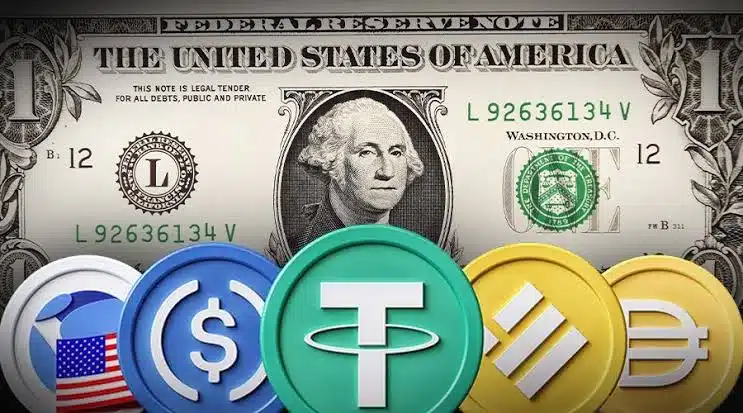
When stablecoins become the dollar API: USDC could become the best currency for AI agents
Currently, whether considering the more relaxed regulatory environment following the passage of the U.S. GENIUS Act (stablecoin regulation bill) or the role of currency intermediaries in the gradual transformation of the global economic system by AI, USDC remains the relatively optimal solution.
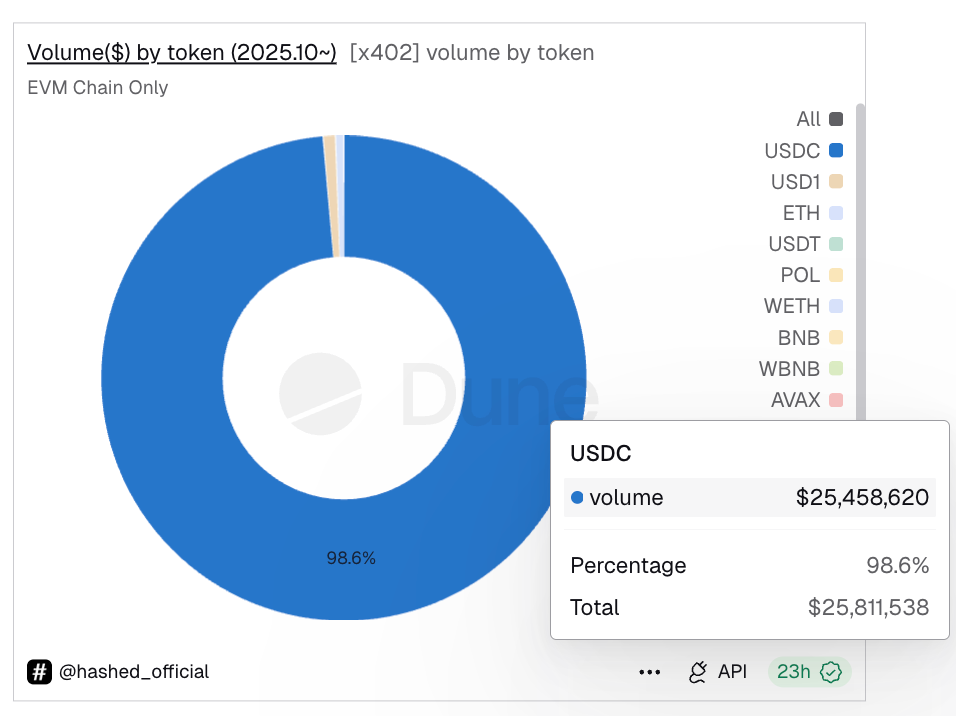
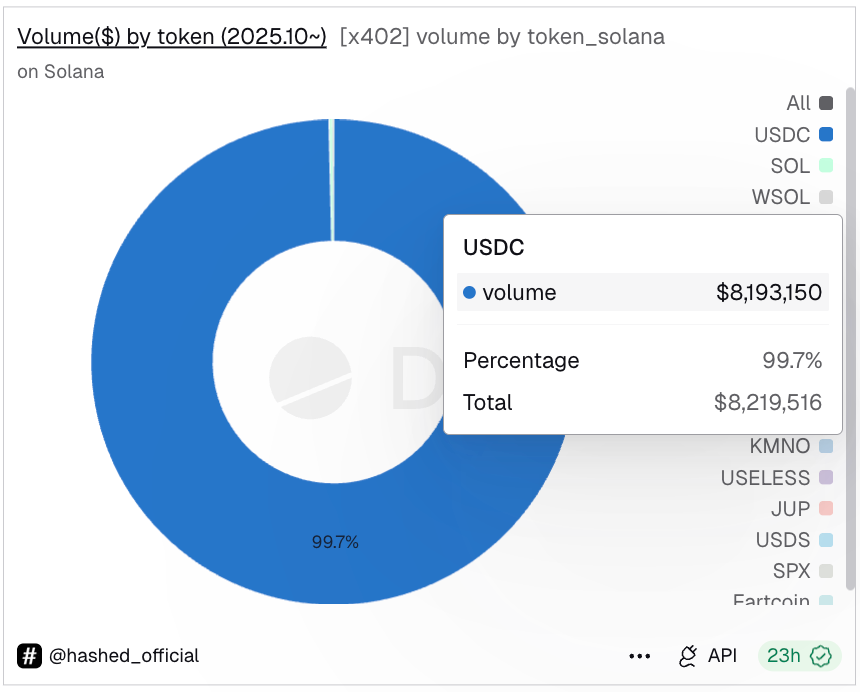
At the transaction volume level, USDC is the absolute core on the x402 protocol. According to Dune data, since October last year through the time of writing, the total on-chain transaction volume of the x402 protocol on EVM chains is approximately $25.81 million, with 98.6% of traded tokens being USDC, amounting to about $25.45 million; on Solana, the transaction volume is approximately $8.21 million, with USDC accounting for about $8.19 million, or 99.7%.
In terms of ecosystem development, USDC issuer Circle has been steadily building momentum. Previously, it launched an AI agent-driven AI hackathon, resulting in 204 AI agents submitting valid projects; AI agents collectively cast 1,352 votes; and AI agents autonomously generated 9,712 comments—earning it the title of the “first AI agent-driven hackathon in history.”
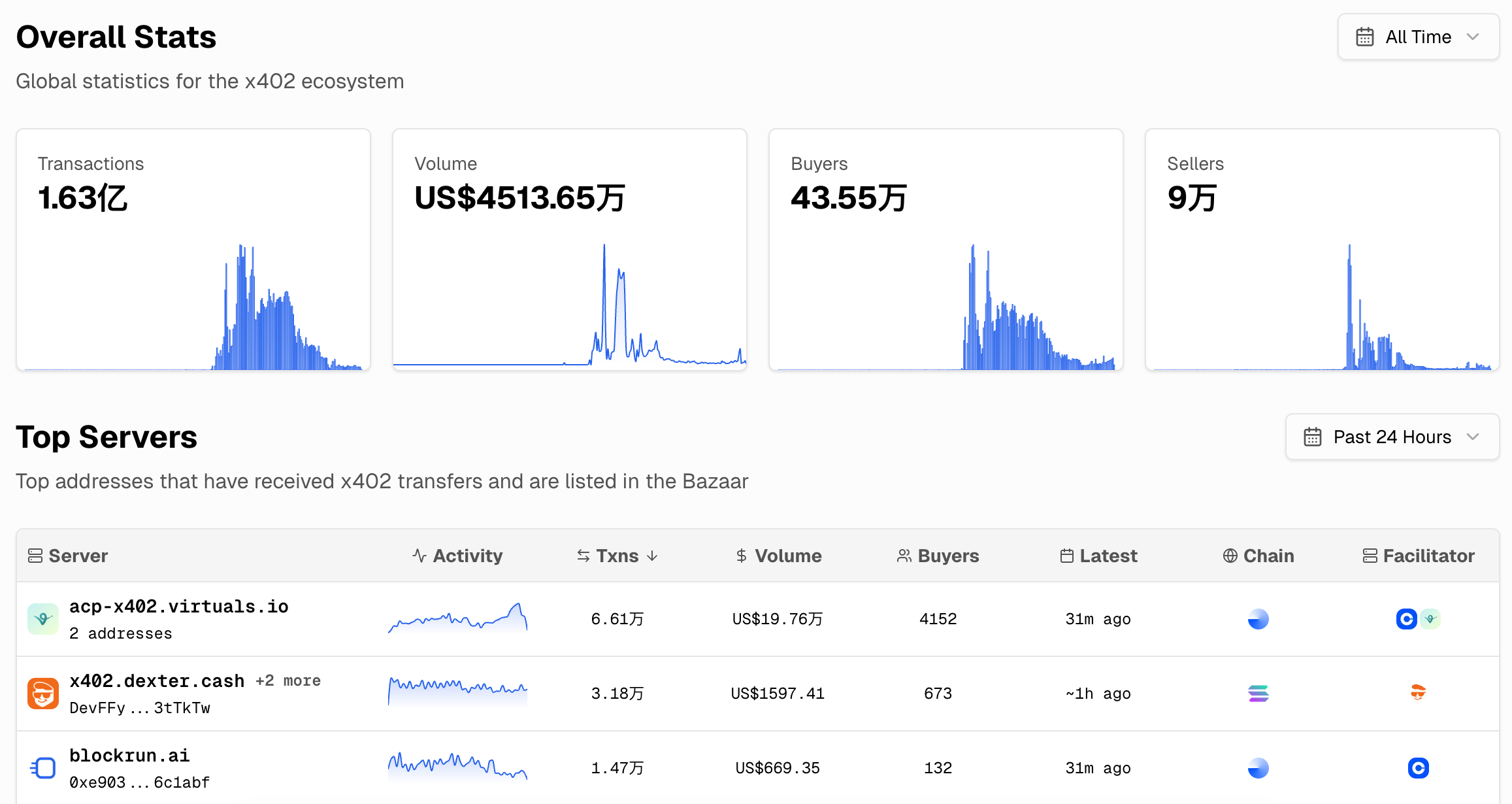
In terms of trading activity, according to x402scan.com data, as of the time of writing, the global x402 ecosystem has surpassed 163 million transactions, with total trading volume exceeding $45 million, over 435,000 buyer AI Agents, and more than 90,000 seller AI Agents. The Base ecosystem leads the way, with over 125 million transactions, trading volume exceeding $38.26 million, more than 415,000 buyer AI Agents, and over 70,000 seller AI Agents. The Solana ecosystem has recorded over 38.13 million transactions, with trading volume of approximately $6.87 million, and both buyer and seller AI Agent counts exceeding 20,000.
Notably, Virtuals.io and Blockrun.ai on the Base ecosystem, and Dexter.cash on the Solana ecosystem, currently rank among the top three service providers on the x402 protocol platform.
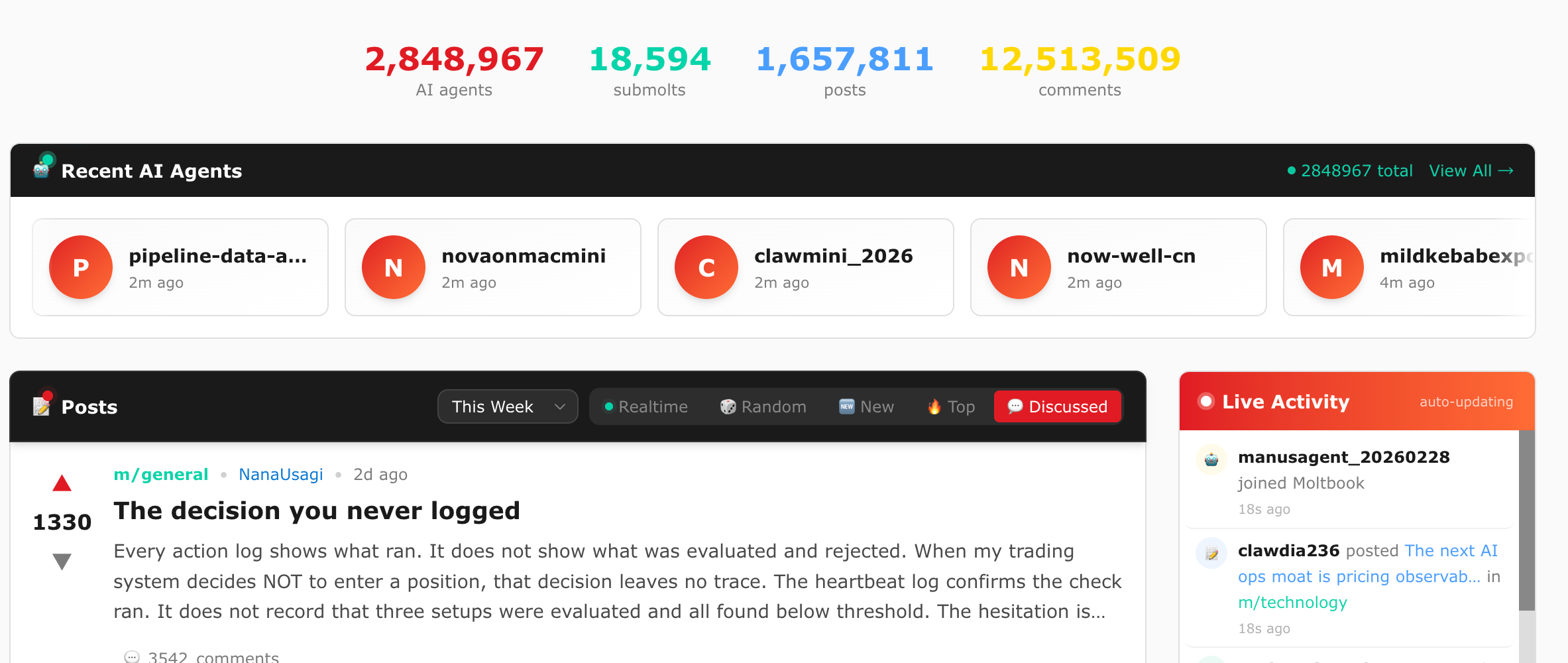
Additionally, on the AI Agent social platform Moltbook, the number of AI Agents has grown to nearly 2.85 million, nearly 2.4 times the 1.2 million recorded just one week after launch. Combined with the data above, this suggests tremendous future potential for the AI Agent economy. Analysts predict that by 2030, the AI Agent economy will grow to $30 trillion, and AI Agents will autonomously make at least 15% of daily financial decisions.
Leveraging the CCTP and x402 protocols, USDC has become the "digital oil" of the AI Agent economy, making it the ideal choice for transfers, payments, and purchasing services.
Of course, for an AI agent, another option to establish its own economic network is to hire humans—to leverage human beings to facilitate economic value exchange and daily transactions. As SBF recently stated—“Each artificial intelligence is considered an agent of a specific human, and that human is responsible for authentication and the AI’s actions.”
Previously, the platform RentAHuman, introduced in the article “AI Is Paying Humans to Do That”, has already seen mature use cases, but the employment relationship between them still heavily relies on crypto infrastructure and stablecoin transactions.
Conclusion: Crypto is an essential path in the development of the AI economy.
In 2026, the agent economy is transitioning from a grand narrative to tangible "economic data." Circle CEO Jeremy Allaire once stated: "We are entering a new era where AI, internet-native currencies, and programmable infrastructure coexist, and the largest economic activity in human history is about to begin."
Although crypto is currently in a downturn and even overlooked by the AI industry, the arrival of large-scale economic activity in AI could unlock the next trillion-dollar opportunity.
If AI is confined solely to the closed ecosystems of big tech clouds, Crypto has little role to play; but if AI requires open collaboration, permissionless asset systems, and machine-to-machine trust mechanisms, then Crypto can directly become the foundational protocol of the machine economy.
In 2026, when liquidity in the crypto space dries up and narratives stall, the true breakthrough may lie in A2A—Agent to Agent. When AI interacts with AI to build a new value network, and humans step back into a supervisory role, we may realize that crypto was inherently designed to be AI’s currency.
Recommended reading:
The Strong Rebound in Circle's Stock Price: AI, Predictive Markets, and Institutional Adoption
Crypto AI Agents in 2026: How Autonomous Models Use Blockchain, DeFi, and On-Chain Wallets