





For most of Solana’s short history, meme coin trading defined a large chunk of its activity. That appears to be changing.
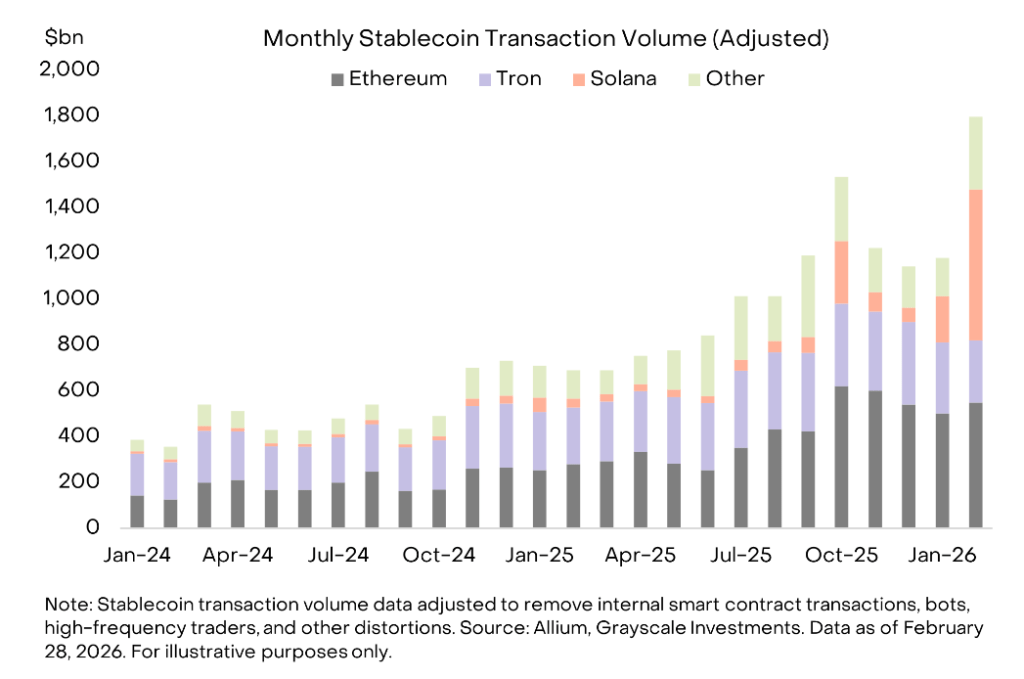
According to a research note from Grayscale Investments, February’s record volume – $650 billion in stablecoin transactions – was driven by a move toward SOL–stablecoin trading pairs and real payment activity — not speculative bets on short-lived tokens.
The network processed more transactions tied to practical money movement than at any point in its existence.
The massive figure covers stablecoin transactions recorded on Solana during February 2026. It marks the highest monthly total ever logged on any blockchain — and it arrived in just 28 days.
Grayscale’s data shows the number more than doubled the previous peak, which was set only four months earlier in October 2025.
Low Fees Drive Small Payment Growth
Standard Chartered had previously flagged Solana’s fee structure as a key reason the network was drawing payment-focused users.
Low transaction costs make small transfers practical in a way that higher-fee blockchains cannot easily match.
Developers have taken notice, building financial tools designed to run entirely on the internet, including micropayment systems that would be unworkable at higher cost per transaction.
Stablecoins Power Blockchains
Stablecoins — digital tokens pegged to currencies like the US dollar — have become one of the main engines of blockchain activity broadly.
On Solana, they are increasingly being used to move money rather than to trade in and out of volatile assets.
That distinction matters. Volume built on payments tends to be stickier than volume built on speculation, which can evaporate when market conditions shift.
Solana now holds the fourth-largest stablecoin supply of any blockchain. Its ranking in USDC circulation is even more striking: second place, trailing only Ethereum.
USDC is widely regarded as the stablecoin most favored by institutional users, which makes Solana’s position in that particular ranking significant.
 Ethereum Holds Its Ground On High-Value Assets
The February data does not suggest Solana has overtaken Ethereum overall. According to figures from rwa.xyz, Ethereum carried $15.57 billion in tokenized real-world assets over the past 30 days.
Solana’s comparable figure was $2 billion. Tokenized assets — which can include bonds, real estate, and other financial instruments brought onto a blockchain — represent the higher-value end of on-chain finance, and Ethereum remains the dominant platform for that segment.
What Solana appears to be winning is the retail and payments layer: fast, cheap, high-frequency transfers that add up quickly in volume even if individual transactions are small.
Whether that translates into broader institutional adoption remains an open question, but February’s numbers give the network a data point it did not have before.
Featured image from SOPA/Getty Images, chart from TradingView