





Key Insights
- Solana price has rebounded by nearly 20% from its lowest point in December.
- SOL ETF inflows continued on Thursday, bringing the year-to-date increase to $50 million.
- Focus now shifts to the upcoming Alpenglow upgrade.
Solana price held steady this week as American investors continued their accumulation. SOL token was trading at $138 today, up by nearly 20% from its lowest level in December. This article explores whether it has more upside to go ahead of the Alpenglow upgrade.
SOL ETF Inflows are Rising
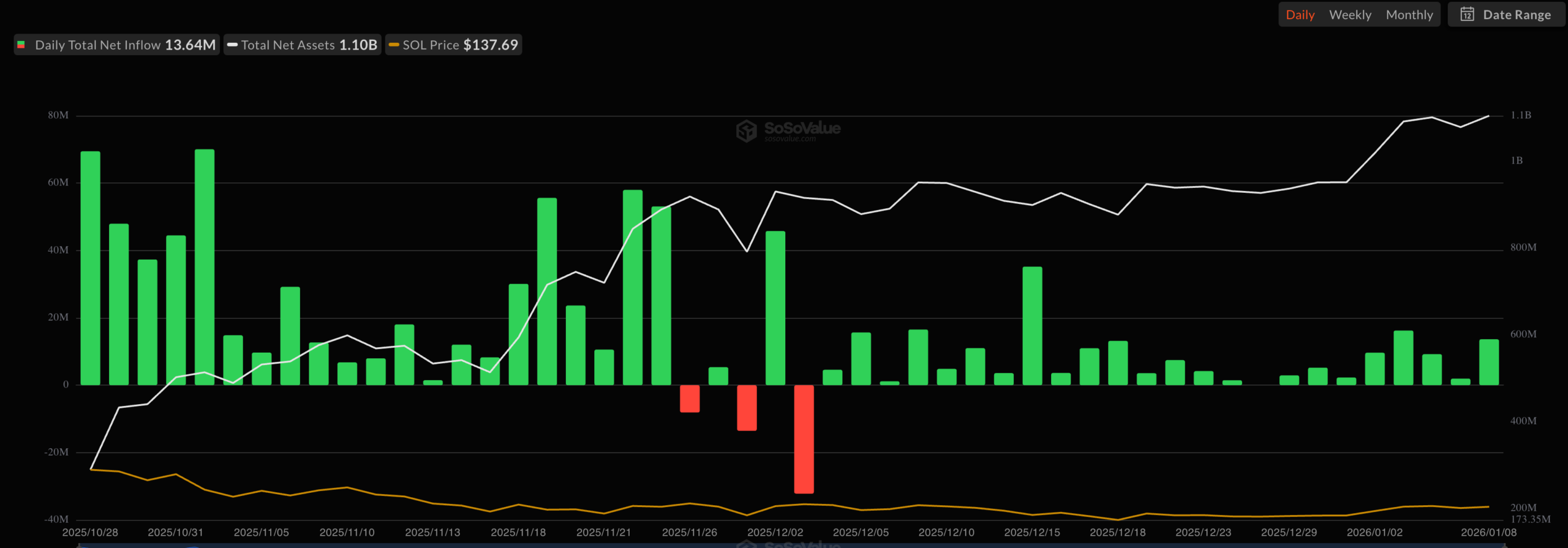
One major catalyst for Solana’s price is that the recently-launched SOL ETFs have continued buying. Data compiled by SoSoValue shows that these funds added $13.65 million on January 8. Inflows have risen by $50 million this month so far.
Solana funds have had over $816 million in inflows since their approval. This brought the net assets to over $1.1 billion. These assets account for about 1.4% of Solana’s market capitalization.
In contrast, Bitcoin ETFs have $117 billion in assets, which is equal to 6.48% of the market cap. Similarly, Ethereum ETFs have $18.95 billion in assets, 5% of the market cap. As such, these numbers mean that the inflow trend has more room to go.
The rising Solana ETF inflows have coincided with the rising futures open interest. Data compiled by CoinGlass shows that the open interest has jumped to $8.21 billion. It’s up sharply from the fourth quarter’s low of $6.6 billion.
OI is an important metric that looks at the outstanding derivatives contracts that are active and not yet settled. It normally shows the amount of money tied to these contracts. A rising figure is a sign that investors are starting to deploy leverage in their positions.
Solana Alpenglow Upgrade is a Major Catalyst
The ongoing Solana price rebound and ETF inflows is happening as the developers wait for the upcoming Alpenglow upgrade. It will happen this quarter.
Alpenglow is designed to make Solana a better blockchain for developers and validators. It is also the most significant protocol overhaul in its history because of what it introduces and replaces.
The most important aspect is that it replaces the proof-of-history and Tower BFT with Votor and Rotor. Votor will be a lightweight, direct-vote-based voting protocol that will enable blocks to finalize in one or two seconds.
On the other hand, Rotor will be a stake-weighted block propagation system. This system will optimize how information spreads across the network.
These upgrades will have a major impact on the network. For example, it will reduce the transaction finality from 12 seconds to sub-second. This improvement will make it one of the fastest chains in the crypto industry.
The upgrade comes at a time when Solana is struggling to gain market share from Ethereum. For example, while Ethereum has a total value locked (TVL) of $150 billion, Solana has $20 billion. Ethereum has a market dominance of 76% in the decentralized finance (DeFi) industry.
Similarly, Ethereum has a stablecoin supply of $166 billion compared to Solana’s $13 billion. As such, the hope is that the upgrades will improve Solana’s network and boost its activity.
Solana Price Technical Analysis
The daily chart shows that the SOL price has bounced back from a low of $117 in December to $138 today. It has already crossed the 50-day Exponential Moving Average (EMA).
The True Strength Index (TSI) has continued rising, and most recently, crossed the zero line. There is a chance that the signal line will cross this line eventually.
Solana has formed a triple-bottom-like chart pattern, which is a common bullish reversal sign. Therefore, the most likely scenario is where the token rebounds and hits the 50% Fibonacci Retracement level at $185. This target is about 35% above the current level.
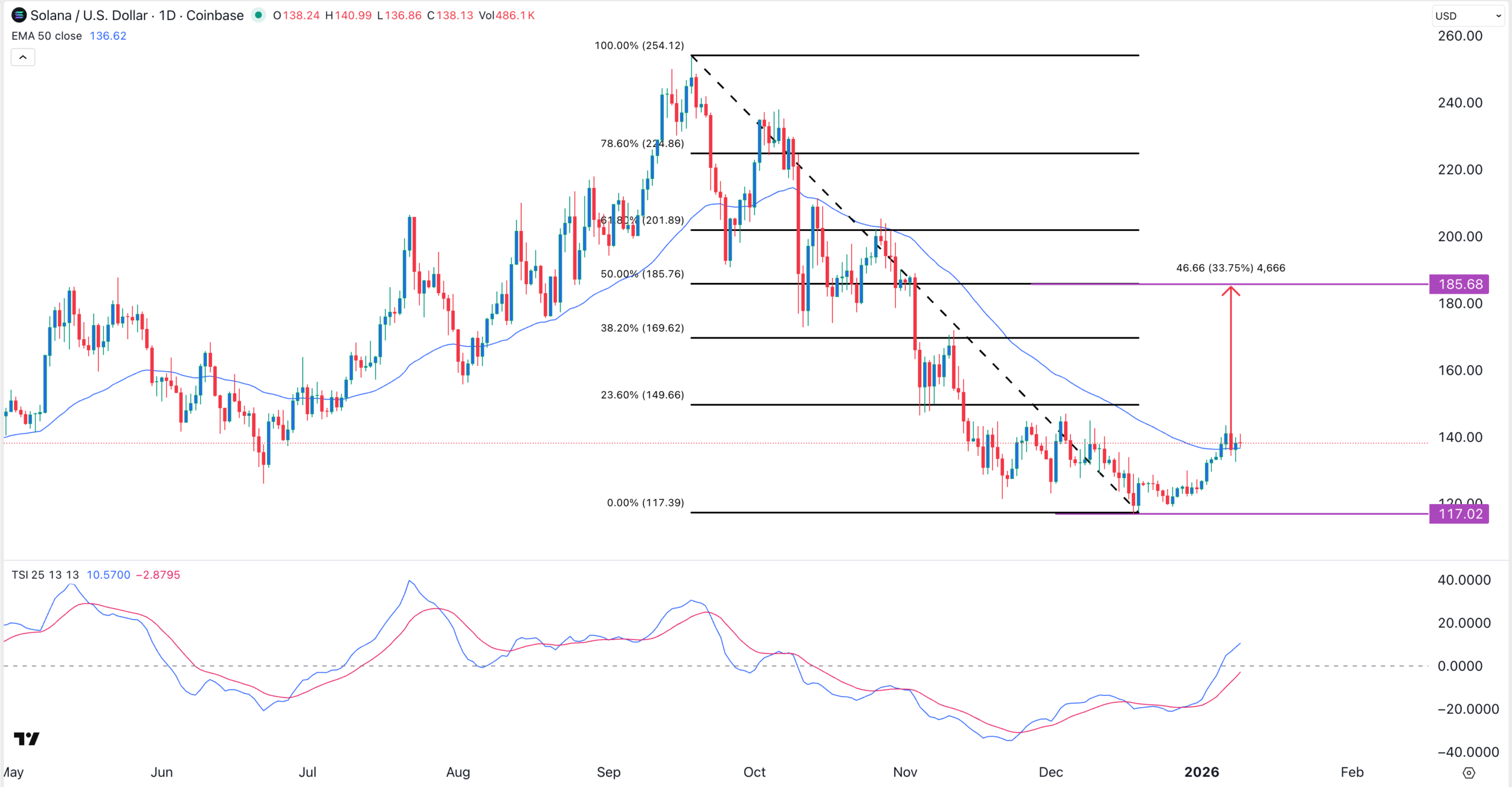
On the flip side, a move below the key support level at $117 will invalidate the bullish view. This stop-loss price is at its lowest level in December. A move below it will point to more downside to $100 and below.
The post Solana Price Prediction as SOL ETF Inflows Rise Ahead of Alpenglow Upgrade appeared first on The Market Periodical.