





TL;DR:
- The Solana Foundation launched STRIDE, a continuous security program for DeFi protocols with a tiered benefits system based on TVL.
- Asymmetric Research will independently manage the program, evaluating protocols across eight categories and publishing results in a public repository.
- Just days ago, Drift Protocol suffered an exploit in which roughly $286 million was stolen in under twelve minutes.
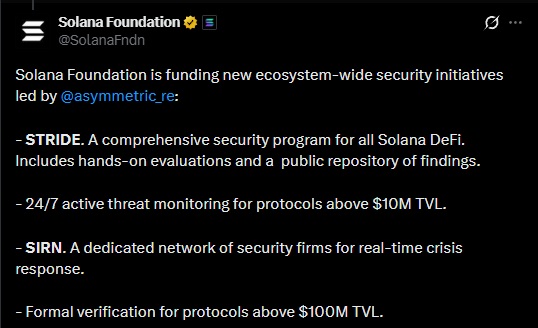
The Solana Foundation announced the launch of STRIDE (Solana Trust, Resilience and Infrastructure for DeFi Enterprises), a continuous security evaluation program aimed at all DeFi protocols built on the network.
The program was funded by the foundation itself through a partnership with security firm Asymmetric Research. It is a response to a situation that has turned critical: just five days after the Drift Protocol exploit allowed attackers to walk away with roughly $286 million in under twelve minutes, exposing the absence of a sustained security standard in Solana’s DeFi layer.
Solana Takes Security to a Structural Level
STRIDE is neither a bug bounty program nor a one-time audit. It is a continuous monitoring framework, independently managed by Asymmetric Research, that evaluates each protocol across eight categories: operational security, access controls, multisig configurations, governance vulnerabilities, among others. Results are published in a public repository accessible to users and investors.
An Incentive Architecture Tied to TVL
The program’s logic is built on a tiered structure. Protocols exceeding $10 million in total value locked that pass the evaluation receive 24/7 threat monitoring funded by the foundation, at no cost to their team. Those surpassing $100 million in TVL gain access to formal verification tools, which use mathematical proofs to map every possible execution path of smart contracts rather than analyzing representative scenarios. Given the current concentration level within the network’s DeFi ecosystem, that threshold covers exactly the protocols whose collapse could trigger systemic contagion.

Running in parallel is SIRN —Solana Incident Response Network—, a coalition of security firms that functions as a shared intelligence network against threats and as a coordinated response mechanism. Its five founding members are Asymmetric Research, OtterSec, Neodyme, Squads, and Zeroshadow. Response prioritization is determined by TVL and the estimated impact of each incident.
Version 0.1 of STRIDE is already live. The network’s pre-existing security infrastructure—which includes tools such as Hypernative, Range Security, Riverguard, and Sec3 X-Ray—addressed individual threat vectors; STRIDE seeks to unify those capabilities under a single evaluation framework.