


The Solana Foundation and Asymmetric Research launched STRIDE on Monday, a tiered security program built to protect decentralized finance ( DeFi) protocols across the Solana ecosystem with ongoing evaluations, threat monitoring, and formal verification. The initiative follows the Drift Protocol hack that saw $286 million pilfered in 12 minutes last week.
Key Takeaways:
- The Solana Foundation and Asymmetric Research launched STRIDE on April 6, 2026, a tiered DeFi security program covering all protocols.
- Protocols exceeding $10M TVL qualify for foundation-funded 24/7 monitoring, while those above $100M TVL receive formal verification.
- The new Solana Incident Response Network (SIRN) unites five founding firms, including OtterSec and Neodyme, for real-time crisis coordination.
The program, which stands for Solana Trust, Resilience and Infrastructure for DeFi Enterprises, moves away from the traditional model of one-off audits and replaces it with continuous, foundation-funded protection scaled to each protocol’s size and risk profile.
STRIDE is structured around eight security pillars covering operational security, access controls, multisig configurations, and governance vulnerabilities. Asymmetric Research conducts hands-on assessments of participating protocols and publishes findings in a public repository, giving users and investors direct visibility into each protocol’s security standing.
All SolanaDeFi protocols are eligible to apply. Every participating project receives an independent evaluation and a published report regardless of size.
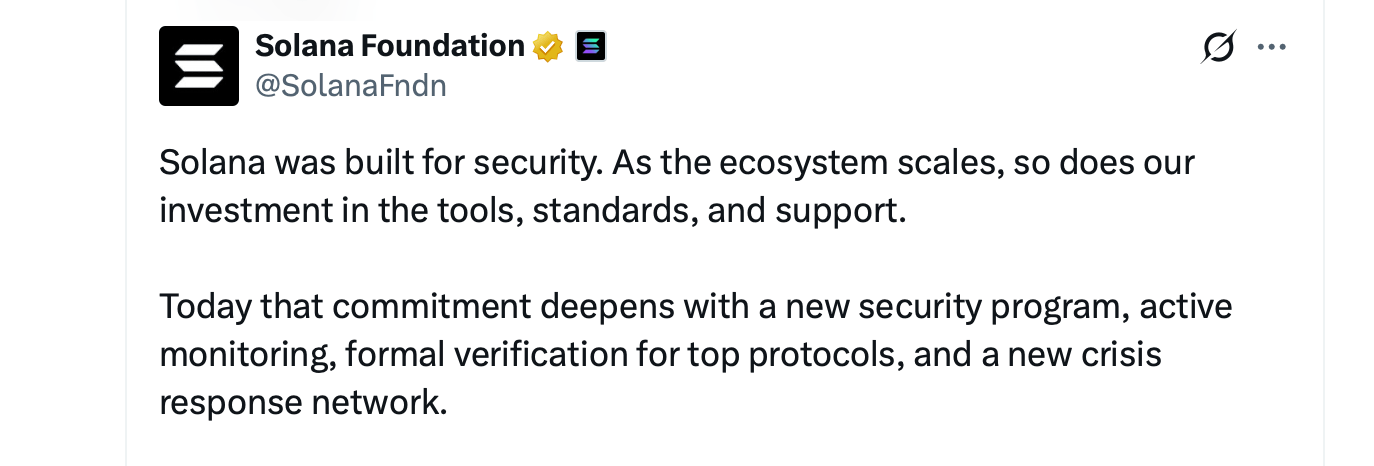
The announcement explains that protocols that pass the STRIDE evaluation and hold more than $10 million in total value locked (TVL) qualify for foundation-funded 24/7 operational security support and real-time threat monitoring. The monitoring is calibrated to risk, meaning higher-value protocols receive more intensive coverage aimed at catching suspicious activity before it escalates.
For the largest protocols, those managing more than $100 million in TVL, the Solana Foundation funds formal verification. This method uses mathematical proofs to check every possible execution path in a smart contract, eliminating entire classes of vulnerabilities that standard audits can miss.
STRIDE version 0.1 is live now and is expected to evolve as real-world assessments provide feedback.
Alongside STRIDE, the foundation launched the Solana Incident Response Network, known as SIRN, a coalition of security firms dedicated to real-time crisis response across the ecosystem. Founding members include Asymmetric Research, OtterSec, Neodyme, Squads, and Zeroshadow. SIRN is open to all Solana protocols, with response prioritized by TVL and potential impact.
The program builds on existing no-cost tools the Solana Foundation has already deployed, including Hypernative for ecosystem-wide threat detection, Range Security for real-time risk alerting, Riverguard by Neodyme for attack simulation, Sec3 X-Ray for static analysis, and Auditware Radar for template-based issue detection.
Projects like Squads Multisig, Kamino, and Jupiter Lend have already set high internal security standards, with ten or more audits across some protocols. STRIDE is designed to extend comparable protections to teams that lack the resources to fund that level of coverage independently.
The Solana Foundation also participates in the Crypto Defenders Alliance for cross-industry fraud prevention, and STRIDE adds a Solana-specific layer on top of those broader efforts. The initiative follows the recent $286 million Drift Protocol hack, which was the largest DeFi breach so far in 2026.
Drift Protocol is the largest perpetuals exchange on Solana and it saw its TVL slide from $550 million to the current $234 million. The project’s token, DRIFT, as of 6:30 p.m. Eastern time on Monday, is down more than 37% over the last seven days. DRIFT is 98.5% below the crypto asset’s all-time high of $2.60 logged in November 2024.