





Key Insights
- Solana ETF inflows have continued rising in the past few days.
- These ETFs have added over $792 million in inflows, with their assets moving to over $1.09 billion.
- Technical analysis suggests that the token will continue rising in the coming weeks.
Solana ETF inflows started the year well. It’s continuing a trend that has been ongoing since they were approved in October last year. These inflows have continued as the SOL price has jumped to its highest level since December 12. It’s 12% above the lowest point in December.
Solana ETF Inflows Have Jumped
Third-party data showed Solana ETF inflows kept rising this year. Institutional and retail investors accelerated their demand for the asset.
According to SoSoValue, spot SOL ETFs have had over $792 million in inflows since their launch in October. This inflow has brought the cumulative total assets to over $1.09 billion.
Bitwise, which was the first one to be approved, has accumulated $638M in inflows and now has $731M in assets.
Grayscale’s GSOL has had $109 million in inflows and over $181 million in assets. The other large Solana ETFs are by companies like Fidelity, VanEck, 21Shares, Franklin, and Invesco.
The rising inflows are a sign that investors are optimistic about Solana. It has become a major competitor to Ethereum in some areas.
For example, data compiled by DeFiLlama shows that Solana DEX volume jumped to $107.7 billion in the last 30 days. It’s much higher than Ethereum and BSC’s $43 billion and $50 billion, respectively.
Solana Spot Volume and Futures Open Interest Have Soared
More data shows that Solana’s demand has continued rising in the past few days. Data compiled by CoinGecko shows that the daily volume jumped to $5.82 billion, the biggest increase since December 19th.
More data shows that Solana futures open interest has been slowly increasing in the past few weeks. It’s moving from a low of $6.8 billion on December 19th to $8.3 billion on January 6.
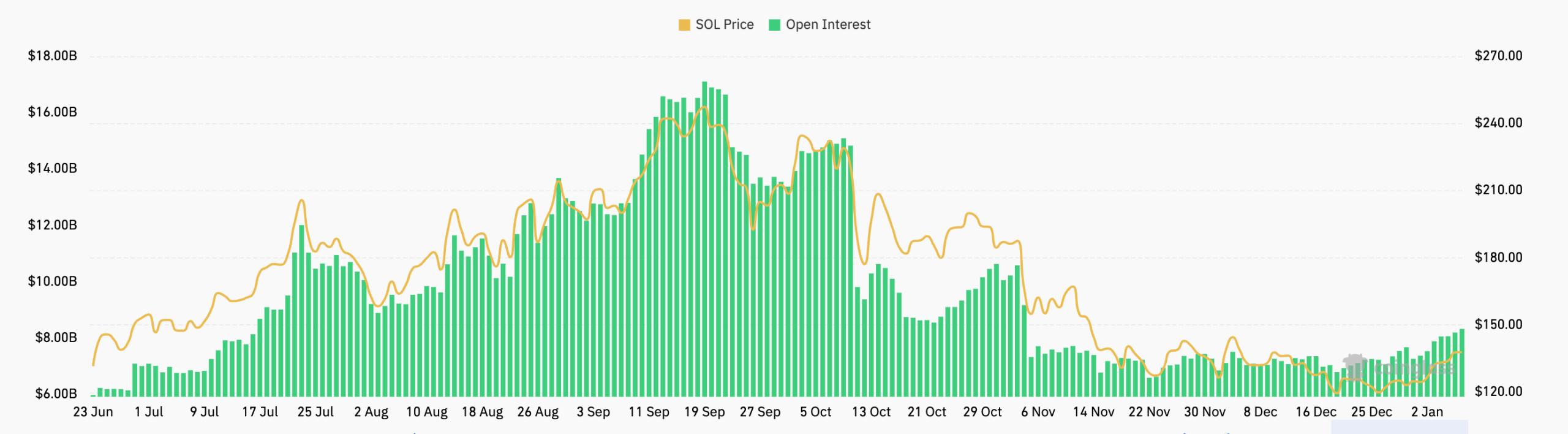
Futures open interest is an important metric that looks at the outstanding contracts in the futures market. A higher open interest is often seen as being bullish, especially when the price is rising.
Top Reasons why Solana Demand is Rising
There are a few reasons why demand for Solana has jumped in the past few weeks. One of them is the fact that the crypto market rally is underway, which has affected Bitcoin and other altcoins.
Bitcoin has jumped to $94,000, while the market capitalization of all coins has moved to over $3.3 trillion. The other reason is that Solana will implement the Alpenglow upgrade later this year.
Solana’s upgrade reduced block confirmation time sharply. It dropped from 12.8 seconds to just 100–150 microseconds. This change made Solana one of the fastest chains.
Solana will also have a higher throughput. It will help it handle between 65,000 and 107,000 transactions per second (TPS). That’s much higher than Ethereum.
Alpenglow will also introduce the Rotor and Votor consensus. This will replace proof of history and tower BFT with new components. The integration will help it become a better chain for key industries like decentralized finance and real-world asset (RWA) tokenization.
Solana meme coins showed rising demand. Their market capitalization jumped to over $6.7 billion. This was up from December’s low of $4 billion.
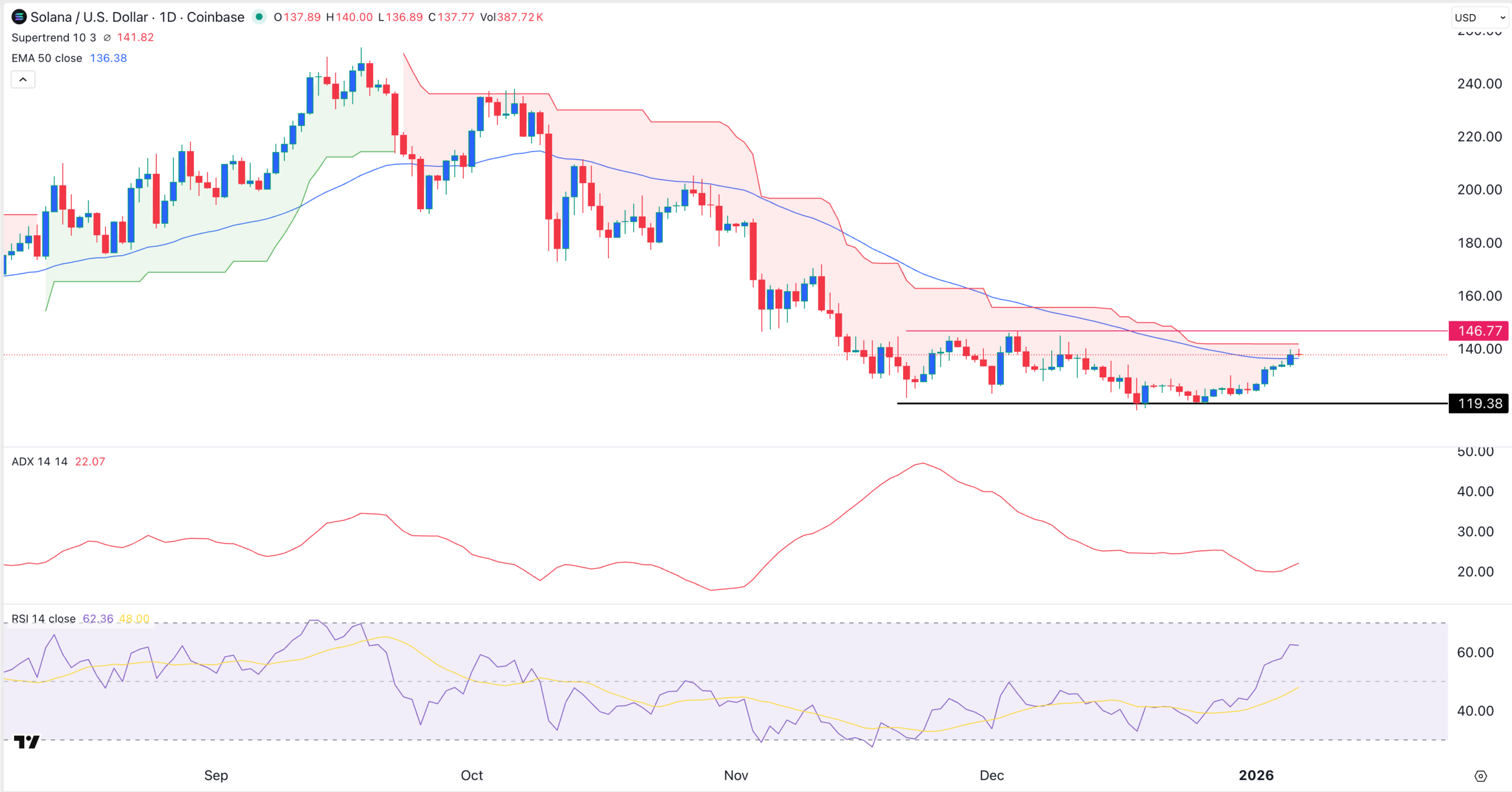
Solana price also has some bullish technicals. The daily timeframe chart showed the token formed a triple-bottom pattern at $120. It also established a neckline at $146, its highest level on December 9 last year.
SOL price has moved above the 50-day Exponential Moving Average (EMA). It’s a sign that bulls are gaining control. Also, the coin is attempting to turn the Supertrend indicator from red to green.
More metrics show the token is gaining momentum, with the Average Directional Index (ADX) having moved to 22. At the same time, the Relative Strength Index (RSI) has moved from 27 in November to 63.
Therefore, the token will likely continue rising, with the next key target level to watch being at $150.
The post Solana ETF Assets Top $1B as Institutional Inflows Accelerate appeared first on The Market Periodical.