





During these stable days for Bitcoin, altcoins have experienced a rare surge in volatility.
Tokens with a market cap under $20 million have seen prices triple, quintuple, or even approach tenfold within days—without any major developments, ecosystem breakthroughs, or new institutional inflows.
There is a ready explanation for this phenomenon: altcoins are high-beta assets, so when Bitcoin rises, altcoins rise even faster. This statement holds statistically, but it doesn’t fully explain the phenomenon. High beta can account for altcoins outperforming Bitcoin, but it cannot explain why their gains differ by factors of dozens. That multiple stems from something else.
The Altcoin Season Index is currently at 34, and BTC dominance is at 58.5%. Together, these numbers indicate that the market is still far from a true altcoin season. Yet, in this market without an altcoin season, certain tokens are moving with the magnitude typically seen only during altcoin seasons.
From December 2024 to April 2026, the total market capitalization of altcoins excluding Bitcoin and Ethereum declined from a peak of approximately $1.16 trillion to around $700 billion, erasing nearly 40%. When market capitalization shrinks sufficiently, the rules of the game change: prices are no longer determined by market consensus, but by who holds enough tokens.
This is a gap created by an oversold condition, not a signal from a bull market.
Altcoins have really dropped too much.
In the blockchain space, there is the concept of a 51% attack—controlling more than half of the network’s hashing power allows one to alter records, double-spend tokens, and rewrite history. The capital version of this logic is even simpler: it requires no technical expertise or computing power, only money. In this round, the altcoin market has seen nearly 40% of its total value evaporate, simultaneously lowering the entry barrier by the same percentage.
As of early April 2026, the total market capitalization of altcoins was approximately $700 billion, a decline of about 40% from the peak of $1.16 trillion in December 2024. If measured against the end of 2025, the decline was approximately 44%. Although the two measurements use different time points, both indicate the same trend: the overall size of this market has nearly halved.
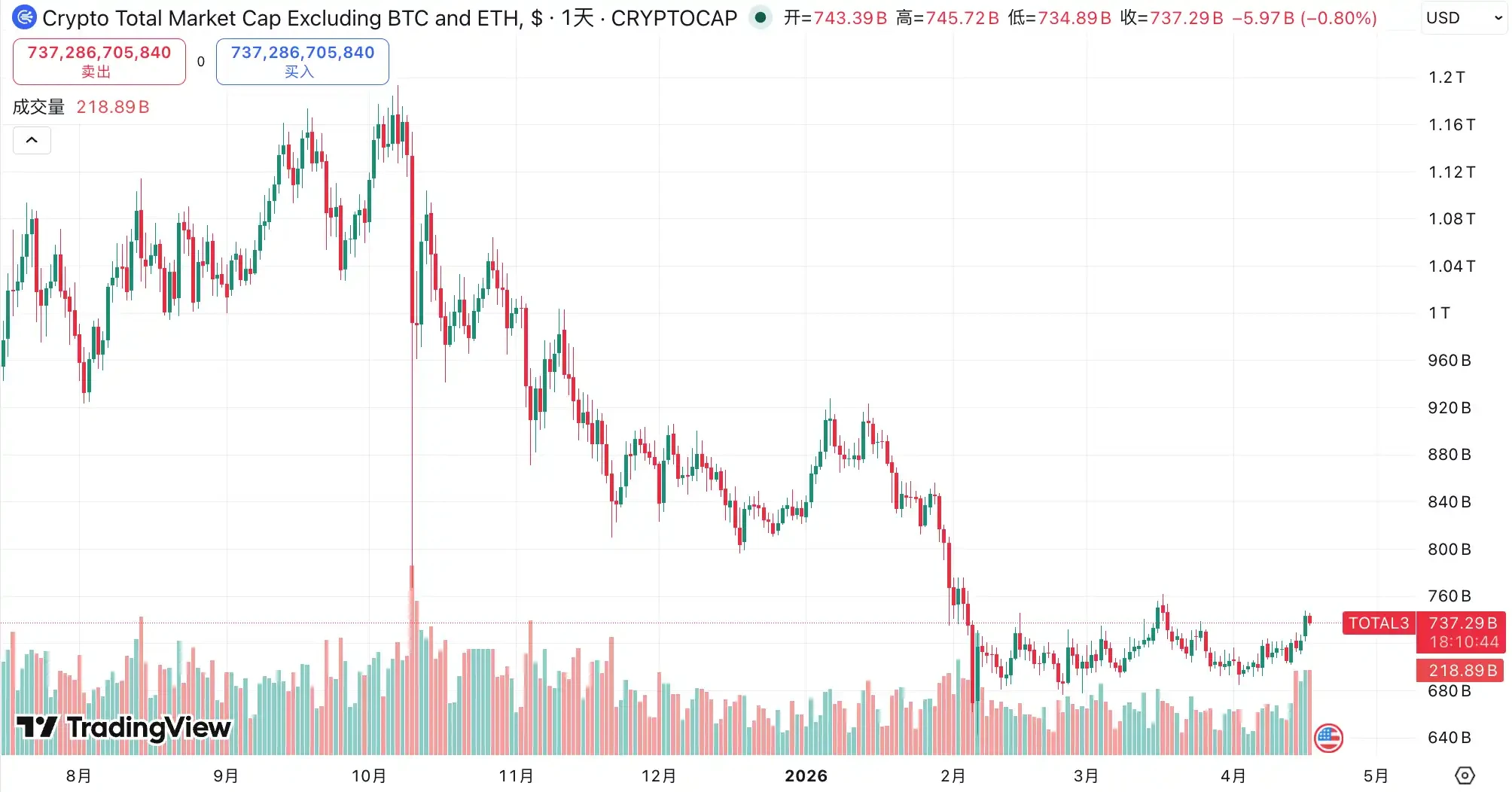
A halving of market cap means that $10 million represents 2% of a $500 million circulating market cap, but 20% of a $50 million circulating market cap. The threshold has dropped tenfold, yet the amount of money remains unchanged. After a severe decline, the cost of controlling the market becomes calculable—and if it’s calculable, it’s executable.
The recent surge in the SIREN token provides a compelling case study. In late March, SIREN experienced a rapid price spike, drawing significant attention. On March 24, on-chain analyst EmberCN issued a warning that a single entity may have controlled up to 88% of SIREN’s circulating supply, equivalent to approximately $1.8 billion at the prevailing price. As the news spread, SIREN’s price plummeted from $2.56 to $0.79 on the same day—a drop of over 70%. During this sharp sell-off, almost no one could exit at a reasonable price, as that level was never genuinely determined by market demand.

A conservative estimate shows that 48 wallets hold approximately 66.5% of the circulating supply. Even by this lowest threshold, a highly concentrated set of addresses already possesses the structural conditions to control price direction. From the moment prices were established, the symmetry of this game was broken. Retail investors, believing they are participating in a free market, have entered a container with a pre-determined exit path.
SIREN is not an isolated case or a black swan; it is the norm for deeply undervalued altcoins. The deeper the decline, the less capital is required to manipulate them. Deep undervaluation is not a discount—it is fragility—and this round of a 40% overall market cap decline means this fragility has been systematically extended across the entire market.
Short positions are fuel.
If the story ended here, the logic would be one-directional: market makers lock up holdings, push the price up, and dump on retail investors, leading to a crash. However, the price action of ultra-low-market-cap altcoins often has an additional layer: short sellers become the fuel for the rally.
During the rapid price surge, the funding rate for SIREN reached -0.2989% per 8 hours, annualized at approximately -328%. This means that shorting SIREN and holding the position requires paying funding fees of about 0.3% of the principal to longs every 8 hours. Over a one-month holding period, these fees alone could erode more than 25% of the principal, not including any unrealized losses from the price increase.
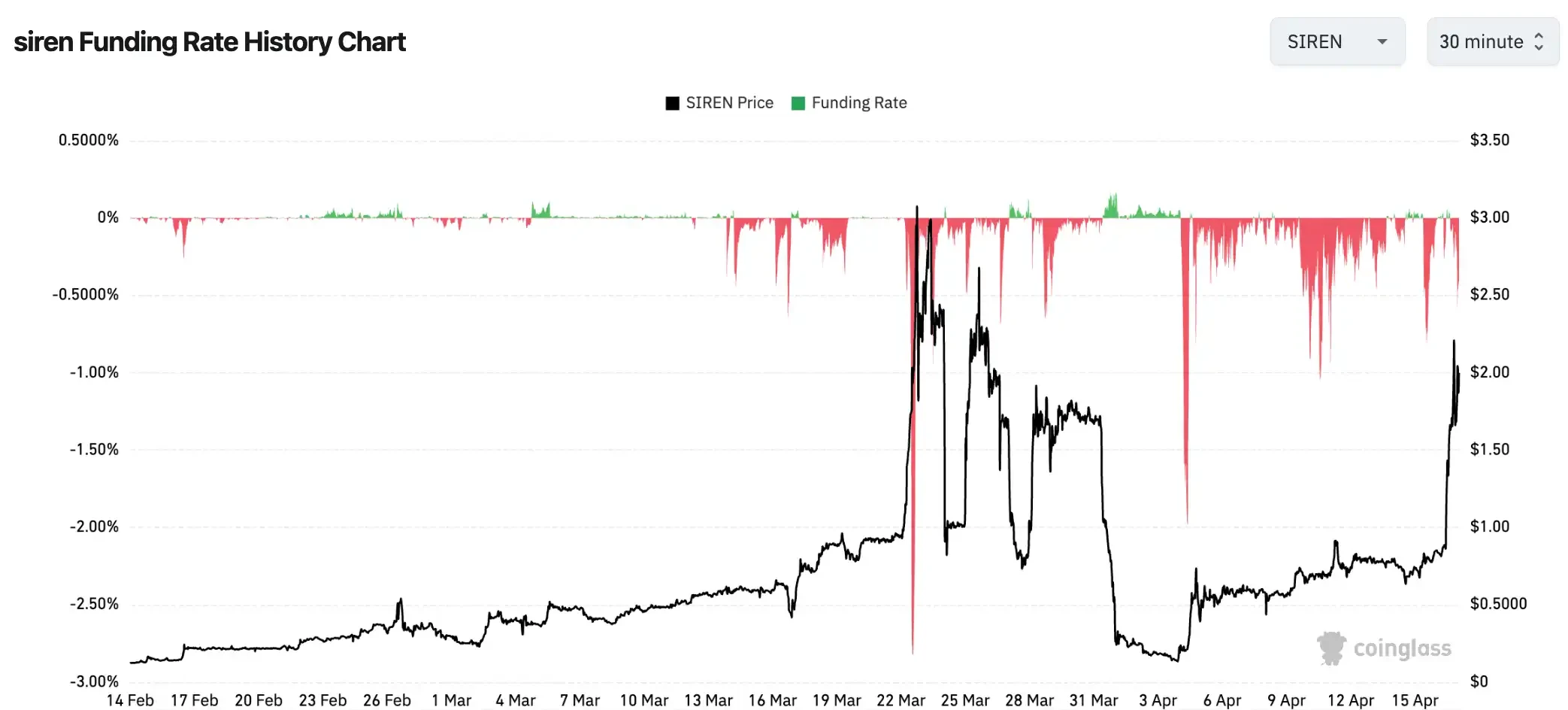
This figure is not uncommon in the small-cap altcoin market. During extreme market conditions, funding rates for some tokens dropped as low as -0.4579% per 8 hours, annualizing to approximately -501%. At this level, short sellers aren’t just risking being wrong on direction—they face the certainty of being slowly worn down by a machine. Even if they’re ultimately right about the direction, they may be exhausted before the right moment arrives.
When you see a altcoin rise 80% and decide to short it, expecting a pullback, every short position you open pays interest to the opposing longs. Meanwhile, if the price continues rising and hits your liquidation level, the system will automatically buy back your position at market price—this forced buy-in further pushes the price higher.
The short squeeze chain operates as follows: as the price rises, short positions incur paper losses; when these losses hit the margin call threshold, the system automatically executes market buy orders to close the positions. These buy orders further push the price higher, triggering more shorts and initiating another round of buying. In low-liquidity, small-cap markets, each trade can cause a significantly larger price movement, making the chain’s transmission far more efficient than in large-cap assets.
There’s an often-overlooked asymmetry here. Someone who decides to short a token after it surges 90% typically believes they’re making a probabilistically sound judgment: “It’s bound to pull back after such a big move.” But in a market with highly concentrated holdings and locked positions, this bet doesn’t just oppose price movement—it also fights funding fees of 0.3% of principal every 8 hours, and the cascading effects triggered by forced liquidations once the liquidation price is hit. This game is asymmetrical from the very start.
The extreme negative funding rate is the dashboard reading of this machine. Shorts have already accumulated their positions, ammunition loaded, and now they’re accelerating upward—those on the other side have only two choices: get liquidated or chase the price higher. Both choices fuel the price rise. This isn’t a rally driven by market consensus; it’s a structurally engineered one-sided depletion.
A bustling market without new money
The BSC chain's weekly DEX trading volume increased by 97% year-over-year, the altcoin season index is 34/100, and BTC dominance is 58.5%. These three figures can simultaneously be true and yet contradict each other.
On-chain activity is indeed scorching hot, but the next two numbers reveal that this market is still in its "Bitcoin season"—less than half of major altcoins have outperformed Bitcoin, and capital remains heavily concentrated in Bitcoin, far from spreading outward. Yet these three figures point to the same reality: this is accelerated circulation of existing capital, not new money entering. The excitement is real, but excitement does not equal expansion.
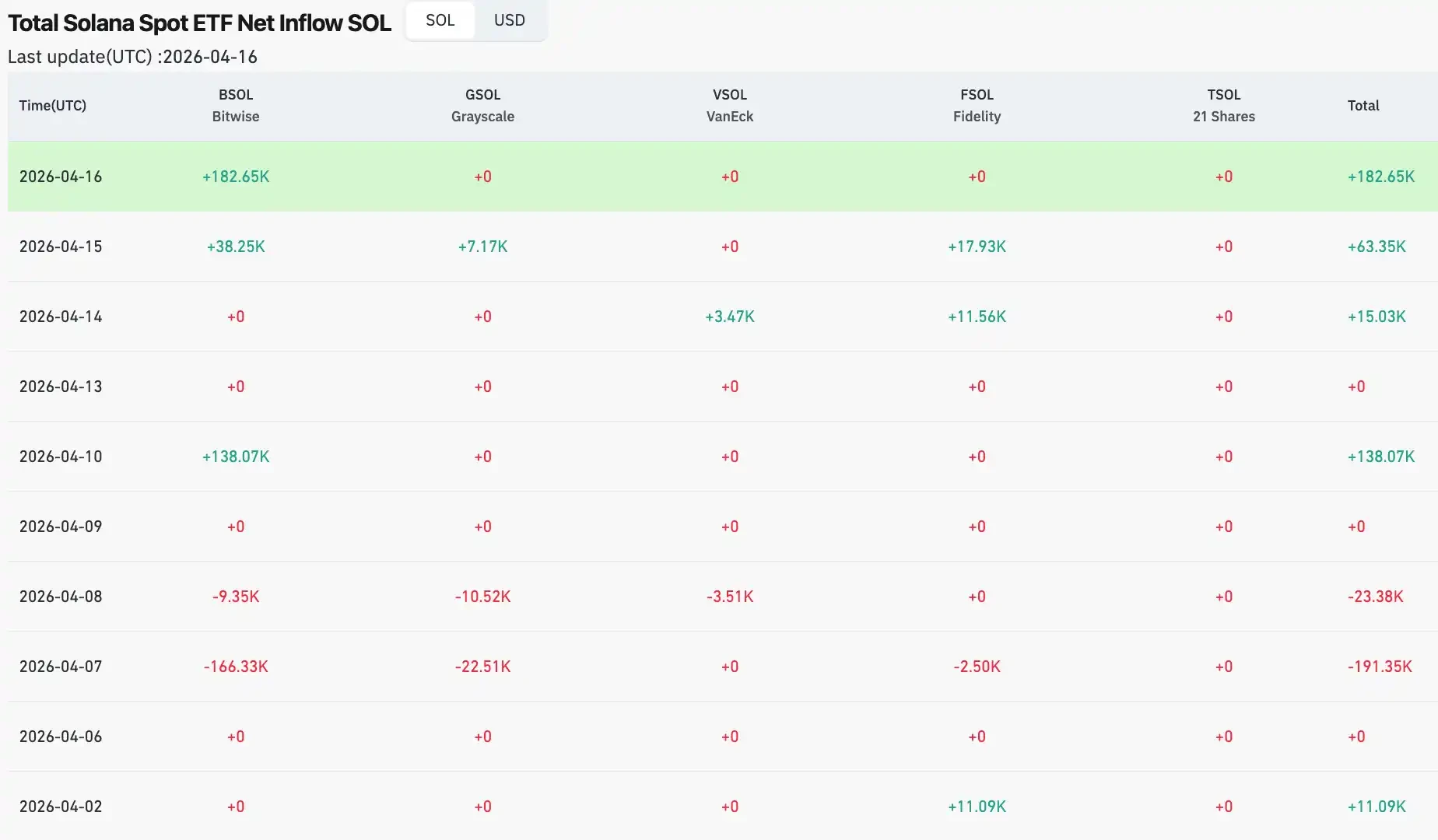
The movement of institutional funds provides supporting evidence. In early April, the daily net inflow for the Solana ETF dropped to zero, following a $6.2 million net outflow on March 30; the XRP ETF continued to experience net outflows at the start of the month, with only a minimal inflow of approximately $64,600 on April 2. Although the Ethereum ETF recorded a $120 million single-day net inflow on April 6, it had previously seen a $71 million outflow the day before. Overall, institutional fund positioning in altcoins reflects caution, not rotation.
The difference compared to the real altcoin season of 2021 is structural. During that cycle, from the beginning of the year to May, BTC’s dominance dropped from over 70% below 40%, hitting a low of approximately 39%. The rotation of capital between Bitcoin and alts was clearly visible, with the Altcoin Season Index peaking above 90. This was a broad expansion driven by excessive macro liquidity, with the afterglow of DeFi Summer still present, retail FOMO flooding in en masse, and stablecoin supply rapidly expanding during the same period, continuously pumping new capital into the ecosystem. Today’s 34 and 58.5% represent an entirely different picture—the engine has just begun to warm up and is far from running at full speed.
There is another variable unique to this cycle: institutional capital entering the market via ETFs follows internal asset allocation logic, not the emotional logic of the crypto market. Institutions are doing “adjust Bitcoin allocation to X%,” not “altcoin season is coming, let’s add altcoins.” This type of capital is structurally unlikely to rotate into altcoins unless explicitly instructed to do so. This is the most fundamental structural difference between 2021 and 2026: in 2021, a large portion of the capital was retail money chasing whatever was hot; today, institutional capital is anchored—its path is fixed and does not drift with market sentiment.
The 97% surge in on-chain trading volume is real, but a market without new money is zero-sum. Every winner’s gain corresponds to another player’s loss, and the total size of the pool remains unchanged. A存量博弈 (存量博弈 translates to "存量博弈" in Chinese, which means "存量博弈" in English — but in context, it refers to "a game among existing participants") doesn’t necessarily lead to a crash, but it defines the structure of this game: the excitement belongs only to those already in the game and holding positions. Those who join later typically use their own money to complete the final leg of others’ exit strategies.
Epilogue
Returning to the initial set of data: Bitcoin rose approximately 0.85% over four days, while several low-market-cap tokens surged several-fold during the same period. You now have a framework. Bitcoin’s rise is one thing—macro conditions are catching their breath, institutional capital is testing the waters, and the market awaits its next clear signal. The explosive rally in altcoins is another matter entirely—oversold conditions and low market caps have created structural vulnerabilities, allowing small amounts of capital to move prices in thinly liquid markets, while extreme negative funding rates have turned short sellers into fuel for longs. Both events happening simultaneously do not mean they tell the same story.
Altcoin Season Index: 34, BTC Dominance: 58.5%. By 2021 historical standards, this market hasn’t even completed its warm-up phase. BTC dominance must decline from 58% to around 39% as it was that year; institutional capital must expand from “Bitcoin allocation” to “crypto asset portfolio allocation”; and new capital must continue flowing in rather than exiting at peaks. None of these conditions can be resolved by a single price surge.
There are two types of people in this machine: those who know who it’s running for, and those who are the fuel it needs to run.
BTC's rise is the signal; the explosive gains in altcoins are the echo. Distinguish between these two things to make a choice in this market that isn't predestined by machines.