








This Issue's Highlights
The reporting period for this weekly newsletter covers May 1, 2026, to May 8, 2026.
This week, the total market capitalization of RWA on-chain stabilized at $30 billion, while the total market capitalization of stablecoins rebounded above $300 billion. However, monthly transaction volume dropped sharply by 25.68%, marking the largest decline in recent times, indicating a significant reduction in large-scale settlement and arbitrage demand. Meanwhile, monthly active addresses and total holders continued to grow steadily, signaling that the market is transitioning into a new phase characterized by a balanced focus on strategic holding and real-world use case adoption, rather than high-frequency trading.
A critical milestone is approaching on the regulatory front: The U.S. Senate Banking Committee may issue a notice of consideration for the CLARITY Act as early as May 9, with a vote expected next week, while the draft is still being finalized; the Bank of England is considering pausing its digital pound initiative in favor of observing private-sector tokenization innovations; the Central Bank of Brazil has banned the use of stablecoins for cross-border payments, while Italy, Argentina, and other regions are advancing regulatory frameworks for tokenization, accelerating the global divergence in policy paths.
At the project level, traditional financial giants are fully embracing blockchain: DTCC plans to launch a tokenized RWA pilot trading program in July, covering Russell 1000 index components and U.S. Treasuries; Japan aims to tokenize its government bonds for 24/7 trading; Ripple, JPMorgan, and Mastercard have successfully completed a cross-border transfer of tokenized Treasuries; Securitize has received FINRA approval to offer custody services for tokenized securities; Galaxy and State Street have launched the tokenized cash management fund SWEEP on Solana; Western Union has launched the USD-backed stablecoin USDPT on Solana.
AI and privacy emerge as new focal points: AWS partners with Coinbase and Stripe to launch an AI agent USDC payment solution; Solana and Google Cloud introduce Pay.sh; Polygon Wallet rolls out USDC/USDT privacy payment features; MoonPay launches a stablecoin debit card designed for AI agents.
On the funding front, Centrifuge received a strategic investment from Coinbase, OpenTrade completed a $17 million funding round, and the RWA blockchain platform Balcony raised $12.7 million in seed funding.
Data pivot
RWA Sector Overview
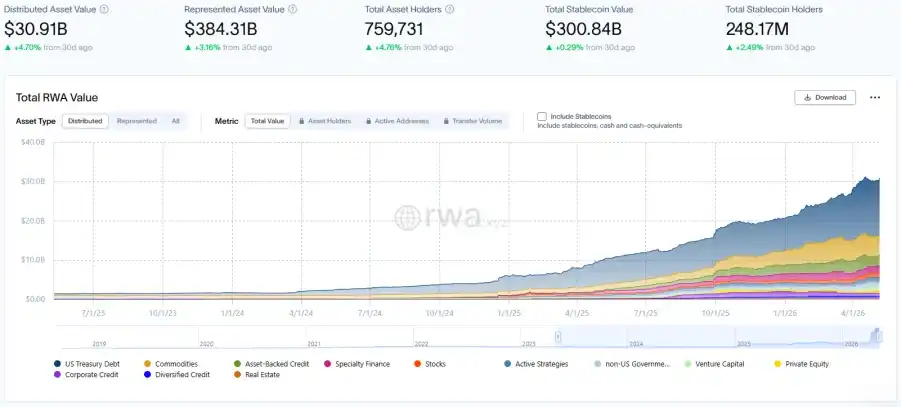
RWA.xyz's latest data reveals that, as of May 8, 2026, the total on-chain market capitalization of RWA reached $30.91 billion, representing a 4.7% month-over-month increase and continuing a steady growth trend over multiple months. The total number of asset holders increased to approximately 759,700, up 4.76% month-over-month, closely aligning with asset growth.
Stablecoin market
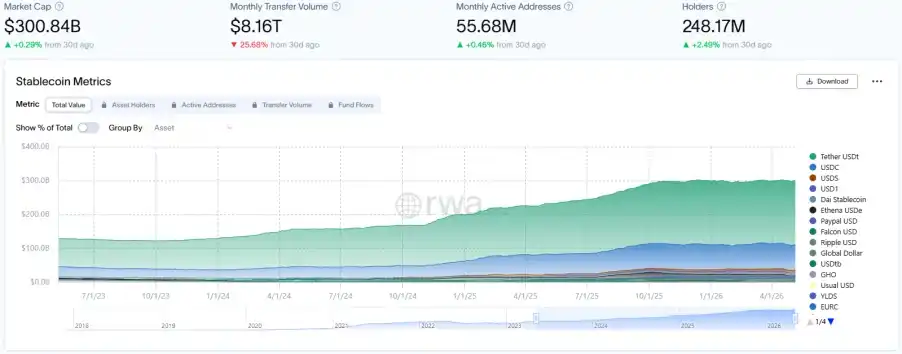
The total market capitalization of stablecoins has rebounded to $300.84 billion, reflecting a modest 0.29% month-over-month increase, while liquidity pools remain largely stable. Monthly transaction volume, however, declined significantly to $8.16 trillion, a sharp 25.68% drop compared to the same period last month—the largest monthly decline in recent times—indicating a marked reduction in large-scale settlement and arbitrage demand.
The total number of monthly active addresses increased to 55.68 million, a marginal rise of 0.46% compared to the previous month; the total number of holders steadily grew to 248 million, an increase of 2.49% compared to the previous month, indicating that retail participation remains stable without significant acceleration.
The leading stablecoins are USDT, USDC, and USDS. Among them, USDT's market capitalization increased by 2.47% month-over-month; USDC's market capitalization rose slightly by 0.35% month-over-month; and USDS's market capitalization increased by 3.1% month-over-month.
Regulatory News
The U.S. Senate Banking Committee may notify as early as May 9 of its consideration of the CLARITY Act, with a vote expected next Thursday.
According to crypto journalist Eleanor Terrett, multiple industry sources revealed that the Senate Banking Committee may notify of its intent to consider the CLARITY Act as early as May 9, and has already distributed draft text to certain industry members, with a vote expected next Thursday. Sources indicated that the draft language is still being finalized and additional revisions are anticipated to reflect the priorities of Democratic offices.
A source, after reviewing the bill and coordinating with industry leaders, said the overall atmosphere is currently positive, but certain bracketed provisions have raised concerns, and some key clauses previously thought to be resolved may still be under change.
The Bank of England is considering putting its digital pound plan on hold to observe private-sector tokenization innovations.
According to Bloomberg, the UK Treasury and the Bank of England are discussing slowing down the progress of the "Britcoin" digital pound project, with the originally planned summer decision to either move forward or halt the initiative now being postponed. Sources indicate that regulators wish to first observe advancements by banks in areas such as tokenized deposits, as these private-sector innovations may, within the existing regulatory framework, achieve fast and low-cost payment functionalities similar to those of a CBDC or stablecoin. The digital pound is currently nearing the end of its design phase, but faces public, parliamentary, and some official scrutiny over issues including privacy, necessity, and its potential impact on the commercial banking system. Internal research at the Bank of England also suggests that as digital payment methods improve, the marginal benefits of launching a retail CBDC are declining.
The Bank of Italy urges the EU to consider developing a tokenized version of the SEPA payment system.
According to Cointelegraph, the Bank of Italy is urging the European Union to consider developing a tokenized version of the SEPA payment system to keep pace with financial innovation.
SEPA, the Single Euro Payments Area, aims to standardize cross-border payments within the eurozone. The Bank of Italy believes that, with the development of tokenization and blockchain-based payments, the EU needs to evaluate pathways for upgrading its existing payment infrastructure.
Argentina plans to improve RWA tokenization regulations and expand the scope of applicable financial instruments.
According to CriptoNoticias, Argentina’s National Securities Commission (CNV) has proposed Draft General Resolution No. 1137, aiming to enhance its regulations on RWA tokenization by expanding their scope to permit a broader range of financial instruments to operate using distributed ledger technology in the country. Prior to this announcement, the existing legal framework only allowed digital representation of specific financial instruments; the proposed resolution removes this restriction, permitting any closed-end mutual fund with authorization for automatic public offering to transition to a digital asset format. Additionally, the resolution extends the duration of the regulatory sandbox until December 31, 2027. This controlled experimental environment is crucial for fintech companies, enabling them to test new business models related to digital currencies and Bitcoin technology without being fully constrained by traditional regulatory frameworks, allowing regulators to observe their behavior before widespread adoption of digital assets.
The Central Bank of Brazil prohibits the use of stablecoins and cryptocurrencies for cross-border payments.
According to Coindesk, the Central Bank of Brazil has prohibited eFX service providers from using stablecoins and other cryptocurrencies, such as Bitcoin, to settle international remittances effective October 1. The ban applies to fintech and payment companies, cutting off backend payment channels for cross-border fund transfers, while individual cryptocurrency investors may still buy and hold assets. eFX payments must now be processed through foreign exchange transactions or non-resident real accounts. Unauthorized companies must apply for approval from the Central Bank of Brazil by May 2027.
Local Insights
Yunfeng Financial's Yunfeng Youyu platform launches the "Physical Gold Token" product.
According to official announcements, on May 7, Yunfeng Financial (stock code: 00376.HK)’s platform “Yunfeng Youyu” officially launched its “Physical Gold Token” product. This product operates under a regulatory framework provided by a licensed financial institution and is supported by core tokenization infrastructure from the financial digital asset infrastructure platform AlphaToken, aiming to offer qualified professional investors (PIs) digital asset allocation services backed by physical gold.
This gold token is backed by physical gold, with each unit representing 1 gram of physical gold certified by LBMA with a purity of 99.99%. The underlying gold assets are held in custody by an internationally qualified, LBMA-certified professional vault and are independently verified and audited. Full allocation and segregated storage mechanisms ensure the transparency and security of the assets.
Project Progress
Japan plans to tokenize government bonds to enable 24/7 trading.
According to the Nikkei Asian Review, several major Japanese banks and securities firms plan to issue and manage Japanese government bonds as digital securities on a blockchain by 2026, enabling 24/7 trading of government bonds. The involved institutions will introduce yen-denominated stablecoins that can circulate on the blockchain for fund settlement, aiming to reduce settlement costs, accelerate delivery, and improve capital efficiency for institutional investors. The digital government bond initiative will allow bonds to trade outside traditional market hours, with financial institutions jointly advancing the necessary infrastructure and regulatory framework.
U.S. securities clearing giant DTCC plans to launch a tokenized RWA pilot trading in July.
According to a May announcement by DTCC, the Depository Trust & Clearing Corporation (DTCC) plans to launch a limited production trading of tokenized real-world assets (RWAs) in July 2026, with full service rollout scheduled for October 2026.
DTCC is a core backend infrastructure institution in the U.S. financial markets, responsible for securities custody, clearing, and settlement. According to DTCC, its subsidiary processed $3 trillion in securities transactions in 2024, covering asset classes such as U.S. equities, corporate bonds, municipal bonds, U.S. Treasuries, mortgage-backed securities, money market instruments, and over-the-counter derivatives.
It is reported that DTCC’s tokenization service will be built on its ComposerX platform suite, with over 50 participating institutions, including BlackRock, Goldman Sachs, JPMorgan Chase, Circle, Ondo Finance, and Ripple Prime. Initial tokenized assets will include Russell 1000 index components, major index ETFs, and U.S. Treasuries.
Ripple, JPMorgan, and others are using the XRP Ledger to enable international settlement of tokenized government bond funds.
According to The Block, JPMorgan, Ripple, Mastercard, and Ondo Finance collaborated on a pilot transaction transferring tokenized U.S. Treasury bonds across borders. The pilot leveraged the XRP Ledger and interbank payment networks to enable institutions to execute cross-border transactions within a single integrated process. Ripple stated that this represents a successful demonstration of integrating the XRP Ledger with global banking infrastructure.
The transaction process is as follows: Ondo first redeems its OUSG on-chain fund on the XRP Ledger; OUSG is a tokenized U.S. Treasury product. Subsequently, Mastercard’s Multi-Token Network transmits instructions via JPMorgan’s blockchain payment platform, Kinexys, ultimately resulting in JPMorgan delivering U.S. dollars to Ripple’s bank account in Singapore.
Bitwise launches its first tokenized crypto arbitrage fund, USCC.
Bitwise Chief Investment Officer Matt Hougan announced the launch of the company’s first tokenized fund, the Bitwise Crypto Carry Fund (USCC), which seeks market-neutral returns through participation in cryptocurrency basis trades, taking over the previously named product managed by Superstate, which will continue to provide underlying technology support. Bitwise noted that the fund is offered only to accredited investors on a private placement basis, with shares not registered under the Securities Act of 1933 or the Investment Company Act of 1940; currently, no redemption mechanism is available, and investors may face high volatility and the risk of total loss.
Securitize has received FINRA approval to offer custody services for tokenized securities within the traditional broker-dealer framework.
Asset tokenization platform Securitize has announced it has received approval from the Financial Industry Regulatory Authority (FINRA) to expand its broker-dealer activities through its subsidiary Securitize Market, enabling it to offer custody services for tokenized securities within the traditional broker-dealer framework, including on-chain atomic swaps and clearing and settlement between tokenized securities and stablecoins, as well as participation in the underwriting and sales of tokenized securities in primary and secondary offerings.
Datavault AI enters into a $150 million gold tokenization plan with Kings Mine Capital
According to BusinessWire, Nasdaq-listed company Datavault AI has announced a strategic partnership with King Mining Capital to jointly launch the GoldVault™ gold tokenization program, with a scale exceeding $150 million, alongside concurrent initiatives in equity investment, physical gold acquisition, and mineral revenue-linked structures.
Under the agreement framework, Datavault AI will receive 5% equity in King Mining Capital and an additional 5% warrant upon completion of the tokenization project. Additionally, the company plans to acquire 20,000 ounces of physical gold through a stock payment at a 30% discount.
Bullish completes the tokenization of 151 million shares on Solana
Solana disclosed on X that cryptocurrency exchange Bullish tokenized all 151 million of its shares on-chain and will migrate its entire cap table to the Solana network following its acquisition of Equiniti. Bullish CEO Thomas Farley announced the news live at Consensus 2026 by completing a real-time wallet-to-wallet share transfer using the Phantom wallet.
Solana and Google Cloud have partnered to launch Pay.sh, a stablecoin payment service for AI agents.
According to Decrypt, the Solana Foundation has partnered with Google Cloud to launch Pay.sh, a service that enables AI agents to pay on-demand for access to Google Cloud and community APIs using stablecoins on Solana, without requiring traditional accounts or subscriptions. The service operates via API proxies running on the Google Cloud platform, connecting agents to backend services using the x402 protocol—an open AI payment standard incubated by Coinbase and now managed by the Linux Foundation—while also supporting machine payment protocols developed by Tempo and Stripe. Each API call by an agent costs only a few cents, supporting services such as Google Cloud, Gemini, Anthropic Claude Code, and OpenAI Codex, as well as blockchain infrastructure and data services like Helius, Alchemy, Dune Analytics, and Nansen. Pay.sh aims to empower enterprise developers with new business models based on programmable money, unattainable through traditional payment channels.
Galaxy and State Street launch the tokenized cash management fund SWEEP on the Solana chain.
According to CoinDesk, Galaxy Digital has partnered with State Street to launch the tokenized fund "State Street Galaxy Onchain Liquidity Sweep Fund (SWEEP)," which migrates cash management and yield products to the blockchain network to enable 24/7 onchain liquidity management.
This product enables institutional investors to allocate stablecoins into a fund, earning returns while maintaining the ability to subscribe and redeem at any time, overcoming the trading hour limitations of traditional money market funds. The fund will initially be built on Solana, with plans to expand to Ethereum and Stellar.
Galaxy provides the tokenization infrastructure, Anchorage Digital offers custody services, and State Street manages the underlying traditional securities assets.
This launch continues the trend of institutional exploration into on-chain cash management, following BlackRock’s BUIDL fund, which validated institutional demand for tokenized U.S. Treasury products and drove continued capital inflows into on-chain fixed-income assets. With State Street managing over $5 trillion in assets, this move is seen as a significant step toward the full tokenization of traditional financial products, marking the expansion of on-chain financial infrastructure into institutional-grade cash management.
Anchorage Digital plans to launch a "Cashless" stablecoin reserve model on Solana.
According to official announcements, Anchorage Digital, a federally chartered U.S. digital asset bank, plans to launch a "Cashless" reserve model on Solana to enhance liquidity, capital efficiency, and security for large-scale institutional stablecoin issuers. This model will hold reserve assets in interest-bearing, low-risk tokenized instruments on Solana, meeting redemption demands through instant liquidity and reducing the need for static cash buffers. Anchorage Digital will issue and manage stablecoins on behalf of institutional partners and is currently exploring potential tokenized instrument solutions with J.P. Morgan Asset Management to support the liquidity framework.
SoFi expands its stablecoin, SoFiUSD, to the Solana network.
According to The Block, SoFi Technologies announced it will launch its stablecoin, SoFiUSD, on Solana. Ben Reynolds, head of SoFi’s enterprise banking business, stated that Solana is well-suited for payment use cases due to its low cost, fast settlement speed, and high throughput. SoFiUSD, initially deployed on Ethereum and set to launch in December 2025, plans to expand to additional networks in the future. Last month, SoFi extended its partnership with Mastercard, positioning SoFiUSD as the settlement currency for its global payment network.
Western Union launches the USD stablecoin USDPT on the Solana blockchain.
According to Businesswire, global money transfer leader Western Union has officially launched the USD-pegged stablecoin USDPT on the Solana blockchain, further expanding its presence in blockchain-based cross-border payments.
USDPT is issued by Anchorage Digital Bank, a U.S. federally chartered crypto bank, and is fully backed by a 1:1 reserve of U.S. dollars to ensure price stability. Leveraging Solana’s high-performance blockchain, it enables efficient and low-cost on-chain transaction settlement. The primary objective of this stablecoin is to provide a professional on-chain settlement layer for cross-border payments, deeply integrating the high-efficiency settlement capabilities of blockchain technology with Western Union’s global compliance framework and extensive distribution network.
Currently, USDPT has been confirmed for direct integration into Western Union’s global payment network, primarily to build a more efficient settlement layer. Initially, it will serve the company’s global agents and partners, with plans to gradually expand to consumer use cases in the future, further enhancing the efficiency and experience of cross-border payments and promoting the convergence of traditional remittances with cryptocurrency infrastructure.
AWS, in collaboration with Coinbase and Stripe, launches an AI agent USDC payment solution.
According to The Block, Amazon Web Services has announced the launch of “Amazon Bedrock AgentCore Payments,” partnering with Coinbase and Stripe to enable AI agents to execute transactions using stablecoins. Developers can leverage Coinbase’s x402 protocol and Stripe-supported infrastructure to allow AI agents to make micropayments in USDC for accessing web content, APIs, MCP services, and other agents. AWS states this is the first managed payment capability designed specifically for autonomous agents, supporting funding of Coinbase or Stripe wallets with stablecoins or fiat currency. The article notes that as the “agentic economy” advances, low-cost, programmable on-chain stablecoins are becoming a critical payment channel.
Polygon Wallet now supports privacy payments for USDC and USDT.
According to The Defiant, Polygon Labs launched a privacy payment feature for its consumer wallet on Monday, in collaboration with the privacy protocol Hinkal, currently supporting USDC and USDT.
It is reported that the Polygon wallet has now added the "Privately Send" option, allowing users to send stablecoins on Polygon through the Hinkal shielded pool, with the sender, recipient, and transfer amount not publicly visible on the blockchain. These transactions will be verified using zero-knowledge proofs, enabling external observers to confirm that a valid transfer has occurred without revealing the participants or the amount.
Polygon Labs states that this feature is designed for institutional payment scenarios, aiming to address the issue of excessive transparency in public chain payments. The design incorporates Know Your Transaction (KYT) screening and operates in a non-custodial mode, meaning no intermediary holds users' assets during the transfer process.
MoonPay launches a stablecoin debit card for AI agents
According to The Block, MoonPay has announced the launch of the MoonAgents Card, a stablecoin debit card designed for AI agents and general users, enabling them to spend stablecoins directly from their on-chain wallets at online merchants worldwide that accept Mastercard. The card instantly converts stablecoins to fiat currency at the point of payment, eliminating the need for users to transfer assets off-chain or pre-load funds. MoonPay stated that, unlike traditional stablecoin debit cards, the MoonAgents Card is specifically engineered for AI agent use cases, giving AI agents the ability to make direct payments to merchants for the first time.
Bakkt completes acquisition of stablecoin payment company DTR
According to Cointelegraph, digital assets company Bakkt has completed its acquisition of stablecoin infrastructure firm Distributed Technologies Research through an equity transaction involving the issuance of over 11.3 million shares (with an additional potential issuance of approximately 726,000 shares). Bakkt’s CEO stated that the transaction aims to combine Bakkt’s institutional infrastructure with DTR’s AI-powered payment engine and stablecoin technology to create a 24/7 digital settlement layer. Bakkt previously announced the transaction in January, alongside its name change to Bakkt Inc.
Kraken plans to acquire Asian stablecoin infrastructure company Reap for $600 million.
According to Bloomberg, cryptocurrency exchange Kraken is acquiring Reap, a Asia-based stablecoin infrastructure company, for approximately $600 million. Reap specializes in stablecoin payments, fiat on- and off-ramps, and enterprise-grade financial infrastructure services. The acquisition is seen as a key move by Kraken to expand its presence in Asia and strengthen its stablecoin payment capabilities; however, neither party has officially confirmed the transaction details.
MSX, the U.S. stock token trading platform, has launched new spot assets across multiple sectors.
The U.S. stock token trading platform Maitong MSX has launched spot trading for $LPTH, a supplier of optical components and infrared imaging; $FORM, a leading provider of semiconductor test equipment; and $APP, a market leader in AI advertising and app monetization.
Funding Updates
Tokenization infrastructure Centrifuge receives a seven-figure dollar strategic investment from Coinbase.
According to The Block, Coinbase announced a "seven-figure dollar" strategic investment in the tokenization infrastructure company Centrifuge and designated it as its primary real-world asset (RWA) tokenization partner within the Base ecosystem.
Under the partnership agreement, Centrifuge will serve as the core infrastructure provider for tokenizing traditional financial assets—such as ETFs, credit funds, and structured products—on the Base chain, handling asset tokenization, structural design, yield APIs, and compliance tools, while integrating with DeFi protocols to expand liquidity. Both parties stated that their long-term goal is to drive the on-chain tokenization of additional financial assets, including equities and potentially Coinbase’s own stock (COIN), and to build a scalable on-chain financial market ecosystem by combining exchange distribution capabilities with RWA infrastructure.
RWA blockchain platform Balcony completes a $12.7 million seed funding round
According to Tamradar, Balcony, an RWA infrastructure built on the Avalanche blockchain, has announced the completion of a $12.7 million seed round led by Blockchange Ventures. To date, its total funding has reached $14 million. The new capital will be used to deploy its on-chain real estate trading and asset settlement platform in the U.S. market, consolidating fragmented property records into an immutable digital registry while leveraging AI detection technologies to combat title fraud.
OpenTrade raises $17 million to expand its stablecoin yield infrastructure
According to The Block, London-based crypto startup OpenTrade has raised $17 million in a strategic funding round led by Mercury Fund and Notion Capital, with participation from a16z crypto, AlbionVC, CMCC Global, and others, bringing its total funding to over $30 million. OpenTrade offers institutional-grade on-chain and real-world asset-backed lending and stablecoin yield products, and plans to use the new capital to expand its infrastructure across both permissioned and permissionless environments. Its offerings include a permissionless protocol layer and a yield vault aggregation framework called Curation+, designed to help fintech companies, digital banks, vaults, and asset issuers build yield strategies across RWA and on-chain assets. OpenTrade reports that its total value locked has surpassed $200 million, with transaction volume exceeding $250 million in 2025, and projects cumulative volume to surpass $1 billion by the end of 2026.
Stablecoin financial services platform UnblockPay has completed a $4.5 million seed round led by Prelude.
According to Financialit, the stablecoin financial services platform UnblockPay has announced the completion of a $4.5 million seed round led by Prelude, with participation from several prominent institutions and angel investors including Plug and Play, Wintermute, and Signature Ventures.
The funds raised in this round will be primarily used to develop compliant financial products, help businesses integrate stablecoin systems into their daily financial operations, establish standardized cross-border settlement solutions, enhance seamless two-way conversion capabilities between fiat currencies and major stablecoins such as USDT and USDC, and continue expanding the ecosystem of compliant stablecoin enterprise services.
Insight Highlights
Report: The global market capitalization of RWA tokenization is approximately $321 billion, with most still remaining in the "wrapped" stage.
According to The Block, Pantera Capital’s latest report states that the global market capitalization of tokenized real-world assets (RWA) currently stands at approximately $321 billion, covering 542 assets. However, the overall on-chain maturity score averages only 2.04 out of 5, with about 77.6% of assets still in the low-maturity phase of merely “wrapping” traditional assets on-chain, while only 2.7% have reached native on-chain forms. The report notes that 168 new tokenized assets were launched in 2025, representing an 115% increase from 2024, and total market capitalization rose by approximately 60% from around $200.6 billion, indicating “rapid expansion in volume outpacing depth of development.” Stablecoins account for roughly 91.6% of the market’s total value (approximately $293 billion) and remain the only category with significant scale and on-chain utility. Pantera believes true maturity in tokenization should enable 24/7 settlement, cross-border transferability, reduced intermediary costs, and deep integration with DeFi.
How is U.S. RWA tackling challenges in real estate, fixed income, and supply chain finance?
PANews overview: The core logic of RWA lies in using an SPV (Special Purpose Vehicle) to establish ownership and tokenize traditional assets, transforming their high entry barriers into divisible on-chain liquidity.
For example, RealT leverages the Reg D/S exemption pathway to enable global micro-investments in real estate fractions; Ondo Finance tokenizes U.S. Treasuries, providing on-chain capital with a high-credit, low-risk yield haven; and Centrifuge connects with MakerDAO to reshape supply chain finance through accounts receivable financing.
Despite challenges such as compliance costs, cross-border custody, and stablecoin risks, RWA is emerging as the most sustainable direction in on-chain finance, supported by technologies like Aave’s institutional module and Chainlink oracles. In summary, RWA is ushering in a new wave of global financial restructuring by combining regulatory compliance with technological abstraction.
Strip releases 288 updates, fully entering the stablecoin and AI agent economy.
PANews overview: Stripe's 288 updates mark its full-scale entry into the AI agent economy and stablecoin space.
In terms of payments and fund management, Stripe has launched the Smart Agent Commerce Suite and Link Agent Wallet, enabling AI agents to autonomously and securely execute transactions, along with new features for stablecoin storage, settlement, and card linking across multiple global markets.
In the risk control domain, Radar has undergone a major upgrade, leveraging AI to enhance defenses against token abuse and account fraud, while introducing an intelligent appeal feature.
In addition, Stripe provides end-to-end foundational support for AI-native business models, from payment flows to revenue management, by introducing programmable Billing, the real-time database Stripe Database, and embedded financial growth tools, aiming to build a global digital financial ecosystem optimized for intelligent agents and seamless interoperability.
Behind the $3.2 billion fundraising, a16z and Haun are betting on who will survive the regulatory cycle.
PANews overview: Haun Ventures and a16z crypto recently completed major funding rounds of $1 billion and $2.2 billion, respectively, signaling that crypto investment logic has shifted from chasing high-growth narratives during bull markets to betting on long-term survivability within a regulatory cycle.
As the industry enters its "adult phase," VCs are increasingly favoring infrastructure with compliance potential, genuine revenue streams, and the ability to integrate into mainstream finance. Stablecoins, due to their practical applications in cross-border payments and asset settlement, are becoming a core investment focus.