



The situation regarding the U.S.-Iran conflict over the past week has been escalating.
The U.S. 82nd Airborne Division has canceled its rotation at the Joint Readiness Training Center, the normally sea-deployed 82nd Combat Aviation Brigade is being transported by air, blood supplies at U.S. military bases in the Middle East have increased by 500%, and Landstuhl Regional Medical Center, the U.S. Department of Defense’s largest overseas hospital, has suspended certain civilian services.
The last time this combination of moves appeared was just before the U.S. invasion of Iraq in 2003.
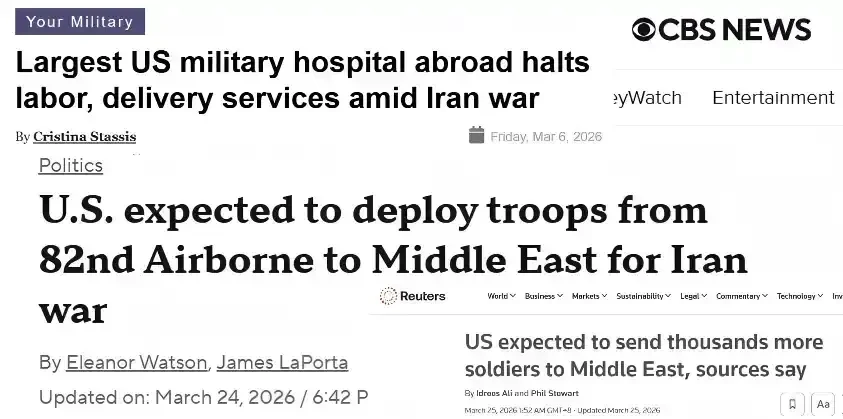
At the height of this tense atmosphere, Trump suddenly posted that the U.S. and Iran had engaged in “very, very good and productive talks,” and announced that the U.S. would suspend military strikes on Iran’s energy infrastructure for five days. At 3:00 AM Beijing Time on March 27, Trump posted again, extending the suspension of strikes until April 6.
This stark contrast between objective facts and Trump’s statements has significantly complicated the analysis of the situation.
Beyond these public statements, another information channel known as "prediction markets" seeks to interpret capital flows as insights into event developments, offering the world a new perspective on information analysis.
In recent days, these funds have begun to concentrate in the same direction.
Multiple insider accounts have taken sides as the ceasefire is about to take effect.
In a prediction market, a trading event created just three weeks ago has seen trading volume exceed $50 million: “Will the United States and Iran cease fire before ___ month ___ day?” If two individuals with differing views on this market can agree on a probability, a trade is matched, along with the corresponding probability of the event occurring.
The market has a clear definition of "ceasefire": both sides publicly announce the cessation of direct military combat. Given the escalating conflict described above, most people would view a ceasefire as a low-probability event, especially as all signs point to further escalation.
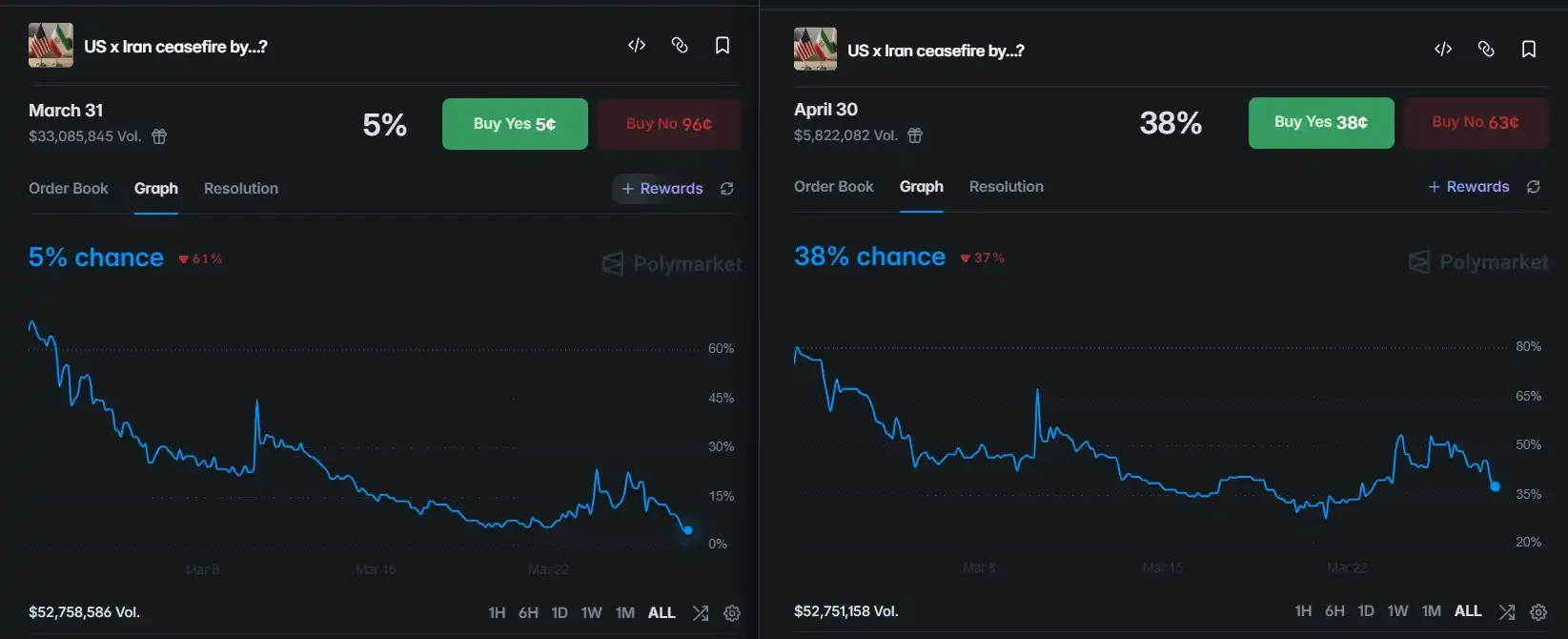
As the public expects, the probability of a ceasefire before April 30 is around 38%, while the chance of a ceasefire before March 31 is only 5%. Many even believe this probability should be lower—those who overestimate the likelihood of a ceasefire are likely gamblers who haven’t even read recent headlines and are just taking a shot in the dark.
Yet among these "gamblers," six highly suspicious accounts emerged, collectively profiting $1.8 million by precisely predicting the timing of the "U.S.-Israel strike on Iran," the "Israel-Hamas ceasefire," the outbreak of this Iran conflict, and the assassination of Iran's former Supreme Leader Khamenei.
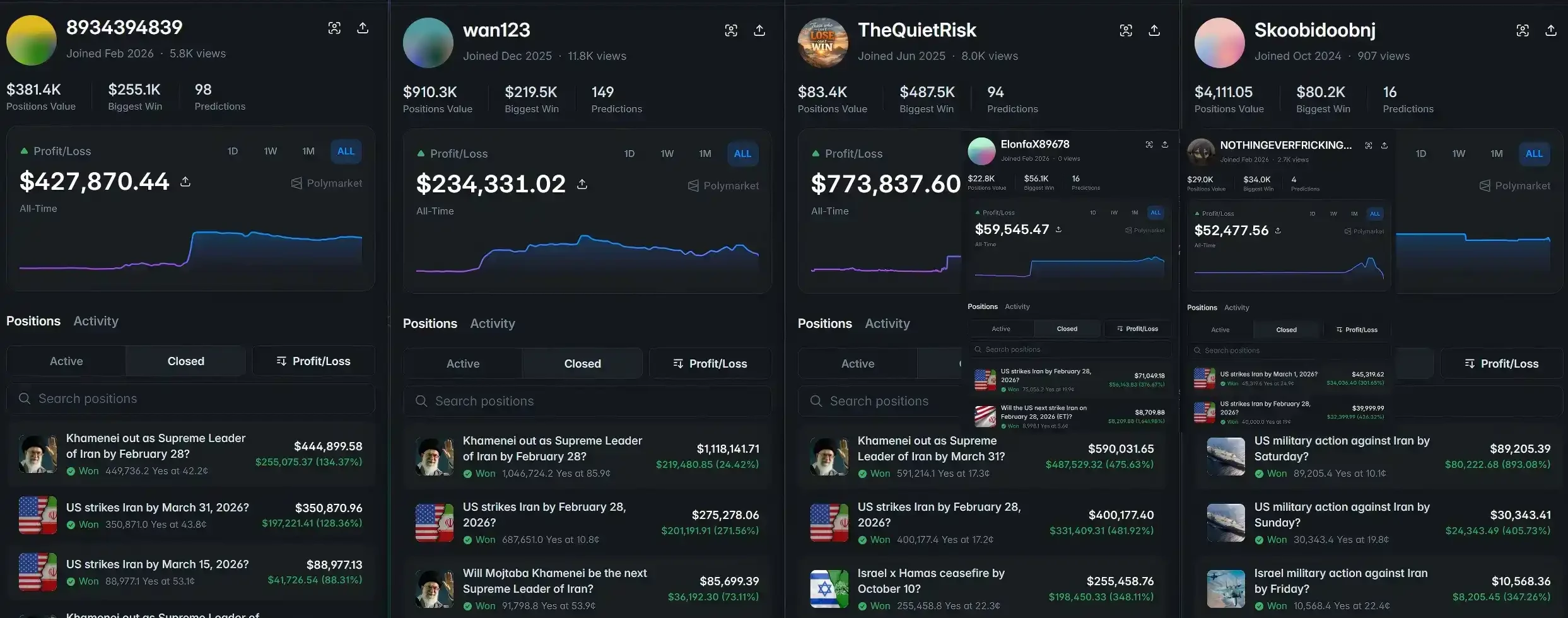
This series of remarkably accurate predictions is not their only commonality. As of March 27, they had collectively invested $285,000 betting that the U.S. and Iran would reach a ceasefire before April 30, with $185,000 placed on the market that the U.S. and Iran would cease fire before March 31.
If these six accounts truly could "foresee the future," we could reverse-engineer both parties' positions by using the knowledge of an impending ceasefire.
Why does Iran want to cease fire?
Now may be Iran’s strongest moment in terms of negotiating power and leverage in this war: the blockade of the Strait of Hormuz has pushed global oil prices higher, no other countries besides the U.S. and Israel are currently directly involved in strike operations, and the new leader’s narrative of resistance has galvanized public sentiment and patriotic unity.
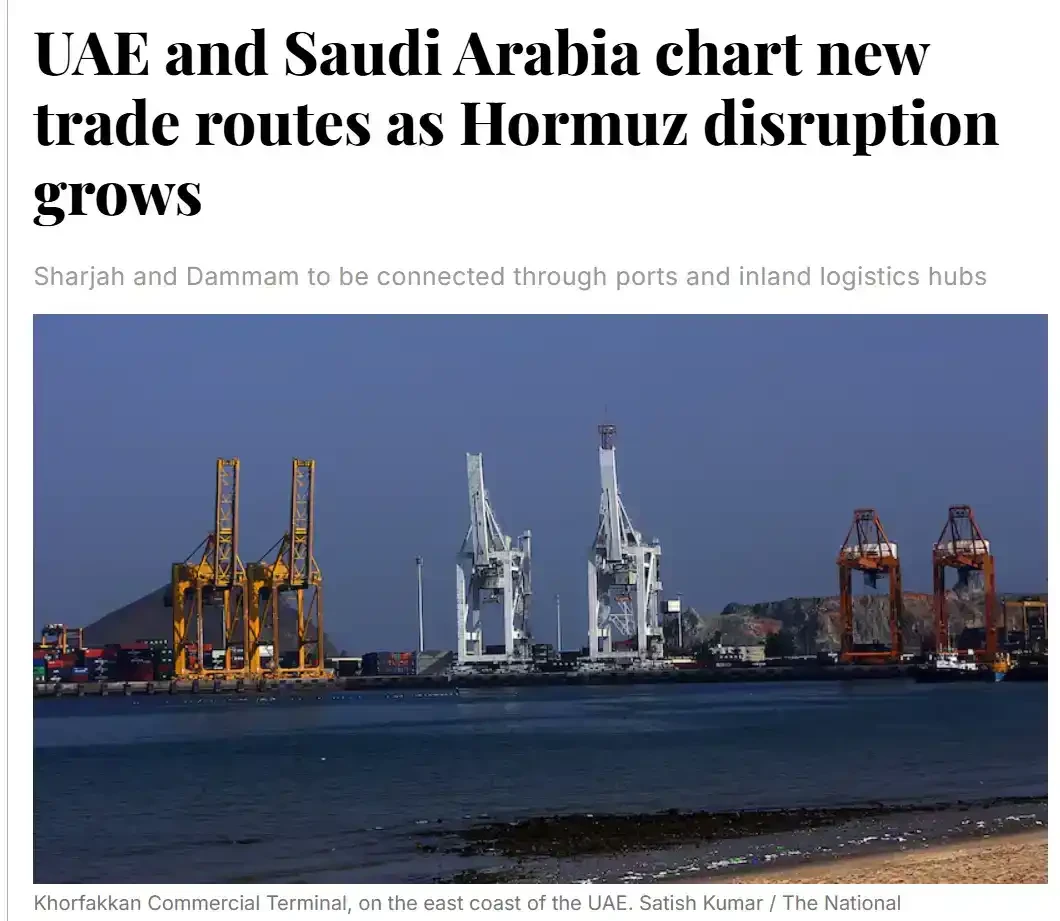
Conversely, if the conflict continues, a series of countermeasures—including the gradual shift of U.S.-aligned Gulf states such as Saudi Arabia and the UAE, the ongoing erosion of Iran’s military capabilities, and the development of alternative routes to the Strait of Hormuz—will cause Iran to lose its dominant position at the negotiating table.
At this point, it is impossible not to mention a highly contentious issue: just before the outbreak of this war, the United States and Iran were engaged in negotiations in Geneva, with progress described by all parties as "productive" and even as "within reach of a historic agreement."
However, the United States and Israel launched a surprise attack on Iran while negotiations were still ongoing. Given this precedent, how can Iran trust the United States to honor its ceasefire commitments?
This touches on the nature of the ceasefire itself: for Iran, the ceasefire is not a matter of trust, but of interest calculation. If the U.S. reneges on the agreement after it is reached, Iran will further solidify its narrative on the international stage that “the U.S. is unreliable.” If the agreement is upheld, Iran secures its most favorable negotiation outcome to date.
This also explains why Iran, despite publicly stating “no negotiations,” maintained communication through multiple backchannels and specifically proposed counteroffers. The public statements were performative, aimed at domestic audiences, while actual contacts sought to secure the best possible exit terms.
In addition, Iran’s proxy network has suffered from organizational fragmentation and ammunition shortages during this round of conflict. Coupled with its domestic economy, which was already on the brink of collapse prior to the war (the Iranian rial has depreciated nearly 90% since 2018), withdrawing while ahead may be their optimal course of action at this time.
The United States, farthest from the battlefield, most wants a ceasefire.
Nearly one month into the conflict, the S&P 500 has declined steadily from pre-war levels, while the Dow Jones has posted four consecutive weekly losses—the longest such streak in three years; gasoline prices have surged from $2.98 before the conflict to $3.98, rising over 30% in three weeks; the 30-year fixed mortgage rate has increased by a full half percentage point; and Goldman Sachs has raised its probability of recession to 30%.
These key data points have limited short-term impact on the average American, but they are fatal for Trump—stock markets and WTI oil prices are his core performance indicators.
At this time, the U.S. government’s most ideal response tool—the Strategic Petroleum Reserve—is losing effectiveness due to aging infrastructure. Since the system, established after the 1975 oil crisis, was originally designed with a 25-year lifespan, its actual sustainable release capacity may now be only half—or even less—of what is officially claimed.
More critically, extracting oil further dissolves the internal structure of salt caverns, meaning that large-scale release and storage itself accelerates system degradation. While releasing oil may help Trump stabilize market sentiment in the short term, if the conflict drags on, the drawbacks of this countermeasure could manifest on the candlestick chart as a sharp surge in oil prices.
In addition to financial data, domestic political considerations in the United States are also a factor Trump must weigh in this round of conflict. When the Iraq War began, Bush’s approval rating was as high as 72%; when the Afghanistan War began, it exceeded 90%.
On the first day of this conflict, Trump’s approval rating was below 40%. Even the classic political science phenomenon known as the “rally ’round the flag” effect—where presidential approval ratings rise following the outbreak of war—failed to materialize during this round of strikes. As of March 25, Trump’s overall approval rating had dropped to 36%, hitting a new low for his second term.
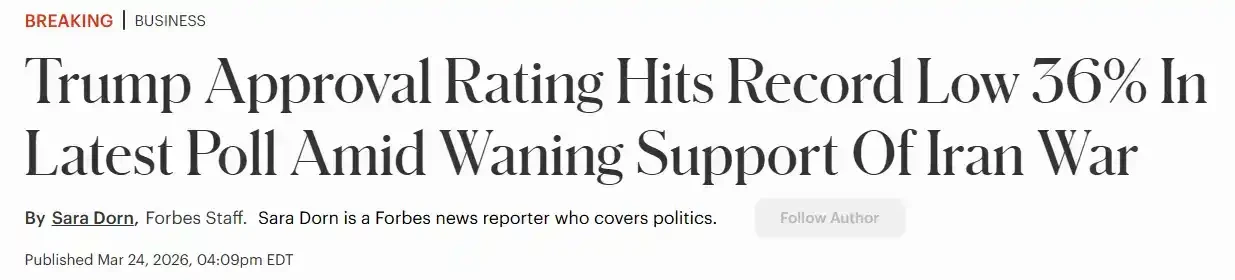
Coupled with his campaign promise of “No New Wars,” Trump’s current performance on the U.S. political stage not only threatens the prospects of his inner circle in the upcoming midterm elections this fall but is also eroding the Republican Party’s influence in the 2028 presidential election.
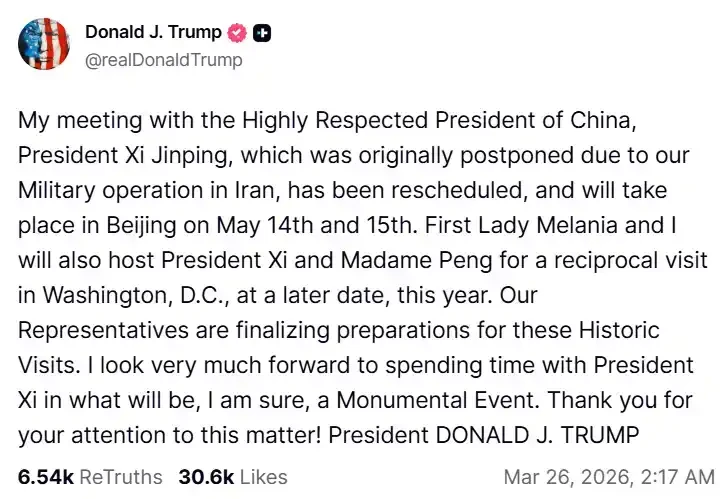
On the other hand, Trump has set a firm deadline of May 14 for himself. Due to the need to "remain in Washington to handle current operations," he postponed his planned visit to China next week and publicly announced yesterday that the trip has been rescheduled to May 14.
It is foreseeable that Trump needs to go to Beijing as a "winner," not as a president trapped in the Middle East quagmire.
Everything is changing, but TACO won't.
There is currently a term used to describe Trump’s extreme pressure followed by a sudden announcement of positive progress: TACO. Its full form is “Trump Always Chickens Out.”
However, given the current tense geopolitical situation in the Middle East, many believe he will not TACO, let alone successfully persuade Iran to agree to a ceasefire.
Three months ago, if someone had told you that Trump would drag Venezuela’s president Maduro to a U.S. courtroom like catching a chick, use Greenland as a tariff bargaining chip to threaten European allies at the World Economic Forum in Davos, and kill Iran’s supreme leader while negotiating with Iran—
All of these events, previously considered to have less than a 1% probability, have occurred. Now, the future we’re watching is whether the extremely low-probability Iran-U.S. ceasefire TACO will unfold as expected over the coming month.