




Author: Gu Yu, ChainCatcher
Today, Kyle Samani, co-founder and managing partner of Multicoin Capital, announced on his social media account that he will step back from the daily management and investment decisions of Multicoin Capital, and in the future will explore opportunities in other technology fields beyond the crypto industry. Multicoin officially stated afterward that the fund will continue to operate normally, and existing investments and team structure will remain unaffected.
"The Best Cryptocurrency Investor" Chooses to Fade Away
This is undoubtedly a major news in the crypto VC circle. For a long time, Kyle Samani has frequently written long articles, participated in industry debates, and maintained clear stances on investment strategies. He has not only become the key figure of Multicoin Capital, but also one of the most influential and authoritative investors in the crypto industry, thanks to his early investment in Solana and the hundreds of times return it has brought.
Previously, Dragonfly managing partner Haseeb Qureshi had onceWrite an articleMentioning the three crypto investors he admires most, Dan Robinson, Chris Dixon, and Kyle Samani are ranked third, second, and first, respectively.
"Kyle is one of the few true contrarian investors in the cryptocurrency space. I almost disagree with all of his views. But his original investment, and his steadfast belief in holding Solana through the trough after the FTX crash, make him undeniably one of the greatest venture capitalists in cryptocurrency history," wrote Haseeb Qureshi.
And it is precisely such a "GOAT" (Greatest Of All Time) who chose to announce his resignation at one of the most bleak moments in the crypto industry, the implications behind this decision can't help but provoke deep thought: Have even the top-tier VC investors been unable to continue holding on? After all, a few years ago, even when the price of SOL dropped below $10 due to the FTX incident, he still insisted on his investment views, and eventually proved himself right with a gain of over 25 times.
And shortly after the announcement, Kyle Samani's tweet, which was quickly deleted from his X account earlier today, was also dug up.
According to the information, Kyle Samani responded to a rant posted by X user Taran (@Taran_ss) by saying: "Cryptocurrencies are just not as interesting as many people (including myself) once imagined. I used to believe in the vision of Web3, in dApps. Now I don't. Blockchains are fundamentally asset ledgers. They will reshape finance, but that's about it, no more than that. DePIN is another area worth noting. Cryptocurrencies will continue to improve, but all the really interesting questions have already been answered, except for the issue of on-chain privacy/confidentiality. (I still firmly believe that Zama will win this race.)"
In this response, Kyle Samani clearly believes that crypto is no longer interesting and no longer believes in the vision of Web3. Besides reshaping finance, it is difficult for blockchain to play a bigger role in other areas. Privacy and DePIN are the only areas he still acknowledges.
Multicoin Capital also further confirmed the matter that "Kyle is no longer interested in crypto" in a letter to LPs, which stated that "Kyle's interests have expanded from cryptocurrency to other tech fields such as artificial intelligence, life sciences, and robotics, and he has decided to invest time in exploring these emerging technologies."
The data also reflects that Multicoin Capital's attitude and strategies are undergoing significant changes. According to RootData, since the second half of 2025, the number of investment rounds in which Multicoin Capital has participated is only 4, and since October 2024, it has only 10 times. Not only has the frequency of investment significantly slowed down compared to previous periods, but it is also clearly behind the investment frequency of other well-known VCs during the same period, ranking below 50th.
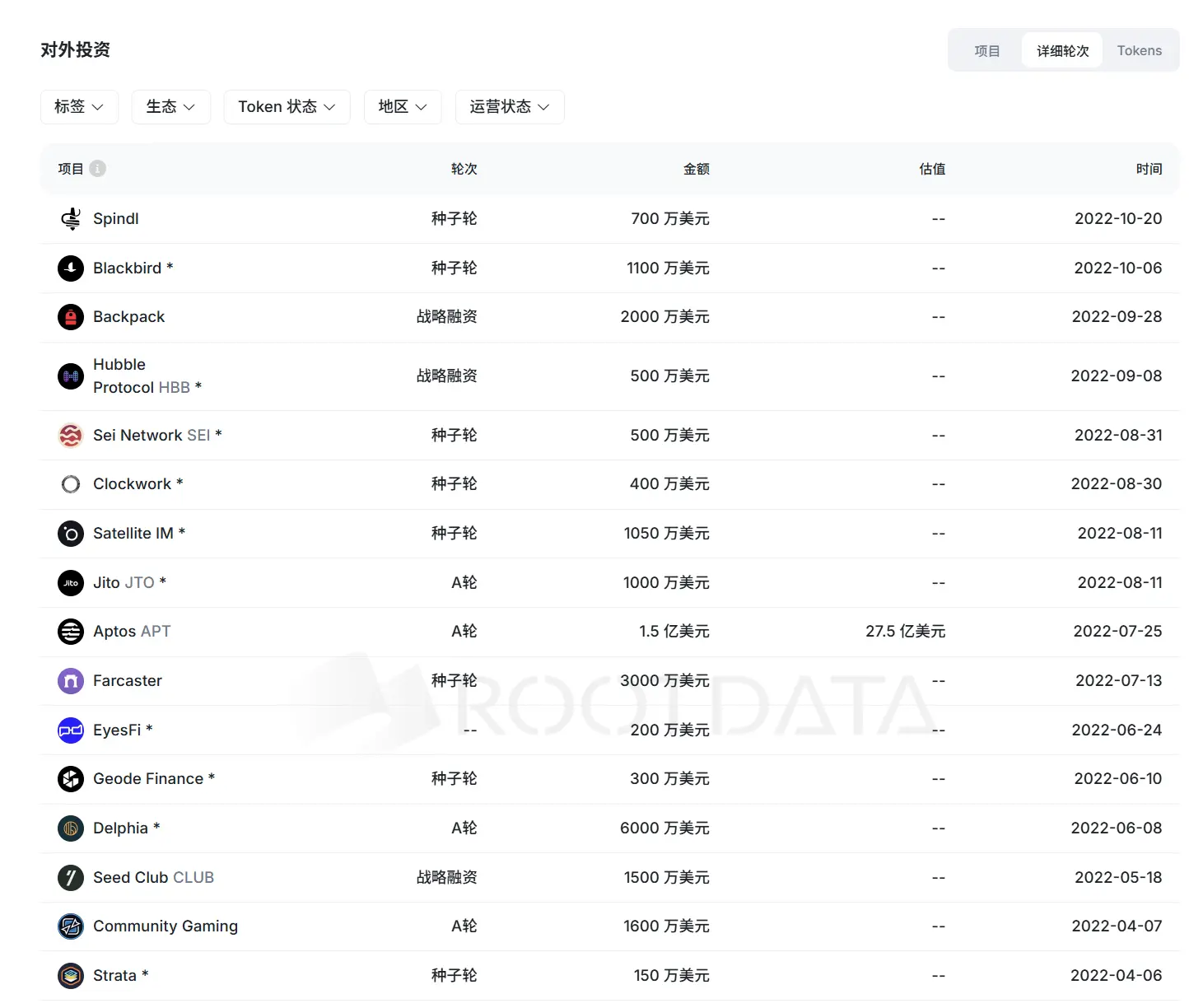
Multicoin Capital investment round history Source:RootData
These transitions are partly due to bleak market conditions and performance. Among the projects that Multicoin Capital has heavily invested in over the past few years, the Wormhole token, which was invested in with a $2.5 billion valuation (the total funding round was $225 million, second only to investment rounds of Forward Industries, FTX, and Solana), now has an FDV of only $220 million. The Pyth Network token has an FDV of merely $480 million, and Solana's market cap has once again dropped below $100.
Up to this point, the reason for Kyle Samani's departure has become very clear: he believes the direction of development in cryptocurrency has deviated from his expectations, and even from his values. The disillusionment has made him decide to leave this place of heartbreak and try to regain his passion in fields such as AI and life sciences.
Next, Multicoin Capital will also have to face the aftermath of "losing its soul." Kyle Samani's departure will inevitably raise questions from the outside about its future direction and leadership: With investment activities slowing down sharply and organizational restructuring, will Multicoin Capital still remain one of the top VCs in the industry with the most research-oriented and resolute convictions?
The Low Point of Idealism
In fact, before Kyle Samani, many crypto investors and entrepreneurs have already expressed similar views, resigning and choosing to take a break from the crypto industry. Just in January, a16z Crypto general partner Arianna Simpson announced her departure and plans to launch a new fund that will invest in various industry areas beyond crypto.
A more well-known case is Ken Chan, the former co-founder and chief technology officer of Aevo. In an article published on November 25, he bluntly stated that he had wasted 8 years of his life on cryptocurrency and described the crypto industry as "the world's largest and most engaged super casino."
"Eight years of toil in the cryptocurrency space have completely destroyed my ability to discern sustainable business models. In the cryptocurrency space, you don't need a successful company or product to make money. The cryptocurrency industry is full of tokens with high market capitalizations that are virtually ignored," Ken Chan believes. "This industry mindset is extremely harmful, and I believe it will lead to a long-term collapse in social mobility for the younger generation."
A series of consecutive cases is gradually outlining a clearer trend: against the backdrop of a persistently tight macroeconomic environment, as the wealth effect in the crypto market becomes significantly weaker, the large-scale implementation of typical products has been long hindered, and the core narratives that once supported industry expansion are being disproven one by one, the crypto industry is now, in a phased manner, losing a portion of its earliest and most idealistic builders and investors.
This exodus does not signify a fundamental rejection of cryptography, but rather reflects the idealism-driven patience being tested by the continuously extended cycle of realization. Before the return structure, industry order, and long-term expectations are reestablished, some core participants have chosen to exit for a period of time.
In the past few cycles, many VC investors have emphasized that high-return investments often occur when the market is "neglected," and that bear markets are the best moments to capture investment alpha. However, now even the "historical best investors" are choosing to turn away at this moment, which itself sends a signal that the industry should take seriously: the problem may no longer be just cyclical market corrections, but rather the crypto industry is facing a phase bottleneck in terms of innovation capability, value orientation, and narrative vision, and is perhaps undergoing an unprecedented scrutiny and reevaluation.
However, fortunately, more first-tier VCs such as Coinbase Ventures, a16z, YZi Labs, and Pantera Capital remain active, each making over 30 investments in the past year. For the crypto industry currently in an adjustment phase, the support from these VCs may not immediately bring about a new boom, but at least it means that this round of revaluation has not yet turned into a complete exit.