






Author: Curry, Shenchao TechFlow
Shenchao Overview: The SEC has approved the registration statement for the Morgan Stanley Bitcoin Trust (ticker: MSBT), which will begin trading on NYSE Arca on April 8 with an annual management fee of 0.14%, the lowest in the market.
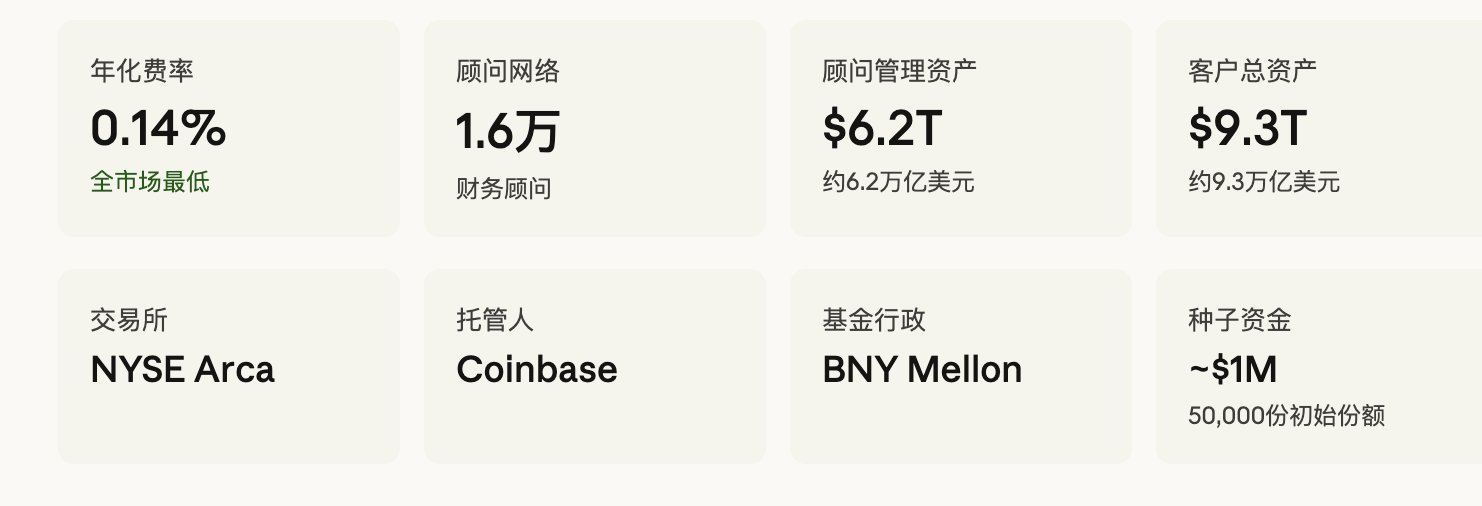
Morgan Stanley thus becomes the first major U.S. bank to directly issue a spot Bitcoin ETF, and its approximately 16,000 financial advisors, who manage $6.2 trillion in client assets, will be able to recommend the product to clients on its launch day.
Morgan Stanley's spot Bitcoin ETF has officially entered the countdown.
According to CoinDesk on April 8, the U.S. Securities and Exchange Commission (SEC) announced that the registration statement for the Morgan Stanley Bitcoin Trust (ticker: MSBT) has become effective, with the bank filing its final prospectus on the same day. Bloomberg ETF analyst Eric Balchunas confirmed on X that MSBT will begin trading on NYSE Arca on Wednesday, April 8.
This is only three months since Morgan Stanley first filed its S-1 registration statement in January this year—far faster than the market expected from application to listing.
Lowest fees in the market, first large bank to issue independently
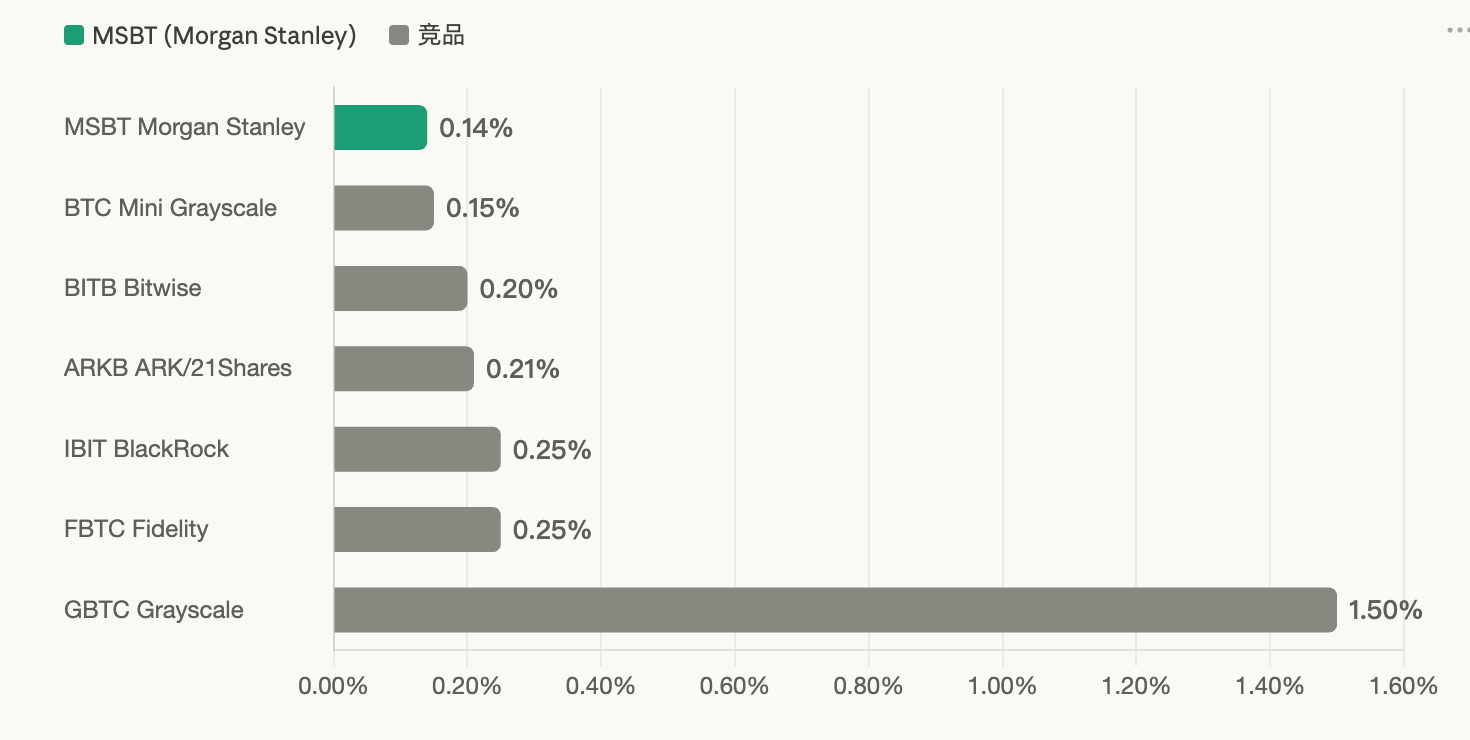
The annual management fee for MSBT is set at 0.14%, 1 basis point lower than Grayscale’s Bitcoin Mini Trust at 0.15% and 11 basis points lower than BlackRock’s IBIT at 0.25%, making it the lowest-fee Bitcoin spot ETF currently available in the United States.
Key competitor fee comparison: Grayscale Bitcoin Mini Trust at 0.15%, Bitwise BITB at 0.20%, ARK/21Shares ARKB at 0.21%, BlackRock IBIT and Fidelity FBTC both at 0.25%, and Grayscale’s flagship product GBTC at 1.5%.
Fees are one of the few key differentiators in the spot Bitcoin ETF market. All products directly hold Bitcoin and track the spot price, resulting in highly homogenized investment strategies—where cost differences have a significant impact on large allocations and long-term holdings. With a $100,000 investment, MSBT saves approximately $110 annually in management fees compared to IBIT.
Historical data has shown that fees drive capital flows: Grayscale’s flagship product, GBTC, charged a 1.5% fee, and since its conversion to an ETF in January 2024, its assets under management have more than halved from approximately $29 billion.
Regarding the MSBT product structure, the fund directly holds bitcoin and tracks the CoinDesk Bitcoin Benchmark's 4:00 PM New York settlement price, without using leverage, derivatives, or active trading strategies. Coinbase serves as the custodian and prime broker, while BNY Mellon handles cash custody and fund administration. The initial seed capital is approximately $1 million, equivalent to 50,000 creation baskets.
More importantly, MSBT is the 12th spot Bitcoin ETF to launch since the first batch debuted in January 2024, and the first such ETF directly issued and listed by a major U.S. bank. Previous listings were all issued by asset managers or crypto-native firms; Morgan Stanley’s entry signals that Wall Street giants are shifting from “distributing others’ products” to “creating their own.”
The distribution network is the real weapon.
Fees are just one card on Morgan Stanley’s table; the real differentiation lies in the distribution network.
Morgan Stanley’s approximately 16,000 financial advisors manage about $6.2 trillion in client assets (with total client assets across the firm reaching approximately $9.3 trillion). MSBT will have access to this distribution network on its first day of launch. Bloomberg ETF analyst Balchunas referred to Morgan Stanley as a “captive audience” in the Bitcoin ETF market, noting that while Fidelity also has a portion of an advisor network, “Morgan Stanley is an entirely different scale.”
Amy Oldenburg, head of digital assets strategy at the firm, previously revealed that approximately 80% of crypto ETF trading activity comes from retail investors, rather than advisor-managed accounts.
A proprietary product with the lowest fees in the market has the potential to eliminate cost concerns for advisors recommending Bitcoin allocations, unlocking this underutilized channel for incremental growth.
Morgan Stanley’s Global Investment Committee previously advised clients to allocate 0–4% of their portfolios to crypto assets. Phong Le, CEO of Strategy (formerly MicroStrategy), made a more aggressive estimate on X: based on $6.2 trillion in client assets and a 2% allocation, the potential capital inflow could reach approximately $160 billion—nearly three times the current assets under management of BlackRock’s IBIT. He referred to MSBT as “Monster Bitcoin.”
However, the actual rollout timeline remains uncertain. Between product availability and large-scale recommendations through advisory channels, multiple steps are typically required, including compliance approval, investment policy adjustments, and client education.
More Than Just One ETF: Morgan Stanley’s Comprehensive Crypto Strategy
MSBT is not an isolated product. Morgan Stanley is systematically building infrastructure for crypto assets.
In January, the bank filed applications for both Bitcoin and Solana spot ETFs, followed by an application for a staked Ethereum ETF. In February, Morgan Stanley applied for a National Trust Bank charter (Morgan Stanley Digital Trust) to directly provide customers with digital asset custody, trading, and staking services.
On the retail side, the bank plans to offer spot trading of Bitcoin, Ethereum, and Solana through the E*Trade platform in the first half of 2026, in partnership with Zero Hash. Jed Finn, head of the wealth management division, described direct crypto trading as “the tip of the iceberg,” hinting at future services such as custody, wallets, and tokenized assets.
The logic behind this multi-channel strategy is clear: institutional clients receive MSBT allocations through advisors, while retail investors trade cryptocurrencies directly through E*Trade—all within Morgan Stanley’s ecosystem. CEO Ted Pick has already engaged with the U.S. Treasury regarding product development.
Reddit community: "Traditional finance has surrendered."
The message sparked lively discussion in the Reddit crypto community. Several users interpreted Morgan Stanley’s self-issued Bitcoin ETF as a "signal of surrender" from traditional finance, viewing the shift by major Wall Street institutions from resistance and观望 to active adoption as evidence that the institutionalization of Bitcoin as an asset class is now irreversible.
Some users have also offered a pragmatic perspective: trading volume on the first day of listing and net capital inflow in the first month will be key indicators of whether the distribution network can truly be converted into actual allocations.