





Consensus Miami 2026 will be held in Miami from May 5–7, 2026. This year’s Consensus event will bring together over 20,000 attendees, including leading institutional figures, federal policymakers, and crypto pioneers, to chart the convergence of traditional finance and digital assets. The conference will focus on the deep integration of global institutional finance, autonomous AI agents, and cryptocurrency, while highlighting Miami’s role as a global hub for tech and finance.
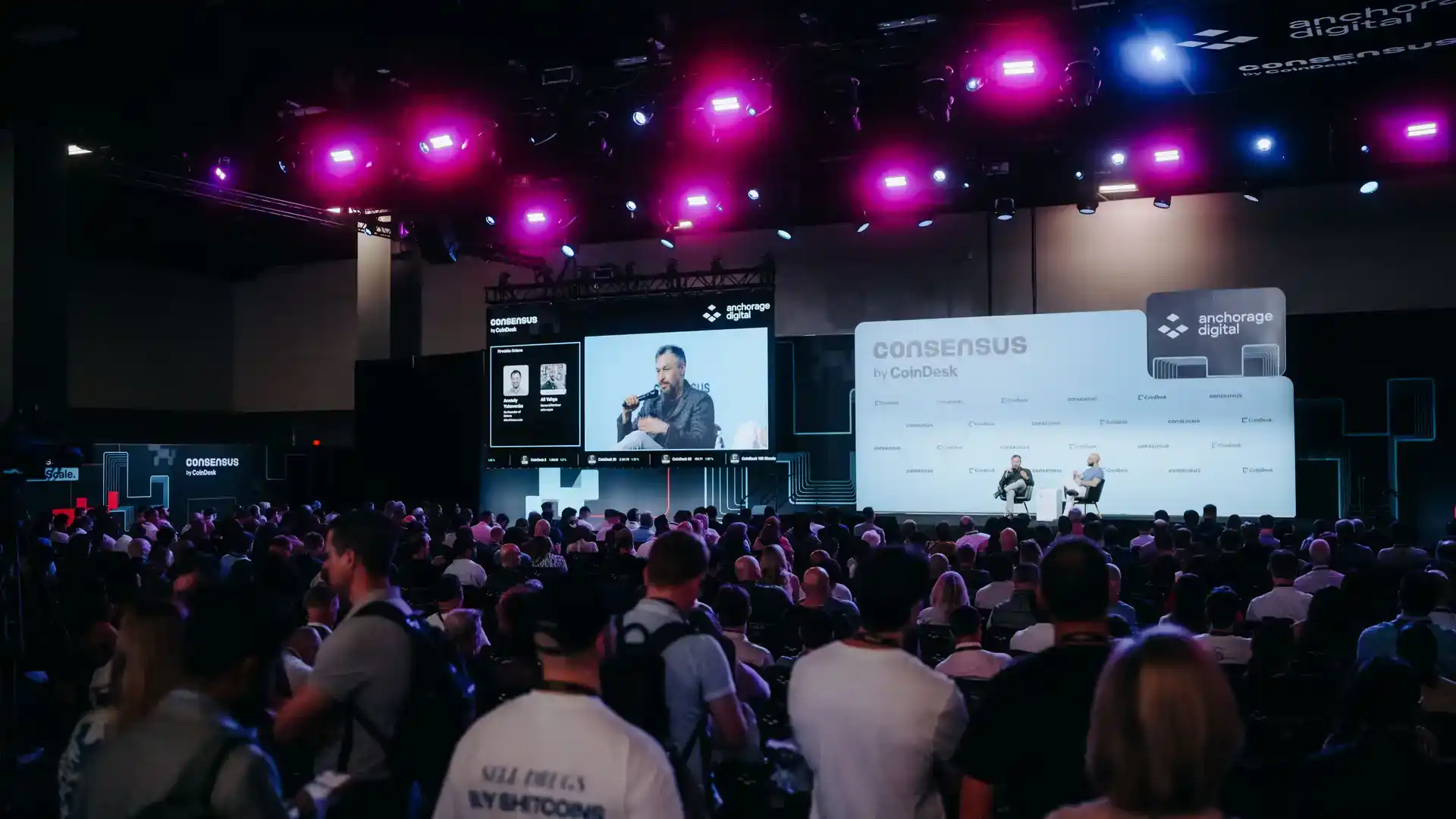
The agenda for Consensus Miami 2026 is tightly centered around the three core forces reshaping global finance: scaling cryptocurrency adoption, institutional-grade integration, and agent-based commerce. Speakers including Arthur Hayes (Co-founder of BitMEX), Lily Liu (Chair of the Solana Foundation), and Jesse Pollak (Vice President of Engineering at Coinbase) will deliver keynote speeches or participate in fireside chats. Below are the key insights compiled by BlockBetas for the conference:
May 7
Raoul Pal: Cryptocurrencies are the "universal equity" of the AI era; agents will account for three-fifths of DeFi users within five years.
Raoul Pal, co-founder and CEO of Real Vision, said at the Consensus 2026 conference in Miami:
Humanity is at an unprecedented turning point in history: we are on the verge of encountering AGI entities that are smarter, more adaptable, and more powerful than humans, with AI capabilities currently doubling in strength every year. By 2028, the annual volume of text produced by AI will surpass the total amount of text ever created by humans—and all of this will happen within five years.
After AI replaces labor at scale, the solution is not traditional universal basic income (UBI), but rather “Universal Basic Equity.” For the first time in human history, ordinary people can directly own the underlying networks by holding crypto infrastructure tokens and benefit in tandem with the expansion of the agent economy. Institutional entry does not deviate from crypto’s spirit—it is the first time anyone, anywhere in the world, can buy BTC, ETH, and SOL on equal footing with firms like BlackRock.
During the rapid-fire Q&A, Pal said that if forced to choose one, he would pick Solana over Bitcoin, and predicted that within five years, agents and humans will make up the primary user base of DeFi in a 3:2 ratio.
Arthur Hayes: Liquidity, not regulatory利好, influences Bitcoin's price.
BitMEX co-founder Arthur Hayes said at Consensus 2026:
The cryptocurrency industry does not require regulation; regulation is largely irrelevant to Bitcoin's value proposition. The two core factors determining Bitcoin's price are technological reliability and fiat liquidity, with the latter being the true driver.
Whether it was quantitative easing during Obama’s tenure, Trump’s first term “helicopter money,” or the approximately $2.5 trillion in reverse repurchase operations released by Treasury Secretary Yellen during Biden’s administration through the substitution of short-term bonds for long-term debt, each round of monetary expansion has closely coincided with significant rallies in Bitcoin. Although the Trump administration has signed cryptocurrency-related legislation and signaled regulatory clarity, Bitcoin’s price has still declined by about 25% over the past 18 months, demonstrating that regulatory tailwinds do not directly drive price increases—liquidity is the fundamental factor.
The Trump family previously faced de-banking, asset freezes, and numerous lawsuits—experiences that led them to recognize Bitcoin’s value as an asset outside state control. If Bitcoin ultimately becomes just another derivative on bank balance sheets, it will lose its true meaning.
Cardano's founder: By 2035, AI agents will be more important to the internet than humans, and giants like Google are "very frightened."
Cardano founder Charles Hoskinson stated at Consensus 2026 that by 2035, most search, transaction, and activity on the internet will be performed by AI agents rather than human users, fundamentally disrupting the business models of tech giants like Google, Amazon, and Facebook.
Hoskinson said that AI agents do not click on ads and have no brand loyalty, thus directly undermining platform models that rely on advertising revenue. “Amazon, Google, and Facebook are panicked by the AI agent revolution because all of their business models will be disrupted.”
He believes that AI agents will increasingly take on tasks such as due diligence, trade execution, and DeFi interactions within the crypto industry, and calls AI "one of the best things ever to happen to cryptocurrency," as it has the potential to significantly improve the currently complex user experience.
Hoskinson also emphasized that users should retain control over their own data, identity, and assets, rather than relying on custodial wallets or third-party platforms. He criticized the current cryptocurrency ecosystem for being overly fragmented, stating, “Over the past few years, 11 million tokens have been issued—we no longer need more tokens; what we need now is collaboration.”
He also noted that traditional financial institutions are shifting their attitudes; for example, JPMorgan, which previously closed users' bank accounts related to cryptocurrency, is now launching blockchain-based products.
Wall Street clearing giant DTCC is collaborating with multiple Layer 1 blockchains to bring corporate actions such as dividends on-chain.
Frank La Salla, CEO of DTCC (Depository Trust & Clearing Corporation), the U.S. securities clearing giant, said the company is collaborating with multiple high-performance Layer 1 blockchains to explore migrating complex corporate actions such as dividend distributions and tender offers to on-chain processing.
At Consensus 2026, Salla stated that most blockchains currently lack sufficient efficiency in handling corporate actions, while DTCC processes millions of dividend payments daily, requiring a Layer 1 network with high throughput and high stability. DTCC is one of the core infrastructure components of the U.S. capital markets, handling approximately $20 trillion in U.S. Treasuries and securities transactions daily.
The institution plans to launch a pilot for its tokenized securities platform in July this year, with the goal of broader rollout by October. La Salla believes that "tokenized collateral" could become the first large-scale institutional application of blockchain. In the future, Asian institutions could even access dollar liquidity in real time via on-chain collateral on Sunday in New York.
However, he warned that blockchain still faces challenges such as scalability, liquidity fragmentation, and risk management, particularly in replicating the efficiency of "netting" in traditional financial systems within a decentralized environment.
U.S. Senator: Cryptocurrency market structure legislation will not pass without ethical provisions.
U.S. Senator Kirsten Gillibrand stated at the Consensus conference that the cryptocurrency market structure bill will not pass without the inclusion of ethical provisions. She emphasized that it must be prohibited for members of Congress, senior government officials, and the president and vice president to profit from their insider status within the cryptocurrency industry. Currently, several Democratic senators have expressed concerns about President Trump and his family’s connections to cryptocurrency; Bloomberg estimates that Trump has earned at least $1.4 billion through cryptocurrency venture investments.
The bill previously stalled in the Senate over issues related to stablecoin incentives, but a compromise has now been reached; however, ethics provisions have become a new obstacle. Gillibrand stated she is working with the White House and both parties to ensure these elements are included and to push for the addition of consumer protection and anti-terrorism financing provisions, with the bill有望 passing before the August recess.
May 6
The CFTC proposes to confirm protections for non-custodial software developers through formal rulemaking.
CFTC Chair Michael Selig stated at the Consensus Miami conference that the agency plans to convert its favorable stance toward non-custodial software developers into formal rules. Previously, in March, the CFTC issued a no-action letter to the crypto wallet provider Phantom, clearly indicating that self-custodial wallet software developers meeting specific conditions do not need to register as brokers. Compared to temporary guidance, the CFTC prefers establishing formal rules to quickly solidify its regulatory position, providing clear guidance to U.S. developers and promoting the development and deployment of related software.
This aligns with similar guidance issued by the SEC last month, which stated that interfaces such as DeFi wallets are generally not considered brokers. Both regulatory agencies are currently working to clarify their regulatory stance on software developers, which supports the growth of non-custodial wallets and DeFi tools in the United States.
Kraken: IPO preparations are approximately 80% complete
Kraken co-CEO Arjun Sethi said at the Consensus Miami event that IPO preparations are “about 80% complete,” with the company having submitted its application to the SEC and currently awaiting the right market conditions.
Kraken previously paused its IPO plans in March.
Toly: The Solana network's major upgrade, 'Alpenglow,' is set to launch as early as next quarter.
Solana co-founder Toly stated at Consensus Miami 2026 that Solana’s major upgrade, "Alpenglow," is expected to launch this year, potentially as early as next quarter. Toly said the Alpenglow upgrade will bring transaction confirmation speeds close to the physical limit of "light speed," enhancing the network’s speed, reliability, and transaction finality—marking a shift from Solana’s early-stage innovations to a more mature phase focused on performance guarantees and reliability, which is critical for time-sensitive applications such as financial services.
May 5
Arthur Hayes: Altcoins will not disappear; the market will continue to shake out.
Arthur Hayes said at Consensus 2026 that although "99% of altcoins may go to zero," this phenomenon is similar to the historical turnover of S&P 500 components and does not signify the end of the industry.
Hayes noted that approximately 98% of S&P 500 companies since 1929 have been eliminated, and market clearing is a normal cycle; the altcoin ecosystem will continue to persist and evolve.