





Author: Prathik Desai
Article compiled by: Block Unicorn
The further back you look, the further forward you are likely to see.” — Winston Churchill
The current state of the Digital Asset Treasury (DAT) bears a striking resemblance to closed-end funds in 1920s America. Investors purchased shares in closed-end funds, which then bought stocks on public markets. Investors indirectly gained beta exposure to these stocks, paying a premium for the privilege. The speculative premium on these funds once reached as high as 30% above net asset value (NAV), until the 1929 stock market bubble turned premiums into discounts. Investors ultimately learned the hard way that this investment approach was not worthwhile.
When I read this, it felt familiar, like everything we’ve seen in the DAT ecosystem over the past few months. It’s hard not to see the similarities.
DATs based on Bitcoin (such as Strategy) provide leveraged returns tied to the price of BTC. Investors pay a premium for this. This flywheel effect works when cryptocurrency prices rise, but it unravels during market crashes. Whether DATs can operate sustainably across market cycles depends on which underlying assets their appreciation is tied to. Most crypto vaults centered around BTC and ETH are leveraged bets on the price appreciation of the underlying cryptocurrencies.
But what if the token’s price is closely tied to the revenue generated by its ecosystem? What if it has little to no correlation with uncertainty? Even more ideally, what if it exhibits negative correlation with the performance of other asset classes during periods of macroeconomic uncertainty?
In today’s in-depth analysis, I’ll use a digital asset strategy (DAT) company based on HYPE as an example to explore why a DAT’s asset selection determines the sustainability of its digital asset strategy.
Hyperliquid Strategies (ticker: PURR)'s DAT journey began with the formation and acquisition of Rorschach LLC, a special purpose acquisition company (SPAC). Subsequently, the company completed a reverse merger with Sonnet BioTherapeutics, a Nasdaq-listed biotechnology company that was struggling at the time, with its flagship cancer drug having sought commercial partners for years.
This is identical to the strategy previously used by Twenty One Capital on the BTC project, when BTC was supported by Tether, Cantor Fitzgerald, and SoftBank.
At its inception, PURR held 12.6 million HYPE tokens, valued at $583 million, and $305 million in cash. Earlier this year, the company spent $129.5 million to acquire an additional 5 million HYPE tokens.
But why should the Hyperliquid Strategy achieve better results than the previous DAT?
Different jars
In the first wave of DATs, the very structure of the instrument was innovative. Companies could convert BTC to ETH, or ETH to SOL, and this model worked well. This was because its flywheel effect was built around a premium on the company’s net asset value (NAV). The underlying assets didn’t matter—so long as DAT shares traded at a premium, investors would buy, expecting higher returns from the token’s price appreciation.
However, this bet reversed as the market struggled to recover from the largest single-day liquidation in the cryptocurrency industry.
Although the liquidation came suddenly and followed new trade tariff threats from U.S. President Donald Trump against China, DAT's fate was not unexpected.
Several months before the liquidation event, we published an article highlighting risks in the DAT model of Strategy, the leading Bitcoin vault strategy:
This strategy performed well during Bitcoin’s bull market, as capital appreciation enabled the purchase of more Bitcoin, while rising market value drove a surge in financial performance. However, the sustainability of this model depends on continued market access and rising Bitcoin prices. Any significant downturn in the cryptocurrency market could quickly reverse second-quarter results, while fixed expenses such as debt interest and preferred dividends continue unchanged.
Fast-forward to mid-November, and we saw months of concerns about DAT unfold in real time: mNAV decline, slowing Treasury purchases, and a drop in DAT’s stock price.
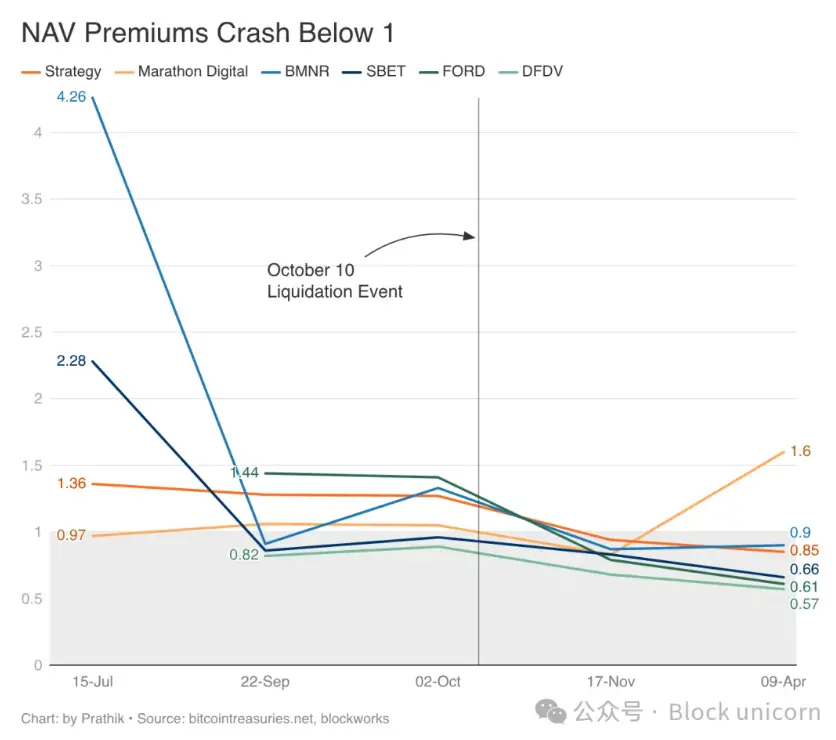
The problem with this strategy is that the three core treasury assets—Bitcoin (BTC), Ethereum (ETH), and SOL—share a common and significant drawback: they do not generate cash flow themselves. Their price appreciation depends entirely on how people trade these cryptocurrencies, which in turn is driven by multiple factors: ETF fund flows, institutional investor interest, discussions on online forums and communities, and investors’ perception of BTC’s role as “digital gold” within the broader macroeconomic landscape.
Indeed, ETH and SOL do compensate for their slow token appreciation through staking rewards. However, staking rewards are paid in newly minted tokens. Each time ETH and SOL staking rewards are distributed, the ownership of existing token holders is diluted to pay validators.
Funds holding these assets—whether BTC, ETH, or SOL—operate similarly to closed-end funds with a single non-dividend-paying position. Their only path to profit is through token price appreciation or an expansion of the net asset value premium. The former is influenced by market volatility, while the latter is driven by market narratives.
Although both Ethereum and Solana generate transaction fees, only a relatively small portion of this revenue is returned to token holders. In 2025, Ethereum’s on-chain fee revenue was approximately $515 million, while Solana’s was $645 million. Most of this revenue does not reach token holders; it is either captured by validators or offset by newly issued tokens.
In comparison, the Hyperliquid protocol generated nearly $1 billion in fees last year. More compellingly, 97% of these fees were returned to HYPE holders through buybacks via the assistance fund.
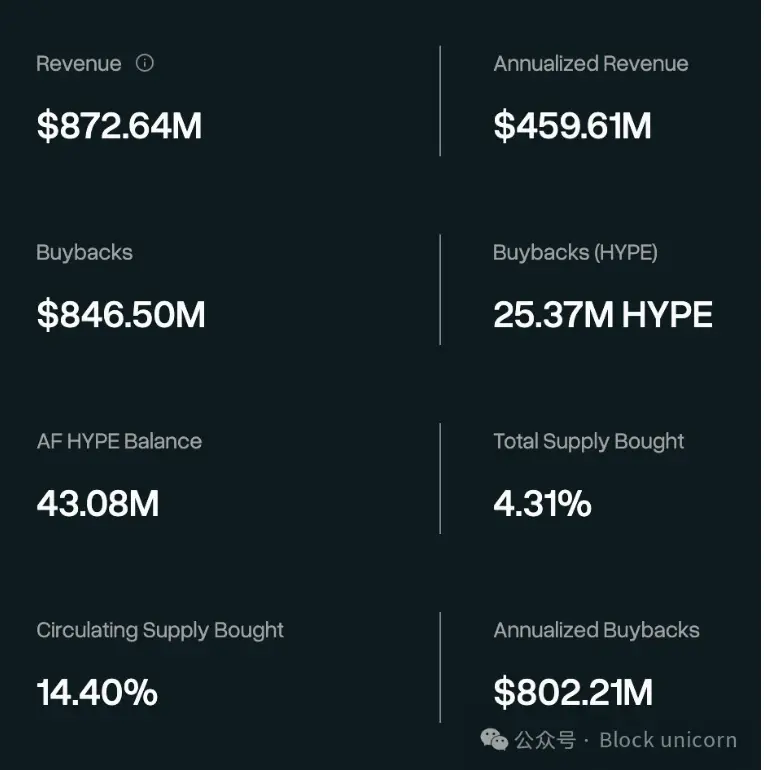 Hyperliquid currently has a daily trading volume of $5 billion to $7 billion, a monthly trading volume of approximately $200 billion, and generates about $730 million in fee revenue annually from trading activity. Therefore, every dollar traded on Hyperliquid contributes to the fundamental strength of HYPE’s pricing.
This makes the HYPE vault feel less like storing BTC or ETH in a vault awaiting market valuation, and more like holding receipts for derivative exchange fees.
Any listed wrapper holding HYPE, including PURR’s recent holding of HYPE, is essentially still a bet on the price of HYPE. Their organizational structure is identical to that of treasury companies for BTC, ETH, or SOL, allowing us to view them through the same lens. However, given the fundamental factors driving the token’s price movement, I am more optimistic about HYPE treasury companies.
The price of PURR reflects an indirect claim on the present value of all cash flows generated by the Hyperliquid protocol from its derivatives business.
You don't have to take my word for it. Hyperliquid has proven this multiple times recently.
A verified case
During the U.S.-Israel-Iran conflict last month, risk assets and traditional markets experienced volatility. HYPE rose 40%, while the S&P 500 and Bitcoin underperformed, declining 3% to 5% and rising 5%, respectively.
Since the largest cryptocurrency liquidation event on October 10, HYPE has risen by approximately 60%, while BTC has fallen by 40%.
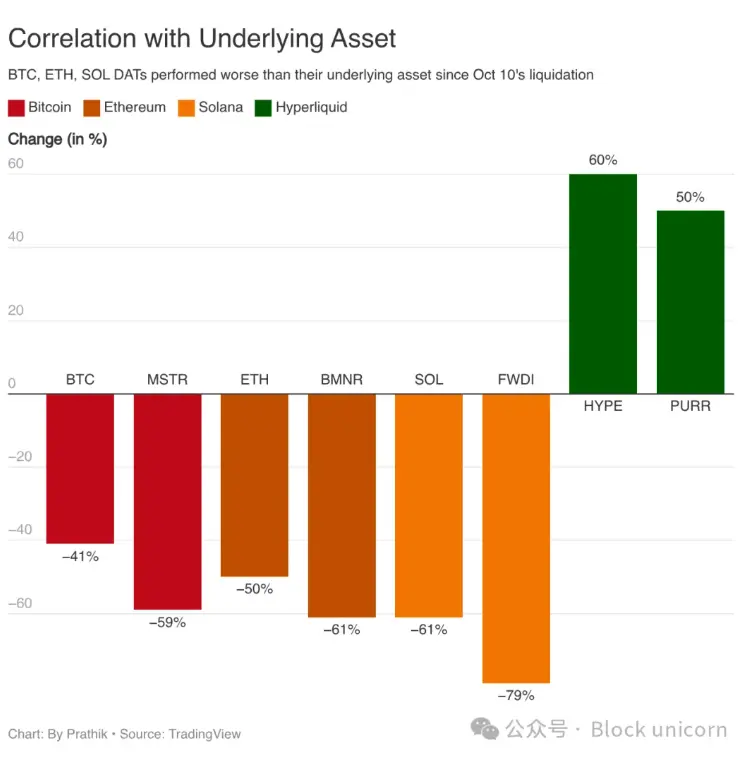 This is no coincidence. Uncertainty-driven volatility disadvantages passive stores of value but benefits derivative exchanges. Uncertainty prompts traders to hedge their positions. Liquidation events generate fees for both sides. Factors that erode the net asset value (mNAV) of Bitcoin vault strategies benefit traders by increasing capital at the trading venue.
This bear market, which led to the decline of Bitcoin and Ethereum vaults, brought record trading volume and fees to Hyperliquid’s ecosystem. While Bitcoin and Ethereum vaults could only wait for the market downturn to pass, Hyperliquid’s profits thrived in this environment.
Hyperliquid's HIP-3 market strengthens this argument by bringing traditional assets such as silver and gold onto the blockchain, enabling investors across financial markets to express their views across asset classes.
I believe this is precisely what sets HYPE's DAT strategy apart from other strategies.
No one is safe
Purr's DAT strategy remains a bet on Hyperliquid's price. Hyperliquid may lose its original market share to competitors such as Lighter and Aster, or to protocols not yet conceived.
However, despite these challenges, what inspires confidence is the selection of underlying assets. PURR’s institutional supporters promote their DAT strategy as “the only way for U.S. investors to access HYPE.” But if fund companies are approved to launch HYPE spot ETFs, the entire DAT strategy could become obsolete. Both 21Shares and Grayscale have already submitted applications.
Earlier DATs needed to worry about maintaining their net asset value premium, which depended on market sentiment and investor confidence in the model. In contrast, HYPE-based DATs only need to answer a simpler question: Can Hyperliquid sustain profitability? This question depends more on weekly fee data, potential market share, and the protocol roadmap—including the upcoming HIP-4.
All of these are data points analysts can use to make informed decisions. Analysts may still be wrong, but their judgments are supported by data.
There is a counterargument here.
What if Ethereum and Solana surpass Hyperliquid in fee revenue? This is not impossible. But given that Hyperliquid returns profits to HYPE holders through buybacks, the situation becomes much more complex.
Although Ethereum returns a portion of fees to ETH holders, this amount is fully offset by the new ETH issued to validators. All of Solana’s fees go to validators, with only a negligible portion ultimately reaching Solana holders. For either Ethereum or Solana to match Hyperliquid’s token yield, their underlying token economics would need to be completely rewritten—and network activity would need to increase several-fold over current levels. Neither of these changes can be achieved overnight.
Even if this scenario occurs, I believe the same argument still holds. I do not think HYPE will remain the only successful asset for DAT indefinitely. I believe that DATs built on assets capable of generating continuous returns for holders will have a longer lifespan than those built on assets that cannot generate sustained returns.
These two models are fundamentally different. First-generation DATs (Debt Financing Agreements) expect investors to believe in the story being pitched, while second-generation DATs expect investors to believe in the cash flow.
The closed-end funds that survived the 1929 bubble were those that continued to pay dividends during market declines. Everything else was merely packaging for speculation.
DATs based on hype may ultimately fade away like other DATs. No one can be certain. But criticism of them will likely focus on market share, fee stability, and other fundamental business metrics—at least not ending with the “I told you so” refrain seen in the collapse of BTC DATs.