


Curve Finance founder Michael Egorov is calling for industry-wide security standards after a wave of DeFi exploits. Investors say repeated failures are part of the sector’s evolution, not a sign of decline.
Key Takeaways:
- Curve Finance’s Michael Egorov has urged for industry-wide DeFi standards after recent onchain exploits, targeting centralized weak points.
- Requests Ethereum and Solana Foundations to push coordination, shaping safer industry design.
- Dragonfly’s Haseeb Qureshi says failures persist, but standards will rise as capital grows.
DeFi Needs Shared Security Standards, Curve Founder Warns
A fresh wave of decentralized finance exploits is prompting renewed calls for industry-wide security standards, as prominent developers warn that many failures remain avoidable.
Michael Egorov, founder of Curve Finance and Yield Basis, said recent hacks have exposed a recurring weakness: reliance on centralized points of failure within supposedly decentralized systems. He urged the industry to shift from reactive fixes to preventative design.
“All issues like this should be prevented before they happen. We should probably come together and develop safety standards for DeFi,” Egorov said, adding that critical dependencies should be distributed wherever possible. Where centralization cannot be eliminated, he argued, trust should be split across multiple parties and supported by clearer best practices.
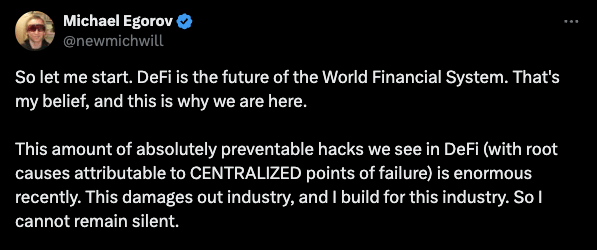
His comments come amid growing concern over the resilience of DeFi infrastructure, particularly as the sector scales and attracts institutional interest. While smart contract audits have become standard, Egorov suggested that broader system design, including how external components are configured, remains inconsistent.
He called for coordinated action led by major ecosystem players, including the Ethereum and Solana Foundations, to establish shared guidelines for building and verifying secure protocols. The aim would be to create a common framework that developers, auditors, and risk managers can follow.
Still, not all industry participants see recent incidents such as the KelpDAO exploit as a sign of structural weakness.
Haseeb Qureshi, managing partner at venture firm Dragonfly, said failures have long been part of DeFi’s development cycle. He pointed to past crises, including the Terra collapse and earlier market disruptions, as examples of how the ecosystem has adapted over time.
“ DeFi learns through failures. The important thing is that these failures are not fatal. The heart of DeFi is risk-averse and robust,” Qureshi said, drawing parallels with traditional finance, which evolved through banking crises and market shocks. He argued that while losses can be significant, they are rarely existential for the system as a whole.
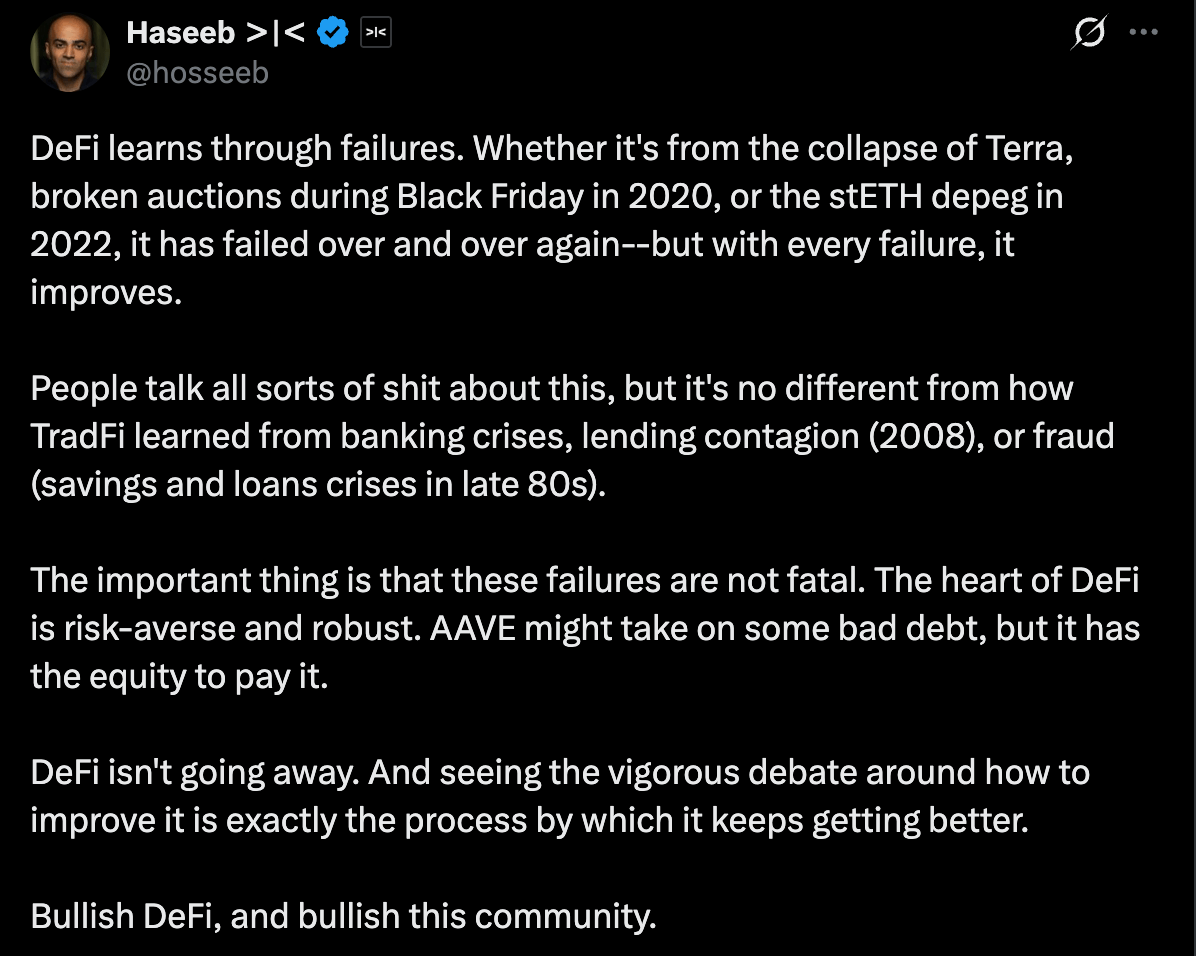
Protocols are increasingly designed with safeguards, such as overcollateralization and reserve buffers, that help absorb stress events. In many cases, platforms can withstand isolated failures without triggering broader contagion.
The debate highlights a tension at the heart of DeFi’s growth. On one side, developers are pushing for higher standards and greater coordination to reduce risk. On the other hand, investors view periodic disruptions as part of a natural process of innovation and refinement.
What remains clear is that expectations are changing. As more capital flows into decentralized markets, the tolerance for preventable failures is declining. Whether the industry can align on those principles will likely shape how DeFi matures in the years ahead.