



Written by: willthetrill
Translated: Chopper, Foresight News
Is the hiring market in the cryptocurrency industry saturated now? The answer is both yes and no. Although there have been sporadic layoffs in December, overall, the hiring momentum remained strong in the fourth quarter.
To uncover the truth, I specifically retrieved relevant data from major vertical cryptocurrency industry job portals for the first two weeks of January 2026 (this data does not include official company job pages). The results showed that only 85 to 90 new independent positions were added during that period.
The beginning of this year has been rather quiet. In contrast, the data for January 2025 is quite impressive, with a total of 1,192 job postings in a single month, making it the month with the highest number of job openings for the entire year of 2025.
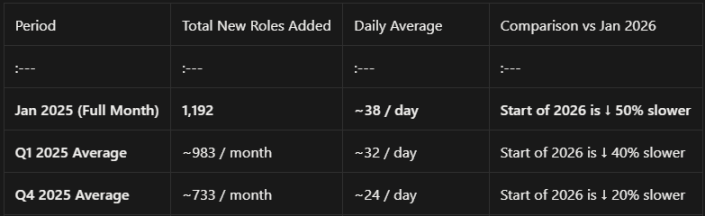
Data as of January 12, 2026
In the first two weeks of January 2025, the average number of job postings per day was approximately 38; however, during the same period in 2026, the average daily number of job postings dropped to only about 6.5.
The hiring activity in early January dropped by about 80% compared to the same period last year. This data confirms the widespread market speculation: the industry's start this year is far less heated than it was last year.
Based on the analysis of the above job data details, the main characteristics of the current recruitment market are as follows:
- Job Type Distribution: Technical/Engineering positions account for 60%, and non-technical/market expansion positions account for 40%.
- Position distribution: Approximately 65% of roles are mid- to senior-level positions, such as Specialist, Senior Specialist, Supervisor, and Department Head. This signal indicates that the company is prioritizing the recruitment of experienced professionals to lead key projects related to core product development and business growth.
- Experience Requirements: Most positions require applicants to have more than 5 years of relevant experience; management positions require more than 7 years of experience.
When conducting screening interviews with candidates, I often ask them: What is currently attracting you to the crypto industry? The answers I receive are usually one of two things: prediction markets and stablecoins. It's therefore no surprise that data shows about 60% of hiring demand is concentrated in infrastructure teams, stablecoin projects, and payment/financial technology infrastructure startups. Additionally, the talent competition between the two platforms, Kalshi and Polymarket, continues, and this rivalry is expected to persist.
Currently, the most aggressive in recruitment are companies in the growth stage (i.e., those that have completed Series A or later rounds of financing). A quick look at the job pages and Ashby platform information of several companies also confirms this conclusion.
- Series A companies: Lifi Protocol is hiring for 13 positions, Privy IO (acquired) is hiring for 10 positions, Crossmint is hiring for 10 positions, and Coinflow Labs is hiring for 14 positions.
- B-round company: TurnkeyHQ is hiring for 12 positions;
- Series C-funded company: Raincards is hiring for 49 positions;
- Series D-funded company: Anchorage is hiring for 66 positions.
However, perhaps more intriguing is the change in the flow of talent.
I have been working full-time in recruitment for the crypto industry for five years, and I can't help but reflect: "Has there ever been a public chain ecosystem that has challenged Ethereum's dominance in recruitment and developer growth as Solana has?" The answer is no—at least not to this extent.
Looking back at history, other public blockchains such as Polkadot and Cosmos have all experienced phases of rapid growth in developer numbers. However, they have never managed to challenge Ethereum at the same level in terms of market share or sustained hiring scale.
Solana is the first ecosystem with genuine strength to rival Ethereum. In 2024, it set a historic milestone by achieving, for the first time since 2016, a higher percentage of new contributing developers than Ethereum. Solana attracted over 22% of new developers in the crypto industry, while Ethereum accounted for approximately 16%. This phenomenon is rare, especially considering that in the past, Ethereum had almost exclusively captured the majority of new talent.
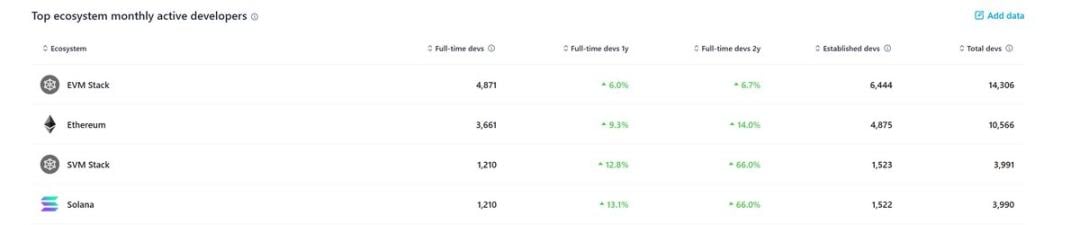
Data Source: Electric Capital's Developer Report, as of January 14, 2026
In the third quarter of 2025 alone, 23 Solana ecosystem projects completed fundraising, securing a total of $211 million. This represents a 70% year-over-year growth in ecosystem funding.
For example, after a project secures $13.5 million in funding (such as Raikucom's financing in Q3 2025), its top priority is to hire 5–10 senior engineers and build the core engineering and market expansion teams. These positions are often not posted on public job boards, but instead filled through investor/angel investor networks, hackathons, and targeted headhunting.
The cryptocurrency industry is continuously evolving, and the landscape of the hiring market will also change accordingly. Token issuance has driven the internet capital market to its maximum potential, but the reality is that the prices of the majority of tokens issued in the past two years have declined.
I believe that by 2026, the ripple effects of this phenomenon will gradually become apparent, influencing how companies secure risk financing, develop market expansion strategies, and, of course, impacting their talent recruitment strategies as well.
The projects that will stand out this year will undoubtedly be those with solid business fundamentals, real user bases, solutions to real needs, and, most importantly, the ability to generate revenue.